What Is Figurative Language?
A house that's stood empty for years just sits there: paint peeling, nobody home. Say instead that the house wears its emptiness like a coat it can't take off, and the same fact turns into something felt rather than reported. That's figurative language, one branch of the broader family of rhetorical devices, wording that means something beyond its literal, word-for-word sense. It asks a reader to picture, feel or infer a thing rather than just receive it as fact.
Most craft sites list the devices one by one, simile first, then metaphor, then personification, in whatever order a textbook happens to teach them. Fine for a quiz. Less useful mid-draft, when what you need isn't a device name but a line that does a specific job: builds dread, lands a joke, makes a death land emotionally. This piece sorts 33 verified lines from published fiction the second way, by effect, after a fast reference pass through the twelve device names themselves. Prefer the term on its own first? Self-publishing terms starting with F defines it in one line.
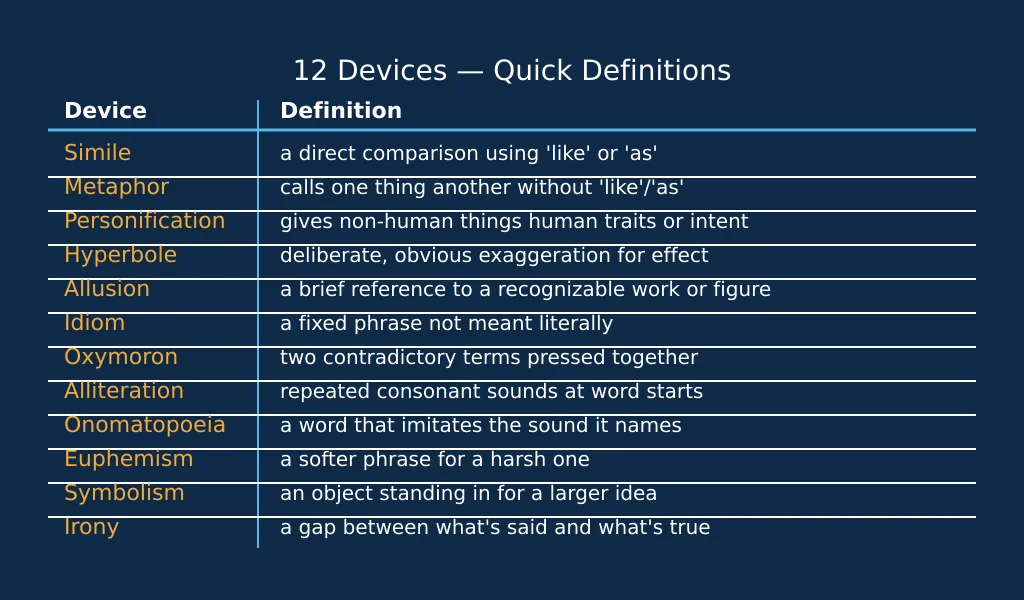
The 12 Types of Figurative Language (Quick Definitions)
These are the twelve devices figurative language usually gets sorted into. None of the phrases below are attributed to a novel: they're generic, built-for-this-list examples, so you can see the shape of each device before the real quotes further down do the actual work. Poetry leans on most of these harder than fiction does; if you're working in verse rather than prose, 33 poetry forms covers the containers these devices get poured into.
- Simile: a direct comparison using "like" or "as." Example: "the road unwound like a ribbon."
- Metaphor: calls one thing another without "like" or "as." Example: "her voice was a blade."
- Personification: gives a non-human thing human traits or intent. Example: "the wind argued with the shutters."
- Hyperbole: deliberate, obvious exaggeration for effect. Example: "I've told you a thousand times."
- Allusion: a brief reference to another work or figure the reader is expected to recognize. Example: "he had a temper worthy of Lear."
- Idiom: a fixed phrase whose meaning isn't literal even to native speakers. Example: "she let the cat out of the bag."
- Oxymoron: two contradictory terms pressed together. Example: "a deafening silence."
- Alliteration: repeated consonant sounds at the start of nearby words. Example: "the silent, sullen sea."
- Onomatopoeia: a word that imitates the sound it names. Example: "the kettle hissed."
- Euphemism: a softer phrase substituted for a harsh one. Example: "he passed away in his sleep."
- Symbolism: an object or image standing in for an idea larger than itself. Example: a wilting houseplant standing in for a dying marriage.
- Irony: a gap between what's said or expected and what's actually true. Example: a fire station burning down.
Drafting a story of your own? Draft scenes from your outline in Sudowrite, an AI writing tool built for fiction that keeps a story bible of your characters. Free trial, no card needed. (affiliate link)
33 Figurative Language Examples From Famous Novels, Sorted by Effect
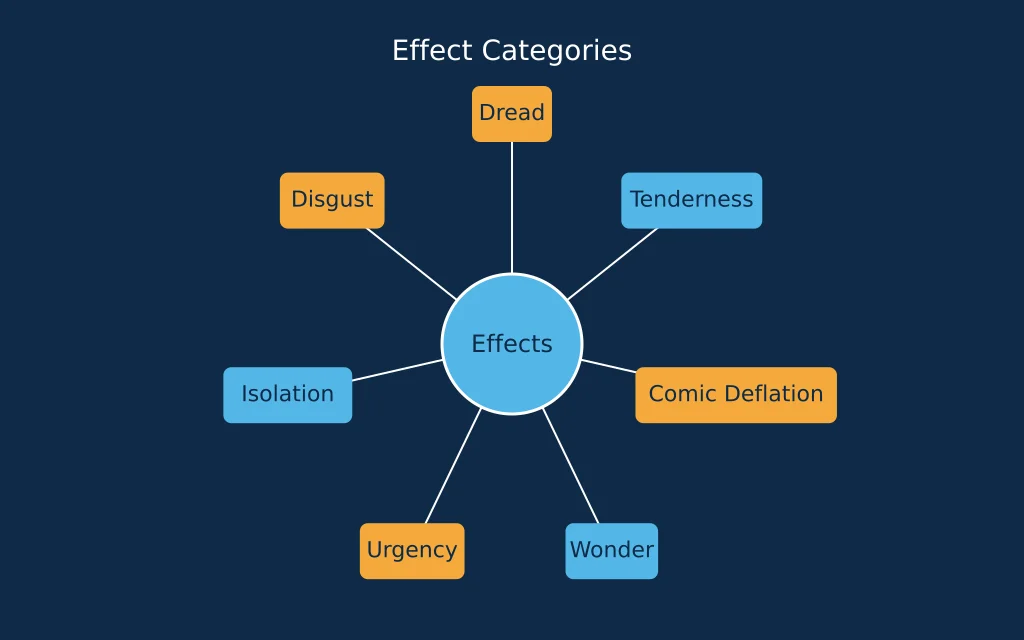
The 33 lines below are verbatim, sourced from the published text of each novel, not paraphrased and not textbook stand-ins. These are examples of figurative language in novels grouped by the job each line does, so you can match a line to the effect you're chasing in your own scene—whether that means pulling a fresh simile example or another device entirely—instead of hunting device by device for something that happens to fit.
| Effect | Entries | What it signals |
|---|---|---|
| Dread and Fear | 11 | Something ordinary turns into a threat, or something huge starts to feel like it's watching you. |
| Tenderness and Grief | 8 | A touch, a symbol or a kept promise gets slowed down enough to feel. |
| Comic Deflation | 4 | Something serious gets undercut right at the point it threatens to turn heavy. |
| Wonder and Awe | 6 | Something already large gets made to feel larger, or something small stands in for something vast. |
| Urgency and Danger | 4 | A moment speeds up instead of slowing down. |
Use the table as a map, not a menu: pick the effect your scene needs, then read only that category below.
Dread and Fear
Eleven of the thirty-three lines land here, more than any other category. Dread is where figurative language earns its keep hardest: a flat description of a bad thing rarely lands as hard as an image that makes the badness physical.
- The Great Gatsby, F. Scott Fitzgerald: "This is a valley of ashes—a fantastic farm where ashes grow like wheat into ridges and hills." The simile sits inside a larger metaphor, industrial waste as farmland, and turns a wasteland into something with its own grim agriculture.
- The Great Gatsby, F. Scott Fitzgerald: "The eyes of Doctor T. J. Eckleburg are blue and gigantic—their retinas are one yard high." The hyperbole blows a billboard up into something that watches. That's the unease the image is built to produce.
- To Kill a Mockingbird, Harper Lee: "In the secret courts of men's hearts Atticus had no case." The metaphor moves the verdict out of the courtroom and into somewhere no lawyer can argue. That's where the novel's real dread lives.
- Fahrenheit 451, Ray Bradbury: "A book is a loaded gun in the house next door." One flat metaphor turns an object the reader assumes is harmless into a threat. Borrow the move: state the danger as fact, don't hedge it with "like" or "as."
- Nineteen Eighty-Four, George Orwell: "Nothing was your own except the few cubic centimetres inside your skull." The metaphor shrinks a person's entire interior life down to a measurable, almost clinical volume. That smallness is the dread.
- Nineteen Eighty-Four, George Orwell: "You were lifted clean out of the stream of history." The metaphor makes erasure sound gentle, almost like rescue. Sounding violent would have been easier to survive.
- Nineteen Eighty-Four, George Orwell: "If you want a picture of the future, imagine a boot stamping on a human face — forever." The image works as an argument rather than decoration: it's the metaphor a whole political system gets reduced to.
- The Shining, Stephen King: "This inhuman place makes human monsters." The metaphor pins the horror on the building itself, not on any one character. Borrow it when you need blame to outlast the villain who did the actual harm.
- Pet Sematary, Stephen King: "Death is a mystery, and burial is a secret." The parallel structure treats two ordinary nouns as sealed containers, and the flatness of the sentence is what makes it unsettling.
- It, Stephen King: "The terror… began… with a boat made from a sheet of newspaper floating down a gutter swollen with rain." An ordinary, almost tender image carries the dread instead of announcing it, quiet work before anything actually happens.
- The Hunger Games, Suzanne Collins: "Like being home again, when they bring in the hopelessly mangled person." The simile is dread built from familiarity rather than novelty: the horror is that this sight is routine enough to feel like home.
Tenderness and Grief
Eight lines do a gentler job: they slow a scene down and make an ordinary feeling, a touch or a kept promise, worth stopping for.
- The Great Gatsby, F. Scott Fitzgerald: "The exhilarating ripple of her voice was a wild tonic in the rain." The metaphor drops the "like" or "as" entirely and just states the voice is the tonic. Comparison becomes fact that way, and the tenderness lands harder for it.
- The Great Gatsby, F. Scott Fitzgerald: "At his lips' touch she blossomed for him like a flower." The simile borrows the slowest possible natural process, a bloom, to describe a single moment. That stretches the tenderness out.
- To Kill a Mockingbird, Harper Lee: "Mockingbirds don't do one thing but make music for us to enjoy… they don't do one thing but sing their hearts out for us." The idiom "sing their hearts out" turns the novel's title image into something with feeling attached, which is what makes the later moral weight land.
- To Kill a Mockingbird, Harper Lee: "You never really know a man until you stand in his shoes and walk around in them." A worn idiom gets its literal legs back; the novel has spent enough pages on it that the line lands as earned advice, not cliché.
- Fahrenheit 451, Ray Bradbury: "In the dim, wavering light, a page hung open and it was like a snowy feather, the words delicately painted thereon." The simile treats a page of a burning book as impossibly light and precious in the same breath.
- Nineteen Eighty-Four, George Orwell: "The girl's waist in the bend of his arm was soft and warm… yielding as water." Rare work for this novel: tenderness in a book that almost never allows it. The rarity is why the line stands out.
- Nineteen Eighty-Four, George Orwell: "The paperweight was the room he was in, and the coral was Julia's life and his own." The symbolism collapses a whole relationship into an object small enough to fit in a hand, and just as breakable.
- Mockingjay, Suzanne Collins: "What I need is the dandelion in the spring… the promise that life can go on." The symbol does double duty: dandelions are usually a weed, but here the metaphor reframes one as proof of survival.
Comic Deflation
Four figurative lines undercut something serious right at the moment it threatens to get heavy. A specific, useful trick in its own right.
- To Kill a Mockingbird, Harper Lee: "Aunt Alexandra would have been analogous to Mount Everest: throughout my early life, she was cold and there." The simile takes a genuinely tense family relationship and flattens it into a joke a child narrator would actually make.
- Slaughterhouse-Five, Kurt Vonnegut: "There would always be wars, that they were as easy to stop as glaciers." The simile compares something catastrophic to something merely slow, and the mismatch in scale is the joke, bleak as it is.
- Slaughterhouse-Five, Kurt Vonnegut: "The gun made a ripping sound like the opening of the zipper on the fly of God Almighty." A moment of violence gets deflated by an absurd, almost blasphemous simile. Vonnegut's whole method sits inside that single line.
- Slaughterhouse-Five, Kurt Vonnegut: "A money tree. It had twenty-dollar bills for leaves. Its flowers were government bonds." The extended metaphor turns capitalism into a children's-book image, and the childishness is the satire.
Wonder and Awe
Six lines make something feel bigger than the sentence describing it. Wonder runs on that gap.
- The Great Gatsby, F. Scott Fitzgerald: "In his blue gardens men and girls came and went like moths among the whisperings and the champagne and the stars." The simile turns party guests into something weightless, drawn to light. Gatsby wants them seen from precisely that distance.
- The Great Gatsby, F. Scott Fitzgerald: "A universe of ineffable gaudiness spun itself out in his brain while the clock ticked on the washstand." The metaphor scales a young man's private ambition up to the size of a universe, against the smallest possible domestic detail.
- The Great Gatsby, F. Scott Fitzgerald: "Gatsby believed in the green light, the orgastic future that year by year recedes before us." The symbolism turns a dock light into the whole idea of an unreachable future, which is why it's the image the closing page returns to.
- Fahrenheit 451, Ray Bradbury: "The sun burnt every day. It burnt Time." The personification gives the sun a target beyond heat, an abstraction. Only eight words, and the sentence still feels enormous.
- Slaughterhouse-Five, Kurt Vonnegut: "Here we are, Mr. Pilgrim, trapped in the amber of this moment." The metaphor makes fatalism sound almost beautiful, preserved rather than stuck. Awe, not despair, is what this novel keeps returning to.
- Slaughterhouse-Five, Kurt Vonnegut: "The Tralfamadorians can look at all the different moments just that way we can look at a stretch of the Rocky Mountains." The simile makes an alien species' relationship to time graspable by comparing it to something a reader has actually seen.
Urgency and Danger
Four figurative lines speed a moment up instead of slowing it down. Useful wherever a scene can't wait.
- To Kill a Mockingbird, Harper Lee: "Apparently, Mayella's recital had given her confidence… like a steady-eyed cat with a twitchy tail." The simile keeps the sentence calm on its surface while "twitchy tail" signals danger underneath, exactly the courtroom tension the scene needs.
- Fahrenheit 451, Ray Bradbury: "His hands were ravenous." The personification hands the character's own hands an appetite he can't control, compressing a whole compulsion into a single adjective.
- Fahrenheit 451, Ray Bradbury: "He felt the poison working up his wrists… like a spark leaping a gap." The simile turns a slow physical sensation into something electrical and instant. Borrow it whenever a scene needs urgency at the level of a single sentence.
- Nineteen Eighty-Four, George Orwell: "They needed only to rise up and shake themselves like a horse shaking off flies." The simile gives an oppressed population an image of effortless strength, right before the novel makes clear they won't use it.
How to Use These Figurative Language Examples in Your Own Manuscript
Copying one of the lines above word for word is plagiarism, not craft. Model the device instead: same mechanism, your own image, built for your own scene.
- Name the effect first. Dread, tenderness, a joke that lands, wonder, urgency: decide which one the scene needs, then open the matching category above instead of starting from "should this be a metaphor."
- Read three or four entries from that category back to back and notice what they share mechanically. Most of the dread lines above shrink something large down to something measurable, cubic centimetres, a boot, a paperweight. That's the pattern to borrow, not the wording.
- Write the plainest version of your sentence first. Get the fact down, then ask what it would look like as a comparison, an object standing in for the feeling, or an exaggeration, and try two versions before keeping one.
- One figurative line per paragraph, roughly. Five stacked together cancel each other out and start reading as effort instead of feeling. Check the tips for avoiding purple prose if a page starts to feel crowded.
- Be careful in dialogue. Real people rarely talk in polished similes, so a character who does needs a reason established elsewhere, otherwise the line reads as the author borrowing the character's mouth. If you're unsure how a figurative line should sit inside speech, how to format dialogue covers the mechanics.
- Read the sentence aloud. If the comparison makes you admire it rather than feel the thing it describes, it's working against the scene. Clarity beats cleverness every time a reader has to reread a line to understand what just happened.
Benefits and Drawbacks of Leaning on Figurative Language
Every device on this page earns its place in fiction, and every device can also sink a page. Here's the balance sheet.
- Sharper emotional impact than plain description. A metaphor or simile can make a reader feel a death, a threat or a joy faster than a paragraph of exposition manages.
- Most sentences in a novel pass through a reader unremembered. The odd, exact comparison is the one that gets quoted back years later.
- Overuse tips a page into purple prose, where every sentence reaches for an image and none of them land because there's no plain ground to contrast against.
- It can slow pacing exactly when a scene needs speed. A chase, a fight or a countdown rarely benefits from a reader pausing to admire a simile.
Build Your Own Effect-Sorted Example File While You Draft
Keep a running document instead of trusting your memory. Every time a line stops you, whether it's from a bestseller or your own draft three chapters back, copy it into a file sorted by effect: dread, tenderness, comic deflation, wonder, urgency, whatever categories your own genre actually produces. Study it for a week. Then rewrite it in your own voice and file that version under the same heading.
Sort by effect, not by device, the same way this page does. A file organized as "metaphors" or "similes" tells you what a line is. A file organized as "dread" or "tenderness" tells you when to reach for it, which is the question you'll actually have open at your desk mid-draft.
Pair the file with the site's other desk tools while you build it: 155+ powerful motifs for your novel for recurring images bigger than a single line, 444+ strong verbs for more powerful writing for the sentences around your figurative ones, and 177+ character flaws for the same kind of usable inventory applied to people instead of images.
Frequently Asked Questions
Four questions come up most often about figurative language in literature. Here they are, answered straight.
What are the 12 types of figurative language and examples?
Simile, metaphor, personification, hyperbole, allusion, idiom, oxymoron, alliteration, onomatopoeia, euphemism, symbolism and irony are the twelve most commonly taught. The quick-definitions section above gives one plain example for each, and the 33-line bank further up matches several of them, simile, metaphor, personification and idiom especially, to real published sentences instead of invented ones.
What is the 5 figurative language?
There's no single official list of five. When a source shortens the count that far, it's almost always simile, metaphor, personification, hyperbole and idiom, since those five cover the bulk of what shows up in ordinary fiction — the same neighborhood where adages and proverbs live, ready-made lines you can drop into a scene instead of building a comparison from scratch.
What are the 20 types of figurative language?
Lists that stretch to 20 usually pad the 12 core devices—among them personification, which gets its own sorted list of examples elsewhere on this site—with more specialized ones: synecdoche (a part standing for a whole), metonymy (a related term standing in for a thing), litotes (understatement by negation), anaphora (repetition at the start of successive clauses) and a handful of others. Most fiction writers get more use out of the 12 above than out of the extra eight.
What is one example of figurative language?
Orwell's line in Nineteen Eighty-Four: "Nothing was your own except the few cubic centimetres inside your skull." A metaphor that shrinks a mind down to a measurable space.