What Is a Rhetorical Device? Schemes vs. Tropes, Defined
A rhetorical device is any deliberate pattern of language that shapes how a sentence lands. Writers reach for one when a plain statement would do the job, but a shaped one does the job better: sharper, funnier, more persuasive, more memorable. Scores of named techniques fall under the term (this page defines 130 of them), and every one belongs to one of two families.
What Counts as a Rhetorical Device
If a line of writing repeats a sound, flips a word order, compares two unlike things, or says one thing while meaning another, something in it counts as a rhetorical device. The test isn't how fancy the technique sounds. It's whether the writer chose that pattern on purpose, for an effect a plainer version of the same sentence wouldn't produce.
Schemes: Same Meaning, New Order
A scheme rearranges the words on the page. It repeats a sound, balances two clauses, drops a conjunction, or moves a word out of its expected slot, and none of that changes what the sentence is actually saying. What changes is the rhythm, the emphasis, the shape the sentence makes when it's read aloud. Every entry in this list's scheme half works on that one lever: arrangement.
Tropes: Same Words, New Meaning
A trope changes what a word or phrase points to. Say a sentence needs to communicate that practice sharpens a skill. Rendered as a scheme, using parallel structure for emphasis, it might read: "Practice sharpens the hand, practice steadies the eye, practice quiets the doubt." Rendered as a trope, it turns the same idea into a comparison: "Practice is the whetstone that keeps a dull skill sharp." Same claim, one arrangement, one substitution.
Rhetorical Device vs. Literary Device
These two terms get used interchangeably, and that's a source of real confusion. A rhetorical device is mostly a pattern in the language itself, at the level of the sentence: word choice, word order, comparison, repetition. A few tropes below, allegory, conceit, and symbol, extend that same substitution across a whole passage or work. A literary device is the wider umbrella still, covering structural and narrative techniques a single sentence can't hold, things like foreshadowing, an unreliable narrator, or a frame story. If you're after that fuller inventory, this site's 154 literary devices list covers the narrative layer this page doesn't touch.
What Are the Four Rhetorical Devices? Two Different Answers
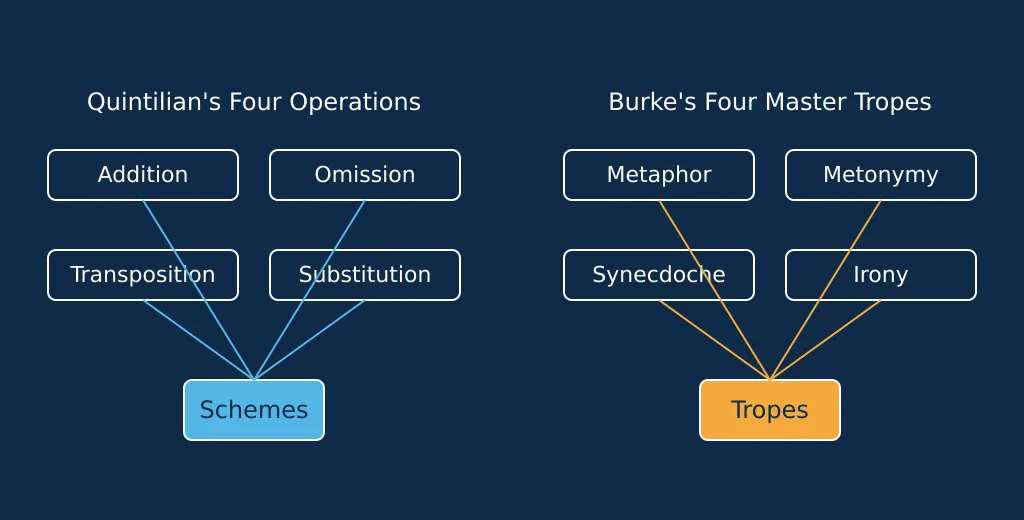
Search that exact question and you'll find two competing four-term lists, and neither one mentions the other. That's not an error on either side. The question collapses two separate systems that classical and modern rhetoric each use to organize the same 135-device list, one built around schemes and one built around tropes.
| Framework | The four terms | What each one means | Which half of this list it explains |
|---|---|---|---|
| Four operations of change | Addition, omission, transposition, substitution |
|
Schemes. This is the framework classical rhetoric handbooks use to sort nearly every entry in the schemes section into one of four operations of change on word order. |
| Four master tropes | Metaphor, metonymy, synecdoche, irony |
|
Tropes. A different, twentieth-century account of rhetoric treats most tropes below as a variation on one of these four moves. |
Neither framework is wrong, and neither cancels the other out. One sorts schemes, one sorts tropes, and "the four rhetorical devices" only sounds like a single settled answer until you notice it's actually naming two different four-part systems built for two different halves of the same list.
Schemes: 57 Devices That Rearrange Words for Effect
This half of the rhetorical devices list covers every technique that works on arrangement: sound, balance, addition, omission, or word order. None of the fifty-seven change what a sentence means. All fifty-seven change how it moves.
Schemes of Repetition and Sound (Emphasis & Rhythm)
These schemes repeat a sound, a word, or a structure. The repetition doesn't add information; it adds weight. A reader registers a repeated pattern as insistence, so reach for one of these when a line needs to land harder than a single pass would allow.
- Anaphora: repeats the same word or phrase at the start of successive clauses or sentences, building momentum toward a climax. It's useful when a list of claims needs to read as one mounting argument.
- Epistrophe: repeats a word or phrase at the end of successive clauses, so the same term lands on the reader again and again as the last thing before the sentence turns.
- Anadiplosis: takes the last word of one clause and opens the next clause with it, chaining ideas so each thought seems to grow directly out of the one that came before it.
- Symploce: combines anaphora and epistrophe, repeating one phrase at the start of a clause and a different phrase at its end, locking both edges of the sentence into place at once.
- Epanalepsis: opens and closes the same clause or sentence with the same word, framing whatever sits between as though bracketed, which makes the middle of the line feel deliberate and contained.
- Diacope: repeats a word with only a few words separating the two instances. A tighter, more urgent echo than anaphora. It often carries panic, longing, or disbelief in dialogue.
- Ploce: repeats a word within a short stretch of text purely for emphasis, without altering its sense, functioning as a verbal underline beneath whichever term the writer wants stressed.
- Polyptoton: repeats a word in a different grammatical form each time, love, lover, loving, so the repetition varies just enough to avoid feeling mechanical while still tying the sentence together.
- Alliteration: repeats the initial consonant sound across nearby words, giving a phrase a percussive rhythm that's easy to remember and easy to read aloud, common in titles and taglines.
- Assonance: repeats a vowel sound across nearby words without matching consonants, producing a softer echo than alliteration; useful for a line that needs rhythm without sounding like a drumbeat.
- Consonance: repeats a consonant sound anywhere in nearby words, not only at the start, tying a sentence together by ear even when the words share no obvious pattern on the page.
- Epizeuxis: repeats a single word immediately, with no words between the repetitions. It's the bluntest emphasis available, best used sparingly since it reads as a shout on the page.
- Sibilance: repeats the "s" sound specifically, a narrower case of consonance that tends to suggest whispering or unease, and turns up often in scenes built around secrecy or menace.
- Refrain: repeats a full line or phrase at intervals across a longer passage, poem, or speech, giving the piece a recurring anchor the reader or listener returns to between new material.
- Onomatopoeia: uses a word whose sound imitates the sound it describes, crack, buzz, hiss, letting a sentence carry a sensory detail in its sound as well as its sense.
Schemes of Balance and Parallel Structure
These schemes balance one part of a sentence against another so the two halves match in length, grammar, or contrast. The sentence reads as though it's been weighed on a scale, which makes it the right tool when an idea works best stated twice, once each way.
- Antithesis: sets two contrasting ideas side by side in parallel grammatical structure, so the contrast becomes the point of the sentence instead of something the reader has to infer on their own.
- Isocolon: strings together clauses of matching length and matching grammar, so each one takes the same shape on the page and the same beat when it's read aloud.
- Parallelism: repeats a grammatical structure across two or more phrases or clauses, the broad category that isocolon, tricolon, and antithesis all draw their shared shape from.
- Chiasmus: mirrors a phrase's structure in reverse in its second half, an A-B-B-A pattern where two paired terms swap positions, producing a line that folds back on itself.
- Antimetabole: repeats chiasmus's mirrored words in reversed order rather than just reversed structure, a tighter, more quotable version built for slogans and the last line of a speech.
- Tricolon: groups three parallel words, phrases, or clauses in a row, a count that reads as complete in a way two feels short of and four starts to feel padded.
- Climax (Gradatio): arranges a series of words or clauses in ascending order of importance, building toward its strongest term at the very end.
- Parison: matches the grammar of parallel clauses word for word, not just their length, so each clause could swap its corresponding word with the other and still make sense.
- Synonymia (also Exergasia): strings together several synonyms, or restates the same idea in different words, circling a point from multiple angles to widen and reinforce it.
- Merism: refers to a whole by naming two of its contrasting parts, young and old standing in for everyone, a compact way to gesture at totality without listing every case.
- Enumeratio: lists the individual parts of something one by one. It trades a single abstract word for a run of specific ones, spelling out particulars a general term would leave implicit.
- Expeditio: lists several possibilities and then rules out all but one, letting the reader watch the options fall away until only the intended conclusion is left standing at the end.
- Distinctio: draws a precise line between a word and a related term it could be confused with, clarifying exactly which sense is meant before the sentence moves on.
- Epanados: returns to an earlier point in a passage and repeats it, often in reversed form, tying a later part of a piece back to something said before.
- Congeries (also Scesis Onomaton): heaps up a cluster of words or phrases with related meanings, often with no conjunctions linking them, to intensify an impression through sheer accumulation.
- Epitheton: attaches a fixed descriptive word to a noun so consistently that the two start to feel inseparable, a technique epic poetry leans on for its recurring names.
- Homoioteleuton: ends a run of clauses with the same or a similar sound, functioning like a loose rhyme in prose that ties the ends of parallel clauses together by ear.
Schemes of Omission and Addition
These schemes work by taking words out or by putting extra ones in. Either move changes a sentence's texture without changing what it's actually saying, speeding a line up or slowing it right down.
- Ellipsis: leaves out a word or words the reader can supply from context, tightening a sentence by trusting the reader to fill the gap.
- Asyndeton: drops the conjunctions between clauses a sentence would normally include, producing a clipped, rapid rhythm that reads as urgency or forward momentum on the page.
- Polysyndeton: reverses asyndeton's move, stringing a conjunction between every clause even where grammar wouldn't require one. The effect slows a sentence down and gives each item equal weight.
- Zeugma: uses one word, usually a verb, to govern two or more other words even though it fits each one differently, letting a single term do double duty in one sentence.
- Syllepsis: a stricter form of zeugma where the shared word stays grammatically correct for every word it governs, even as its sense shifts between them across the sentence.
- Aposiopesis: breaks a sentence off deliberately before it finishes, leaving the rest implied, suggesting emotion too strong, or a thought too dangerous, to say aloud in full.
- Parenthesis: inserts a word, phrase, or clause into a sentence that could stand without it, adding a side comment or qualification without derailing the sentence's main line of thought.
- Apposition: places a noun or noun phrase right beside another to rename or explain it, adding identifying detail without needing a separate clause to carry it.
- Pleonasm: uses more words than a sentence strictly needs to make its point, a redundancy that can read as sloppy or, used on purpose, as deliberate emphasis.
- Tautology: restates the same idea in different words within the same sentence, a close cousin of pleonasm that repeats meaning.
- Prolepsis: raises and answers an objection before anyone has actually made it, letting a piece of writing get ahead of its own pushback before it arrives.
- Epanorthosis (also Correctio): corrects or intensifies a statement immediately after making it, retracting the first version in favor of a stronger or more precise one right there on the page.
- Anacoluthon: shifts a sentence from one grammatical construction to another partway through, a broken syntax that can mimic real interrupted speech or a mind changing direction mid-thought.
- Brachylogia: cuts a sentence down to its barest essentials, omitting connecting words a fuller version would include, favoring speed over completeness wherever a draft can afford it.
- Aporia: voices doubt or hesitation about a point, real or performed, before the sentence commits to a position, letting the writer seem to think the question through in front of the reader.
Schemes of Word Order (Inversion)
These schemes move words out of the order English expects. Nothing gets added or cut here, only shifted, and the shift itself is what draws the reader's eye to a particular word.
- Hyperbaton: departs from a language's normal word order to put a particular word in an unusual position, forcing the reader to slow down right where the writer wants it stressed.
- Anastrophe: inverts the expected order of two elements in a phrase, most often adjective and noun, a narrower and more common case of hyperbaton in everyday prose.
- Hypallage: attaches a descriptive word grammatically to one noun even though it logically belongs to another nearby, a transferred description that reads as slightly off, often deliberately so.
- Synchysis: interlocks the words of two parallel phrases so their natural pairings are separated and scrambled, creating a knot the reader has to untangle to parse the line.
- Tmesis: splits a single word or fixed phrase apart by inserting another word into its middle, an interruption that draws attention to the word being split in two.
- Enallage: substitutes one grammatical form for another where standard usage would expect the original, a plural where singular is expected, breaking a rule on purpose for effect.
- Hysteron Proteron: states the second of two events before the first, reversing the natural or logical sequence so what happened later gets named first.
- Antiptosis: substitutes one grammatical case for another. The inversion shows more clearly in heavily inflected languages than in English, but it still surfaces in fixed archaic phrases.
- Synesis: matches a verb or pronoun to the sense of a noun, as when a collective noun takes a plural verb because it refers to many people.
- Amphibologia: arranges words so a sentence can be parsed more than one way. The ambiguity comes purely from word order; the words themselves carry only one meaning each.
Tropes: 73 Devices That Shift Meaning
Where a scheme changes arrangement, a trope changes meaning. Every device below swaps a literal sense for a figurative one, shifting what a word points to. Tropes are the engine behind most figurative language examples you'll see quoted in craft guides, and the seventy-three here sort into five groups by the kind of shift each one makes.
Tropes of Comparison (Metaphor, Simile, Analogy)
These tropes work by comparison, naming one thing in terms of another because the two share something worth noticing. For a much longer, example-led treatment of the single most common one, the 120 metaphor examples list picks up where this entry leaves off.
- Metaphor: names one thing as though it were another, with no "like" or "as" signaling the comparison, asking the reader to carry the qualities of the second thing onto the first.
- Simile: compares two unlike things explicitly, using "like" or "as" to flag the comparison openly.
- Analogy: extends a comparison across several points of similarity, often explaining something unfamiliar by mapping it onto something the reader already understands well.
- Personification: human traits placed onto something not human. It gives an object, an animal, or an abstract idea the qualities, actions, or feelings that let it act like a person on the page.
- Conceit: stretches a single metaphor across an entire passage or poem, developing it in unusual, sustained detail.
- Allegory: tells a story in which characters, events, or settings stand in for a separate, often abstract meaning running underneath the literal plot the whole way through.
- Anthropomorphism: goes further than personification by giving a non-human subject a full human form or human motives, common in fables where animals reason and speak.
- Zoomorphism: describes a person or object in animal terms, lending them an animal's traits, movement, or menace.
- Pathetic Fallacy: attributes human emotion specifically to nature or weather: a storm that rages as if in sympathy with a character's anger, timed to feel like more than coincidence.
- Parable: tells a short, simple story whose literal events carry a separate moral or spiritual lesson, usually without the extended symbolic machinery a full allegory relies on.
- Fable: tells a short story, often with animal characters, built specifically to close on an explicit stated lesson.
- Exemplum: uses a specific example or brief anecdote to illustrate a general claim, letting one concrete case stand in for the wider point being argued.
- Reification: treats an abstract idea or quality as if it were a physical, concrete thing, letting a writer describe grief or justice as though it had weight or shape.
- Hypocatastasis: implies a comparison by naming only the second term and leaving the first unstated, more compressed than a metaphor because even the word "is" is left out entirely.
- Prosopopoeia: gives a voice to something that can't literally speak, an absent person, an abstract idea, or an inanimate object, letting it address the reader directly on the page.
Tropes of Substitution and Association
These tropes swap one name for another because the two are linked in some way, not because they resemble each other in shape or feeling.
- Metonymy: replaces a thing with the name of something closely associated with it, "the crown" standing in for the monarchy it represents in a given sentence.
- Synecdoche: names a whole by referring to one of its parts, or a part by referring to the whole, as in "hands" standing in for laborers on a job.
- Euphemism: substitutes a milder or more comfortable term for one that would sound harsh, blunt, or unpleasant, softening a statement without changing its underlying meaning.
- Dysphemism: swaps in a harsher or more unpleasant term where a neutral one would do, the mirror image of euphemism. The substitution sharpens a statement's edge on purpose.
- Periphrasis: describes something in several roundabout words, often adding formality, avoiding repetition, or dodging a word the writer wants to sidestep.
- Antonomasia: replaces a proper name with a descriptive title or epithet, or uses a famous name to stand in for a broader quality that name has come to represent.
- Kenning: replaces an everyday noun with a compressed, figurative compound, a technique inherited from Old English and Norse verse where "whale-road" stands in for the sea.
- Eponym: uses a person's name to represent a broader idea or category associated with them, letting one name carry an entire concept without further explanation.
- Metalepsis: substitutes one figurative term for another through an implied middle step, a two-stage trope where the link to the literal meaning is one further step removed than usual.
- Anthimeria: uses one part of speech as if it were another, most often turning a noun into a verb, a small grammatical substitution that can make a sentence feel freshly invented.
- Synesthesia: describes one sense in terms of another, a loud color or a sharp taste, borrowing the vocabulary of one sensory register to describe an experience from a different one entirely.
- Hypocorism: substitutes a pet name or diminutive form for someone's given name, signaling familiarity or affection through the substitution itself.
- Teknonymy: refers to a person by the name of their child, a substitution built around relationship.
- Allusion: refers to a well-known person, event, or work without naming it outright, letting that outside reference stand in for an idea the writer doesn't have to spell out in full.
- Symbol: lets one concrete object stand in for a larger, often abstract idea across an entire piece, repeated until the object and the idea become fused in the reader's mind.
Tropes of Contradiction and Irony
These tropes say one thing while pointing at another, often its opposite, or hold two things together that logically shouldn't fit. Irony's own subtypes get a fuller breakdown in the different types of irony, which extends the three entries below into a dedicated comparison.
- Irony: presents something at odds with what's literally stated or expected, the broad category that verbal, situational, and dramatic irony each narrow down to one specific case.
- Verbal Irony: says the opposite of what's meant, trusting the reader or listener to catch the gap between the words on the page and the intended sense underneath.
- Situational Irony: describes an outcome that runs contrary to what the setup led everyone to expect, a mismatch between expectation and result.
- Dramatic Irony: lets the audience know something a character doesn't, so a line or action means something different to the reader than it does to the person saying or doing it.
- Sarcasm: uses verbal irony with a cutting edge, saying the opposite of what's meant specifically to mock, criticize, or wound.
- Paradox: states something that appears self-contradictory on its face but turns out to express a real truth once the reader stops to work it through.
- Oxymoron: pairs two directly contradictory terms in a single compressed phrase, loud silence or bittersweet, where the contradiction sits inside two or three words instead of a whole sentence.
- Antiphrasis: uses a word or phrase to mean the exact opposite of its literal sense. Verbal irony usually works across a full statement; antiphrasis compresses the same reversal into one term.
- Antanagoge: offsets a criticism or negative point by immediately pairing it with a positive one, softening a complaint by placing something favorable right next to it in the same breath.
- Concession: grants that an opposing point is valid before turning to argue against it anyway, a controlled contradiction that makes the later rebuttal look more reasonable to a skeptical reader.
- Enantiosis: expresses an idea by stating its opposite. Where antiphrasis condenses this into one word, enantiosis can stretch the same reversal across a longer passage of writing.
- Paralipsis: draws attention to a point by claiming to skip over it, mentioning the very thing the speaker insists isn't worth mentioning in the first place.
- Apophasis: raises a subject by denying any intention to raise it. Paralipsis is usually treated as one specific, narrower version of this broader move.
- Asteismus: answers a statement by twisting its literal wording into an unexpected sense, a witty reply that takes the words seriously while ignoring the speaker's actual intent.
- Contrarium: sets two statements against each other so their incompatibility exposes a flaw in one of them, building an argument out of contradiction instead of new evidence.
Tropes of Wordplay and Exaggeration
These tropes play with a word's sound or its scale, stretching, shrinking, or splitting meaning for a laugh or a jolt.
- Pun: exploits two possible meanings of a word, or two different words that sound alike, so a single phrase reads two ways at once for anyone paying attention.
- Antanaclasis: repeats the same word twice in a sentence but attaches a different meaning each time, a specific, structured form of pun built on that repetition.
- Paronomasia: plays on words that sound similar but aren't identical, a looser, punning relative of antanaclasis that trades on near-rhyme.
- Hyperbole: exaggerates a claim well past literal truth for effect, trusting the reader to recognize the overstatement.
- Litotes: understates a point by denying its opposite, saying "not bad" to mean good, a double negative that softens a statement while still landing it clearly.
- Meiosis: diminishes the importance of something through deliberate understatement. It covers any downplaying technique, where litotes narrows the same idea down to one specific grammatical form: a negated opposite.
- Auxesis: arranges words or ideas in order of increasing force, building a claim step by step so the strongest version of it lands last, at the sentence's end.
- Bathos: builds toward a serious or elevated moment and then undercuts it with something trivial or absurd, an anticlimax used deliberately for comic effect.
- Malapropism: swaps in a word that sounds like the intended one but means something else entirely, producing an unintentional-sounding, often comic error in speech or dialogue.
- Spoonerism: swaps the initial sounds of two nearby words, turning a familiar phrase into something else entirely, a slip that reads as an accident even when it's carefully engineered.
- Portmanteau: blends two existing words into one new word, carrying pieces of both original meanings at once and letting a single coinage do the work of a longer phrase.
- Double Entendre: phrases a line so it can be read two ways, one innocent and one suggestive, letting the second meaning surface only for readers already looking for it.
- Innuendo: implies something, often something unflattering or suggestive, without stating it directly, leaving the accusation technically unspoken and deniable if anyone objects.
- Catachresis: applies a word or a metaphor to something it doesn't literally fit, a strained or "wrong" comparison used on purpose.
- Adynaton: exaggerates to the point of describing something literally impossible, when pigs fly, a form of hyperbole pushed all the way to the openly absurd.
Tropes of Address and Emotional Appeal
These tropes turn a sentence toward someone, present or absent, real or imagined, pulling the reader into a direct appeal. Several of them do the persuasive work craft guides usually file under pathos and emotional appeal, using structure to move a reader.
- Apostrophe: addresses someone or something that can't respond, an absent person, an abstract idea, or an object, turning away from the audience to speak to it directly instead.
- Rhetorical Question (also Interrogatio): asks a question with no real answer expected, purely for emphasis, making a point through the shape of an inquiry.
- Epiplexis: asks a question that voices reproach, disbelief, or frustration. It functions as an accusation aimed straight at the listener's conscience.
- Erotesis: poses a question so pointed that its implied answer functions as a forceful assertion, stronger on the page than simply stating the same claim outright would be.
- Hypophora (also Anthypophora): raises a question specifically so the writer or speaker can go on to answer it, using the question as a setup for the point the answer is about to make.
- Exclamatio: breaks into an exclamation to convey strong feeling directly, letting emotional intensity interrupt the sentence's ordinary, level flow of information.
- Optative: expresses a wish or a hope with unusual force, a mood of longing stated outright, saved for the moments a plainer sentence would flatten.
- Commiseratio: appeals directly to an audience's pity or compassion, asking them to feel sympathy alongside the facts.
- Deesis: makes an urgent, often desperate plea, a level of entreaty stronger than a simple request, reserved for the point in a piece where stakes feel highest.
- Obtestation: invokes something solemn or sacred to add weight to an appeal, calling on a shared value the audience already holds to back up a request.
- Threnos: voices formal grief or lament, appealing to shared sorrow, common in eulogies and elegiac passages.
- Epitrope: grants permission or concedes a point, sincerely or ironically, using the concession itself to persuade.
- Sermocinatio: constructs imagined speech for another person or an absent party, quoting words they didn't actually say to make their position vivid and immediate.
Four Devices at Work: Schemes and Tropes in a Sentence
Definitions only go so far. Seeing a device do its job in an actual sentence is what turns a name into something usable at your own desk. Here are two schemes and two tropes, each shown working on a plain, constructed line.
A Scheme for Rhythm: Anaphora
Say a paragraph needs to build urgency without adding new facts. A flat version might read: "She checked the locks, checked the windows, and checked the phone for a signal." Anaphora tightens that into insistence: "She checked the locks. She checked the windows. She checked the phone for a signal that wasn't coming." The repeated opener is doing the emotional work; the facts haven't changed at all.
A Scheme for Balance: Chiasmus
Chiasmus follows an A-B-B-A pattern: two paired terms appear once, then reappear in reverse order. A standard example of the shape: "Ask not what your country can do for you, but what you can do for your country." The two terms, country and you, swap positions across the middle of the line, which is exactly what makes a chiasmus line stick in a reader's ear.
A Trope for Meaning: Metaphor
Take a plain sentence: "Her anger built quickly and then went away." As metaphor: "Her anger was a kettle left on the stove, and then, all at once, the whistle stopped." The literal claim, anger rising and subsiding, hasn't changed. What changed is the image carrying it, and that image is doing more work than the plain version ever could.
A Trope for the Twist: Verbal Irony
Verbal irony needs a gap between what's said and what's meant. A character surveys a flooded kitchen and says, "Well, this is going wonderfully." The literal words claim success; the situation says the opposite, and the reader is trusted to hold both at once without a narrator stepping in to explain the joke.
Pick a Device by the Effect You Want, Not the Alphabet
Once you know what a sentence needs to do, picking a device stops being a guessing game. Name the effect first, then jump to the matching group above.
- Chasing emphasis: go to the repetition schemes. Anaphora, epistrophe, and epizeuxis all exist to make one word or one line impossible to skim past.
- For rhythm across a whole passage, look at balance and sound: isocolon, tricolon, alliteration, and assonance shape how it moves when it's read aloud.
- Humour usually comes from the wordplay tropes. Pun, paronomasia, malapropism, and bathos all depend on a reader catching two meanings, or a sudden drop, at the same moment.
- A forced comparison calls for the comparison tropes: metaphor for a direct claim, simile when the comparison should stay visibly flagged, analogy when one comparison needs to carry several points at once.
- A jab of irony or contradiction sits in that section's tropes. Sarcasm cuts, paradox unsettles, and oxymoron packs the whole contradiction into two words.
One caution applies across every group: pick one device per sentence. Stacking a metaphor, an alliterative run, and a rhetorical question into the same line rarely reads as skillful; it reads as purple prose, and the reader notices the effort before they notice the point.
Rhetorical Device Questions, Answered
A few questions come up often enough to answer directly.
What are rhetorical devices and examples?
A rhetorical device is a deliberate pattern in language, chosen for effect. Alliteration is one example (repeating a starting sound), and metaphor is another (naming one thing as if it were something else). Between them, this page names 130.
What are the four rhetorical devices?
There's no single agreed list. One classical framework names four operations behind the schemes, addition, omission, transposition, and substitution. A separate, later framework names four master tropes instead: metaphor, metonymy, synecdoche, and irony. Both answers are correct for the half of this list they were built to explain.
What are the 20 most common rhetorical devices?
Pulled from the entries above, the twenty that come up most often across craft guides are: metaphor, simile, personification, hyperbole, irony, alliteration, anaphora, antithesis, oxymoron, euphemism, metonymy, synecdoche, pun, rhetorical question, chiasmus, litotes, paradox, apostrophe, onomatopoeia, and parallelism.
What is the best example of a rhetorical device?
There isn't one best example, because the "best" one depends on the effect you're after. For rhythm, a repeated opener like "She checked the locks. She checked the windows." does the job in two short beats. For meaning, a metaphor like "her anger was a kettle left on the stove" does an entirely different job. Judge an example by whether it produces the effect you needed.