What is KENP?
Amazon’s Kindle Edition Normalized Pages (KENP) is a system used to measure how many pages are read in a Kindle book. This allows Amazon to keep track of books borrowed through the Kindle Unlimited program and determine how much each author should be paid. KENP is important because it provides a uniform way to measure page numbers, regardless of the device used.
How are KENP royalties calculated?
Royalty rates for authors are determined on a month-to-month basis, according to what’s available in the KDP Select Global Fund. Just like it sounds, the Global Fund is a pool of funds from Amazon’s global KU marketplaces. You can think of this as “the pot of money” where KU royalties come from.
Amazon publishes the total amount of the Global Fund every month, and this number is used to determine the month’s KENP rate. The KENP rate is the actual royalty amount per page that Amazon pays. We keep this number updated in our KENP royalty calculator with the last published KENP rate from Amazon.
Here’s how that rate is calculated each month:
KDP Select Global Fund / Total Pages Read = KENP Rate
To calculate your own estimated royalties as an author in KDP Select, multiply the KENP rate by your total number of KENP read (according to your sales dashboard). That’s what our Kindle Unlimited royalty calculator does for you.
KENP Pages Read * KENP Rate = Royalties
How high are the monthly KENP rates?
The average KENP rates in the US are around $0.004 and $0.005 per page read. The chart below shows the KENP rates for the US market for the first 9 months of 2022:
|
Month |
KENP Rate (US) |
|
January |
0.00429 |
|
February |
0.00450 |
|
March |
0.00434 |
|
April |
0.00447 |
|
May |
0.00456 |
|
June |
0.00458 |
|
July |
0.00429 |
|
August |
0.00426 |
|
September |
0.00471 |
Monthly KENP rates vary depending on the country. Some marketplaces have higher rates than others. That means that if your book is getting downloaded and read by people in other countries, those royalties will be paid to you at a different rate.
Note that each country’s KENP rate is published in that country’s currency, so you’ll want to convert those royalties into USD (or your own currency).
How much can you earn with KENP royalties?
Now that you have the breakdown of how the numbers work, let’s talk about how much you can earn in KENP royalties as an author with Amazon KDP Select.
Remember, you only get paid based on actual pages read (that’s your KENP read number). If your ebook is 700 pages long, but someone downloads it and they only read the first 200 pages, then your KENP read is 200—and you’ll only get paid royalties on those 200 pages.
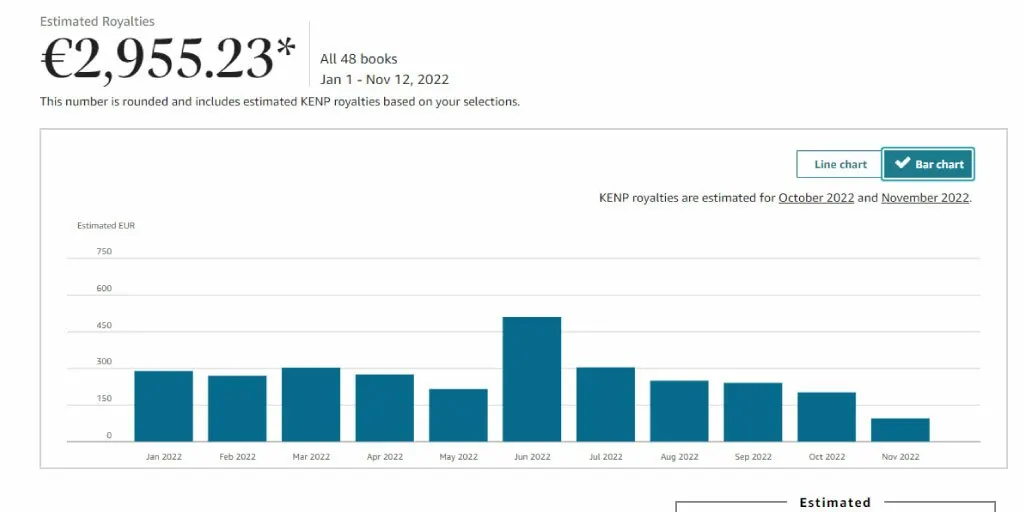
A typical KENP read number for the average novel on Kindle Unlimited is around 250-350 pages. The average KENP rate comes in right around $0.004 – $0.005.
Multiply that KENP rate by the KENP read number, and the average comes out to about $1.00 – $1.75 earned in KENP royalties for each book download in Kindle Unlimited (assuming a KENP read of 250-350 pages).
Did you find this KENP royalty calculator helpful? Try our book royalty calculator to calculate royalties on your regular book sales!
How to Use the KENP Calculator
- Enter your KENP read. Take the number of Kindle Edition Normalized Pages read for the month from your KDP reports.
- Choose the marketplace. Each Amazon store has its own per-page rate, paid in its own currency.
- Check the rate. The rate field is filled with a sample value for the store. KDP sets the real rate every month, so replace it with the rate for the month you are working out, and the royalty updates as you type.
The result is pages read multiplied by the per-page rate. It is an estimate of what Kindle Unlimited pays, before any tax withholding.
What KDP Pays For, and What It Does Not
These rules come from KDP's help page on Kindle Unlimited royalties:
- Only the first read counts. A Kindle Unlimited reader can open your book as often as they like, but you are paid for each page the first time that reader reads it.
- Counting starts at chapter 1. Pages are measured from the Start Reading Location, which Amazon usually sets at the first chapter, to the end of the book. Images, charts and graphs count towards the page total.
- There is a cap per reader. One customer can earn you at most 3,000 normalized pages per title.
- Pages are normalized. KENPC, now in version 3.0, measures pages with standard font, line height and spacing, so the count does not depend on the reader's device or settings.
- Paying for reads is not allowed. KDP does not permit marketing that rewards Kindle Unlimited readers for reading your book.
How the KENP Rate Is Set
Kindle Unlimited royalties come out of the KDP Select Global Fund, which Amazon reviews every month. Each author's payout is their share of all pages read that month. KDP's own example: with a $10 million fund and 100 million pages read, a 100-page ebook read to the end by 100 readers earns $1,000, a 200-page ebook read to the end by 100 readers earns $2,000, and the same 200-page ebook read only halfway on average earns $1,000.
That is why the rate moves from month to month and differs between stores, and why a longer book that readers finish earns more than a short one.
KENP vs. Ebook Sales
A book in KDP Select earns in two ways at once: a royalty on every ebook sold and a KENP payout on pages read through Kindle Unlimited. To compare the two for your own book, work out the sale royalty with the KDP royalty calculator, and estimate how many copies a given Best Sellers Rank sells with the KDP sales calculator.
KENP FAQ
What does KENP stand for?
Kindle Edition Normalized Pages: Amazon's standard page count for a Kindle ebook, used to measure how much of it Kindle Unlimited readers read.
How much does KDP pay per page read?
It changes every month and differs by marketplace, because it comes from dividing the monthly KDP Select Global Fund by all pages read. Use the rate from your KDP reports for the month you want to check.
Where do I find my KENP read?
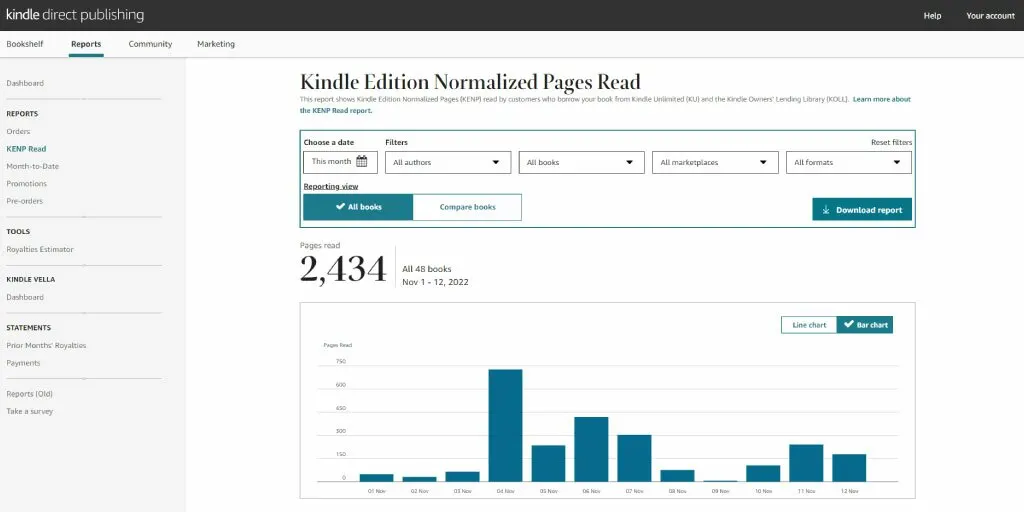
In the Reports section of your KDP account, which shows pages read per title and per marketplace.
Is my KENP page count the same as my print page count?
No. KENPC is calculated from the ebook with standard formatting, so it will not match a paperback's page count. To see how a word count translates into printed pages, use the words to pages calculator.