What Is a Metaphor? (And How This List Is Organized)
You searched "metaphor examples" because you need a line for grief, or time, or danger, right now. A metaphor is an expression that describes a person or object by referring to something else considered to share its characteristics. It states the two things are the same: grief becomes a tide. Metaphor vs. simile comes down to one word: add "like" or "as" back in and the metaphor turns into a simile, which keeps the comparison visible instead of stating it outright. The sixty lines below are grouped by what you're trying to say (grief, time passing, danger, love, change, isolation), so you can jump straight to the category matching your scene.
The Parts of a Metaphor: Tenor, Vehicle, and Ground
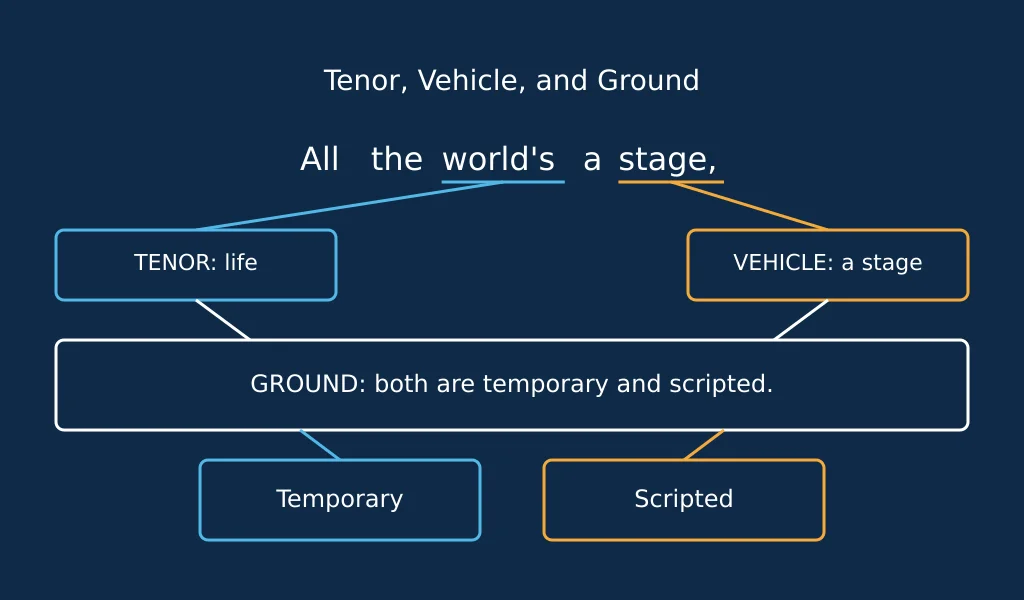
Every metaphor breaks into three working parts. The tenor is the actual subject, the thing you mean. The vehicle is the image doing the comparing, the thing you don't mean literally. The ground is the reason the swap works, whatever the two share. The terms tenor and vehicle come from I. A. Richards's 1936 The Philosophy of Rhetoric; other writers use the general terms ground and figure for that same subject-and-image pair, so "ground" can mean two different things depending on whose terminology you're reading. Here, ground names only the third part: the shared reason the swap works.
Shakespeare's Jaques gives a clean worked example in As You Like It, Act II, Scene VII: "All the world's a stage, / And all the men and women merely players; / They have their exits and their entrances." Life is the tenor. A stage is the vehicle. The ground is that both are temporary and scripted: an exit is coming whether you're an actor or a person nearing eighty.
Keep those three labels while you read the list below: every entry pairs a tenor with a vehicle, and naming the ground tells you whether the borrowed image fits your own scene.
Conceptual Metaphors You Use Without Noticing
Not every metaphor lives inside a novel. Everyday speech runs on the same device so automatically you don't register it as figurative. Time is money: you spend an afternoon, save a weekend, waste an hour you'll never get back. Argument is war: you defend a position, attack a weak point, win the debate. Neither claim is literal, but both shape how English speakers talk about time and disagreement. Notice the pattern in your own sentences, and spotting where a scene wants a fresh metaphor gets easier.
Find Your Category
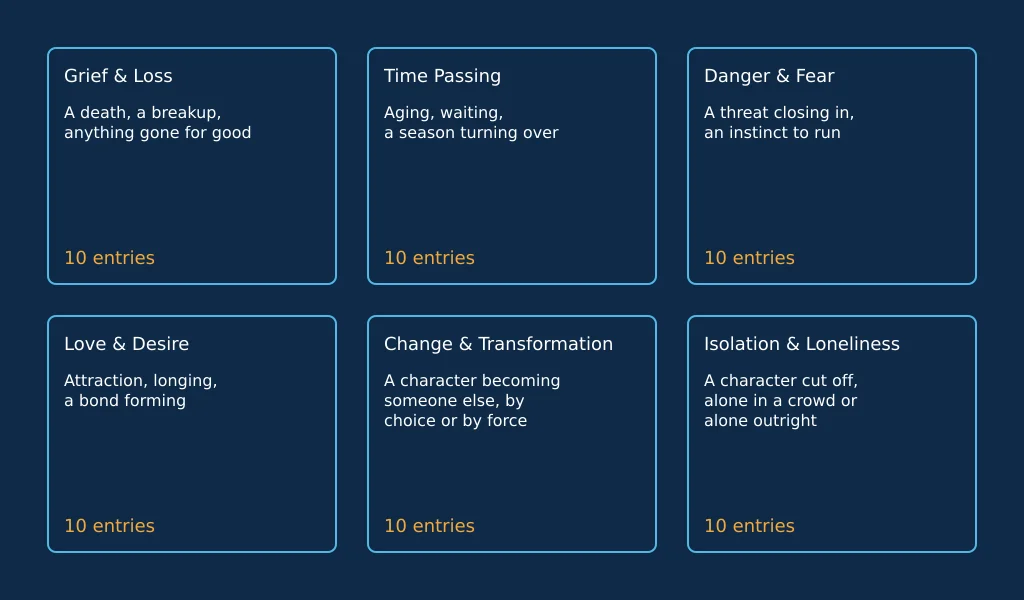
Six categories, sixty lines, ten each. Click through to the category matching the scene stalling your draft, or keep scrolling and read straight through.
| Category | What It's For | Jump To |
|---|---|---|
| Grief & Loss | A death, a breakup, anything gone for good | Jump to Grief & Loss |
| Time Passing | Aging, waiting, a season turning over | Jump to Time Passing |
| Danger & Fear | A threat closing in, an instinct to run | Jump to Danger & Fear |
| Love & Desire | Attraction, longing, a bond forming | Jump to Love & Desire |
| Change & Transformation | A character becoming someone else, by choice or by force | Jump to Change & Transformation |
| Isolation & Loneliness | A character cut off, alone in a crowd or alone outright | Jump to Isolation & Loneliness |
60 Metaphor Examples, Sorted by What You're Trying to Say
These six categories cover the situations a fiction writer reaches for a metaphor most often mid-draft: grief, time, danger, love, change, isolation. Each one runs to ten lines, sixty total, so the number in this heading is one you can count. Every entry bolds the line, then names the vehicle: the concrete image carrying the comparison, so you know what to change before it goes near your manuscript.
Grief & Loss
- Grief is the tide that goes out and doesn't come back.: The tide is the vehicle. Trade it for a process from your own setting, a harvest that fails.
- Her sorrow was a house with the furniture gone.: Furniture is what made the space feel lived in. Name the object she can't look at, a coat on a hook.
- Losing him left a room in her chest with the door nailed shut.: Swap "room" for a place from your story world; a childhood bedroom reads sharper than a generic chest.
- Mourning is a coat you can't take off in summer.: The coat carries the weight of the wrong season. Pick a garment tied to your character's own climate.
- Grief sat at the table, an uninvited relative no one had set a place for.: Replace "relative" with whoever she'd actually seat there, a landlord or an old teacher.
- The funeral folded time in half, and yesterday touched tomorrow.: "Folded" borrows from paper. Give your character her own material's version of folding instead.
- Her father's absence was a missing tooth her tongue kept finding.: This vehicle is a habit. Give your protagonist a tic of her own, a scar she keeps touching.
- Loss left him a ledger with one column struck through.: A ledger fits a character who counts things. Swap it for his own trade's tracking tool.
- The house after the funeral was a stage with the play over.: The stage is doing the work. Swap it for wherever he performs a role, a shop counter gone quiet.
- Grief is a language she was suddenly fluent in and never asked to learn.: The vehicle is an unwanted skill. Pick one your character resents having.
Time Passing
- Time is a river that doesn't wait for you to learn to swim.: Trade the river for a road, anything your character has to keep pace with.
- The years were pages that kept turning themselves, unread.: Swap "pages" for something with its own habit of continuing without you, a clock hand.
- Her thirties were a train that left the platform before she found her ticket.: The departure is the vehicle. Replace the train with a ferry or a harvest truck pulling out at dawn.
- Old age is a clock with the numbers worn off the face.: Swap "numbers" for the markers your character reads time by, tide charts or growth rings.
- Childhood was a shop that pulled its shutters down at the end of a long shift.: The shutters matter more than the shop. Pick whatever closes on a schedule in your own world, a dairy or a ticket window.
- The summer was a candle burning faster at both ends than either of them noticed.: This image is familiar. Swap "candle" for something he ran down instead, a stove or a phone battery.
- Time was a debt collector who never once raised his voice.: Pick a quieter authority figure from your setting, a landlord or a supervisor.
- Her memory of him was a photograph left in the sun too long.: Swap "photograph" for whatever fades in your world, a letter or a mural.
- The decade was sand sliding through a fist that refused to open.: Replace "sand" with a substance she handles daily, flour or thread.
- "All the world's a stage, / And all the men and women merely players; / They have their exits and their entrances," Shakespeare's Jaques says in As You Like It, Act II, Scene VII.: The vehicle is the stage itself. Borrow only the form: life is a [setting], and fill in your own.
Danger & Fear
- Fear is a hand at the back of the neck that isn't there when you turn around.: Swap the hand for a sensation particular to your character's fear, a cold spot or a held breath.
- The forest was a mouth, and they were already halfway down its throat.: Replace the anatomy with your own setting's version, a corridor as a throat.
- Danger walked into the room wearing a smile it hadn't earned.: Swap "smile" for a different disarming detail, a uniform or a familiar voice.
- The city at night was a trap with the teeth still wet.: Replace "trap" and "teeth" with something that closes on its own, a snare or a jaw of rock.
- Her instincts were a smoke alarm going off two rooms early.: Swap the alarm for an early-warning system that fits your world, a ship's bell or a dropped glass.
- The silence before the attack was a held match, waiting to be struck.: Choose an object tied to waiting for ignition, a fuse or a starting gun, and replace the match with it.
- Panic was water rising through the floorboards before anyone had checked the basement.: Swap the water for a slower threat, smoke under a door or a crack widening in a wall.
- His threat was a knife left visible on the table, doing its work unused.: The vehicle here is presence. Replace the knife with something that changes a room by sitting there, a badge or a set of keys.
- The road at night was a tunnel with no far end visible.: Swap "tunnel" for a shape your own setting offers, a canyon or a stretch of open water.
- Fear made her body a house she no longer had keys to.: Replace the house with a place your character knows well, now unfamiliar under stress, a cockpit or a workshop.
Love & Desire
- Being near him was orbiting a sun that never once looked down.: The vehicle is the orbit. Swap "sun" for whatever pulls your character in without meaning to, a mentor or a stage no one else stands on.
- Her voice was a porch light he kept circling back to.: Swap the porch light for a fixture from your own setting, a fire or a screen glow in a dark room.
- Desire was a key he kept in his pocket for a lock that no longer existed.: Replace "key" and "lock" with an object tied to something he's already lost access to.
- His attention was a lamp she kept walking toward.: The lamp is doing double duty, pull and light both. Swap it for an attractor from your world, a lighthouse or a bonfire.
- Love was a currency neither of them had learned to count.: Replace "currency" with a system of value particular to your setting, favors or hours logged.
- Her name in his mouth was a bell he hadn't meant to ring.: Swap the bell for a sound your character makes involuntarily, a cough or a door creak.
- Wanting him was weather she'd stopped checking the forecast for.: Replace "weather" with a system your character can't control, tides or traffic.
- Their marriage was a garden neither of them had time to weed.: The upkeep matters more than the garden. Swap it for whatever the two of them are meant to be tending and aren't, a shared business or an aging car.
- He was a habit she'd built her whole day around.: Replace "habit" with a routine object, a coffee order or a song on repeat.
- Longing was a phone left face-up on the table, waiting to light.: Swap the phone for whatever object he watches for a sign, a mailbox or a doorknob.
Change & Transformation
- Her old life was a skin she finally molted.: Swap "skin" for a process your own world contains, bark shedding or scaffolding coming down.
- He was ore that had to lose most of itself before it could be a blade.: Replace "ore" and "blade" with a material and object from his own trade.
- Recovery was a field he had to burn before anything would grow back.: The burn matters more than the field. Swap it for whatever your character cultivates, a business or a friendship.
- Her transformation was a bridge built while people were still crossing it.: Replace "bridge" with a structure your own setting offers, a road or a staircase.
- The new version of him was scaffolding still bolted to the old frame.: Swap "scaffolding" for a support structure he relies on, a cast or a mentor.
- She was a chrysalis that had forgotten it used to be a caterpillar.: The forgetting carries the line. Replace the chrysalis with a process your own setting contains, a tide clearing after a storm or land regrowing after a fire.
- His change of heart was an engine rebuilt with half the original parts.: Swap "engine" for a machine your character understands, a loom or a ship.
- "One man in his time plays many parts, / His acts being seven ages," Shakespeare writes in As You Like It, Act II, Scene VII.: The vehicle is an actor's parts. Swap "acts" for the roles he's actually played, apprentice or widow.
- Her transformation was a lens ground down until it finally focused.: Replace "lens" with an instrument your protagonist adjusts, a tuning peg or a compass.
- The last of who he'd been was ash the wind had already carried off.: Swap "ash" for whatever residue fits your own setting, sawdust or sea foam.
Isolation & Loneliness
- Replace "player" with a role from your character's own stage, a job or a family position.
- Her apartment was an island with the bridges quietly removed.: Swap "island" for a piece of geography from your own setting, a peninsula or a rooftop.
- Loneliness was a dinner table set for two, cleared down to one plate.: The clearing is the vehicle. Replace the table setting with a domestic ritual she kept and now can't.
- He was a lighthouse nobody's boat still passed.: Swap "lighthouse" for something built to be noticed that no longer is, a shopfront or a radio tower.
- Her silence was a switchboard with every line unplugged.: Replace "switchboard" with a system of connection she used to run, an inbox or a group chat.
- He talked to the dog because the intercom had gone silent years ago.: Swap "intercom" for whatever once connected your protagonist to someone else, a phone line or a shared radio channel.
- Her loneliness was an address book with every entry crossed out.: Replace the address book with a record of relationships specific to her, a contact list or a family tree.
- He was a chair pulled out for a guest who never sat down.: The waiting is what the line leans on. Swap the chair for whatever he prepares for company that stopped arriving.
- The city was a crowd that never once looked up.: Replace "crowd" with the specific public your character moves through, a school hallway or a market.
- Her isolation was a radio left on for company it couldn't give.: Swap "radio" for a device your character keeps running out of pure habit, a television or a nightlight.
Swap the Vehicle Before You Paste the Line
Use the table above to land on the category matching your scene, then look at the concrete noun each entry's note names (the tide, the ledger, the chrysalis) and trade it for a detail from your character's own life. A metaphor that names your character's own object reads as earned; pasted whole, it reads as borrowed, and a version of several of these lines has probably already turned up in someone else's draft.
Six categories can't cover every emotion a scene might need (jealousy, nostalgia, and awe don't get a section here), so adapt from whichever category sits closest. And the swap is a step, not something you can skip: a pre-built line still needs your own detail in it before it earns its place on the page.
If the scene needs more than one figure of speech, the 154 Literary Devices list covers the rest of the toolkit, and the personification examples and figurative language examples pages sort by the same by-purpose logic as this one. A metaphor built to run across a whole chapter usually means you need 110 symbols and what they really mean too. Once the image is right, check the verb carrying it against the 444+ strong verbs list: a flat verb can undo a sharp metaphor in the same sentence.
Metaphor Questions, Answered
What is an example of metaphor?
"Grief is the tide that goes out and doesn't come back," from the Grief & Loss list above, is one. It states grief is a tide outright; a simile would add "like" first.
What best explains a metaphor?
A metaphor names a concrete thing, the vehicle, in place of an abstract one, the tenor, because the two share a ground. The tenor, vehicle, and ground section above walks through the mechanism using Shakespeare's stage line.
What are 20 metaphors?
Grief & Loss and Time Passing, ten lines each, twenty total, every one already paired with an adaptation note.
What is the meaning of metaphor?
A metaphor states one thing is another. The opening section above has the full definition; for fiction, the working version is that a metaphor lets a reader feel what something is like without you spelling it out.