

What Is Description in Fiction? (And Why It's Never Just One Thing)
Your chapter six opens on a paragraph of scenery: fog, a cracked sidewalk, shuttered windows. It reads exactly like the paragraph that opened chapter two, same rhythm, the same five adjectives reached for twice. That's the tell. There are four types of description in fiction: setting, character, action, and sensory, and each one solves a different problem on the page. Description itself is any passage that renders a person, a place, an action, or a sensation clearly enough for a reader to picture it, and which type carries it depends on what you're describing. Reusing one kind scene after scene is what makes a manuscript feel flat, no matter how carefully each sentence is written.
Description in One Sentence
Description names what the reader can't yet see and describes it for them: a face, a room, a punch, a smell. Worth settling the grammar here, since it trips people up. Description is singular and uncountable in its general sense, as in "good description slows a scene down." It only turns plural, descriptions, when you mean separate instances of it, as in "three descriptions of the same house." Both forms show up correctly later in this piece.
Why Fiction Needs Four Kinds, Not One
Fiction leans on four types of description: setting, character, action, and sensory. Each does a job the others can't. Setting orients the reader in space. Character tells them who to watch. Action shows what's happening moment to moment. Sensory borrows the five senses so a scene feels lived-in, not watched from outside. Mixing these up isn't the failure. Reaching for only one, every time, is, and it shows up the same way in a thriller as it does in a quiet literary novel: the reader stops trusting the room because every room reads the same.
Why the Same Paragraph of Scenery Doesn't Work Twice
Two rules sit underneath all four types, and skipping either is what makes description feel like padding. The first governs what goes on the page. The second governs how much of it survives the second draft.
Show, Don't Tell
Telling reports a conclusion: "the house was old." Showing hands over the evidence instead: peeling paint, a porch step that gives underfoot, curtains gone yellow at the seam. Good description almost always shows, because it gives the reader sensory detail and lets them do the concluding themselves. This isn't a rule for chapter one only. It holds across setting, character, action, and sensory description alike, every time you draft one, and it holds just as firmly in a fifty-word aside as it does in a full page.
Less Is More (and the Line Into Purple Prose)
The opposite failure is worse: piling on adjectives until the sentence buckles under its own weight. A handful of exact details beats a page of vague ones, as a rule of thumb. It breaks down only when a scene depends on a full inventory of physical fact the plot needs to call back later, the way a locked-room mystery has to catalogue every object in the study. Push past that point without that excuse and you land in purple prose: readers notice the sentence instead of the story it's supposed to serve, and that's what pulls them out of the scene. A short, exact sentence usually does more work than a long, decorated one.
The 4 Types of Description in Fiction (With Examples)
Each type below solves a different problem on the page. None is optional in a full scene, but which one carries the paragraph changes depending on what you're describing: a place calls for setting, a person calls for character, movement calls for action, and atmosphere calls for sensory detail.
Setting Description
Setting description tells the reader where they are, and often what era or mood governs the place, before the plot asks anything of them. Here's an example of description that does only this, nothing else: "The mill town sat in a fold of hills that kept the fog in past noon most mornings. Its one paved road ran from the church to the shuttered cannery and stopped there, as if the town itself had given up expanding. Everyone who still lived in it had a reason to stay, and none of them talked about it much."
No character moves in that paragraph, and nothing happens in it. Every detail earns its place by describing where the story is about to happen, not by decorating it. A single well-chosen word, "fold" instead of "valley," does more to set mood than a paragraph of geography would. Harper Lee opens To Kill a Mockingbird on Jem's broken arm and a page of Finch family history before Maycomb gets its own extended description, but once it arrives, the town is characterized as a place in its own right: slow, closed-in, worked out well before the plot asks anything of it.
Setting description earns its place at the top of a chapter, right before a change in location, or anywhere later events depend on the reader already knowing what kind of world they're standing in. Keep it short if the location recurs; save the longer version for the reader's first look. What goes wrong here: piling on architectural detail, the trim, the shutter color, the exact count of front steps, none of which will matter again. If the town won't come back, the reader doesn't need its blueprint. If you're building a fictional town or house from nothing, crafting a story's setting is where to start.
Character Description
Character description tells the reader who to watch and what to expect from them, usually within the first few lines of an entrance. Watch what the details do in this passage: "Her hands were the first thing he noticed, knuckles swollen from years of wringing out wash, one thumbnail gone black from a hammer that had missed twice. She caught him looking and didn't cover them. She'd stopped being embarrassed about her hands a long time before he ever met her."
The paragraph never states an adjective about her directly. No "tough," no "weathered." It hands over a body part, a small history, and a reaction, and the reader assembles the person from there. Stephen King introduces Annie Wilkes in Misery on the same principle, pairing a physical detail with a behavioral tell in the same breath, so the reader reads danger in her manner well before the plot confirms it.
This type earns its place at a character's first appearance, or at any later moment where an inner state needs to show through the body. Pick one or two details, not five: a character built from a single unforgettable hand is more vivid on the page than one built from a full physical inventory. A character's second appearance doesn't need this treatment again; one strong entrance carries a reader's memory of a person for the rest of the book, unless something about them has visibly changed. What goes wrong here: naming the emotion right after showing the detail that already proved it, "she looked tired and defeated," when the hands already said so. Trust the detail and cut the label. If a character needs more than a face, 405 character mannerisms gives you the small, repeatable behaviors that description alone can't carry.
Action Description
Action description renders movement and event in real time, and it lives or dies on the verbs carrying it. Here's a passage built the same way: "She broke left, ducked the swing, and drove her shoulder into his ribs before he'd finished turning. He staggered into the shelving. Cans hit the floor. She was already through the door before he found his feet."
Every verb does its own work: broke, ducked, drove, staggered, hit. Nothing waits on a subordinate clause to explain itself, and the short sentences keep the reader moving at the same speed as the characters. The arena sequences in Suzanne Collins' The Hunger Games favor the same construction: short and clipped, concrete verbs over long descriptive ones, because a reader mid-chase doesn't want to pause for a comma.
Use action description for a chase, a fight, or any sequence where pace matters more than atmosphere, and trim adjectives out of it almost entirely; they slow a moving body down. Weak verbs do the same, so keep a list of 444+ strong verbs open while you draft one. Even a fast scene can afford one beat of stillness, a held breath before the next verb, as long as it doesn't tip over into scenery. What goes wrong here: an adverb propping up a weak verb, "sprinted quickly," which only proves the verb wasn't strong enough on its own. Cut the adverb and see if the sentence still stands. If the scene is a fight specifically, writing a fight scene covers the choreography end of the same problem.
Sensory Description
Sensory description borrows smell, taste, touch, and sound, not sight alone, to make a scene feel physically present. Here's an example of description that never once reaches for color: "The bleach smell hit her before the light switch did, chemical and sweet underneath it, the kind that means someone scrubbed a surface twice. The linoleum was cold enough through her socks to stop her at the doorway. Somewhere in the house, a tap was still running."
Sight barely appears in that paragraph, and that's the point. Smell, temperature, and sound carry it, which is what makes the room feel wrong before anything explains why. Gillian Flynn's Sharp Objects gives smell and temperature equal weight with sight in its domestic interiors, so a kitchen or a bedroom can read as wrong through the nose as much as through the eye.
Reach for sensory description in a quiet or unsettling moment, anywhere you want the reader's body to react before their reasoning catches up. It layers well under setting, since a place is never only visual. Sensory detail also works in reverse: easing a reader out of tension by returning attention to something ordinary, a kettle, a clock, once the shock has passed. What goes wrong here: a smell or sound dropped in for texture and never tied to what the character notices or fears. Sensory detail should tell the reader something about the scene, not just prove the room has air in it. Figurative language carries a lot of that weight; 33 figurative language examples is a useful place to borrow from if a sensory passage feels flat.
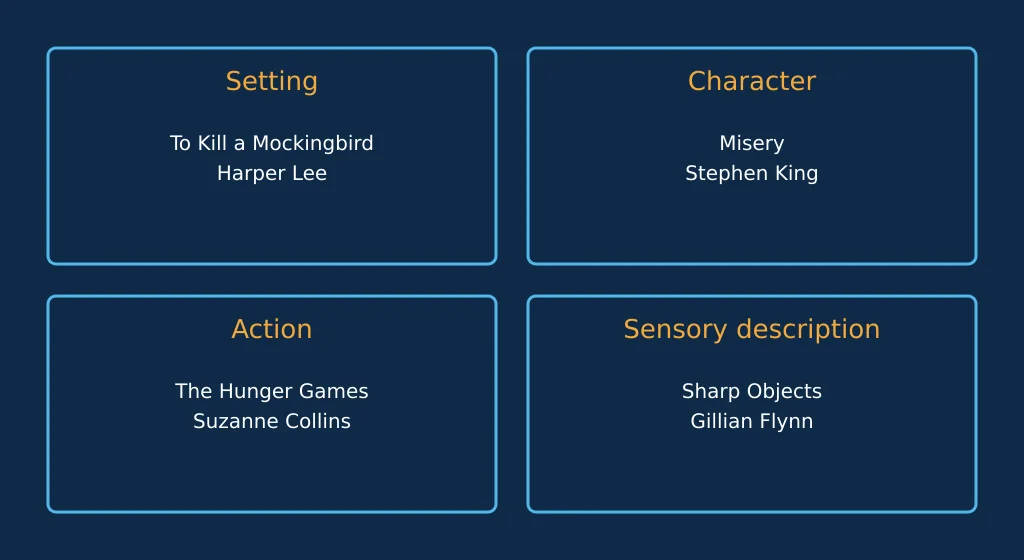
Which Type of Description Does This Scene Need? A Diagnostic
Deciding the type before you draft saves you the rewrite where you notice the whole scene is scenery and nothing happens. Match the scene's actual goal to a row below; what reads naturally can also hinge on choosing a point of view, since description filtered through tight first person has to pass through what that character would actually notice, not what you want the reader to see.
| Scene Goal | Description Type to Use | Why It Works | Example Novel |
|---|---|---|---|
| Opening a chapter in an unfamiliar place | Setting | Orienting detail up front lets the reader trust the geography of the scene, so later movement through it reads as familiar rather than confusing. | To Kill a Mockingbird |
| Introducing a character for the first time | Character | A first physical detail paired with a small behavioral tell gives the reader an emotional read on a person before the plot has confirmed anything about them. | Misery |
| A chase, a fight, or another fast sequence | Action | Short, concrete verbs keep the reader's attention moving at the same speed as the characters, so the prose never outpaces the danger on the page. | The Hunger Games |
| A quiet, intimate, or unsettling moment | Sensory | Senses other than sight make a room feel physically present, so the reader's body registers wrongness in a space before their reasoning explains why. | Sharp Objects |
| Re-establishing a familiar location briefly | Setting | A few chosen details refresh a place the reader already met, which spares a book from re-explaining a setting a returning reader remembers on their own. | the Harry Potter series |
| Showing that a character has changed since we last saw them | Character | Physical detail carried across a book charts a character's change without ever stating outright that something in them has shifted. | The Shining |
Read the Scene Goal column first, not the Description Type column. It's tempting to decide "this needs to feel atmospheric" and reach for sensory description on instinct, but what the scene needs to accomplish should choose the type, not the mood you're aiming for. Once you've matched a goal to a row, check the Why It Works column against what the scene actually needs the reader to conclude; if it doesn't match, you've probably picked the wrong row, not the wrong type.
Some scenes are honestly split between two goals. A character walking into a room mid-argument needs both an introduction and a fast exchange. Don't force one type to carry both goals; layer two types in the same passage instead, which the next section covers in detail. And if a scene's goal isn't listed here at all, ask which of the four questions it's really answering: where, who, what's happening, or what does it feel like. That question always resolves to one of the four types, even when the table doesn't have its exact row.
Layering Two Types in One Passage
The four types aren't exclusive lanes. Most published scenes braid two together in the same paragraph, so place, event, and feeling arrive at once rather than in separate blocks.
A Worked Example: Setting and Sensory
Setting and sensory pair naturally, since a place is rarely only visual. Watch how the second half of this sentence turns a fact about the barn into a feeling about it: "The barn held the day's heat long after the sun had gone, and the air inside smelled of diesel and old hay, thick enough to taste at the back of the throat." The heat is setting, a fact about the place. The smell folding into taste is sensory, and it arrives without needing a sentence of its own.
A Second Layer: Action and Sensory
Danger registers in the body as often as it registers in the plot, and action pairs with sensory description whenever it does. Watch where this passage turns from movement to feeling: "He hit the water wrong, hard on his shoulder, and the cold closed over him instantly, wringing the air out of his lungs before he even knew he was under." The fall is action. Everything after "instantly" is what his body feels, and the sentence never pauses to announce the switch between the two.
Why Layering Works
Dean Koontz's Odd Thomas often works this way, letting atmosphere and physical sensation land in the same paragraph rather than sit in two separate ones. Layering also saves words. One paragraph can carry what two would otherwise need, which keeps a scene moving instead of stalling to finish a full block of place before anything happens in it. Three types crammed into one sentence usually backfires, though; a paragraph doing setting, action, and sensory all at once tends to read as busy rather than rich, so pick the pairing the scene actually needs and leave the third type for the next sentence.
Pros and Cons of Heavy Description
Reaching for more description isn't automatically wrong, but it isn't automatically right either. Weigh what it buys against what it costs before deciding a scene needs a longer paragraph, and remember that the cost usually shows up several pages later, not in the paragraph itself.
Benefits of Detailed Description
- Builds immersion: when detail is precise, the reader trusts the world without being told it's real, which pays off later when something stranger needs believing.
- Doubles as characterization when the detail passes through a character's own point of view, since what a character notices says as much about them as the room does.
- Slows pace deliberately before a turn, giving a moment weight it would lose if the scene rushed past it.
- Anchors a series' world: later books don't have to re-explain a setting a returning reader already knows.
Drawbacks of Overdoing It
- Stalls pace exactly where a reader wants forward motion, and a reader who feels stalled tends to skim rather than reread.
- Risks tipping into purple prose once adjectives start crowding out the nouns, and a reader who notices the ornamentation stops noticing the story.
- Invites skimming: readers cut past blocks that don't move plot or character, and a skipped paragraph might as well not exist.
- Repeats itself book to book if every scene reaches for the same technique, which is its own kind of monotony even when each paragraph is well written on its own.
Match the Description to the Scene You're Actually Writing
Open the scene you're mid-draft on right now and ask what it's actually doing. Orienting the reader somewhere new needs setting. Introducing someone needs character. Movement needs action, verbs first. Anything meant to unsettle or slow the reader down needs sensory detail borrowed from more than sight.
If what's on the page right now is scenery and nothing else, here's the fix for each type, not a repeat of the definitions above:
- Setting stalled: cut every detail that won't recur, and check whether the paragraph would survive as three sentences instead of eight.
- Character stalled: swap the adjective doing the work for one physical detail plus one small history, the way the knuckle passage did earlier.
- Action stalled: read it aloud and cross out every adjective and adverb. If the sentence still moves, they weren't carrying anything.
- Sensory stalled: name the one sense a reader would notice first in that room, in that weather, on that body, and cut back to just it.
Pick the type the scene is actually short on before you add a single word back.
FAQ: What Are Types of Descriptions?
Quick answers, in the wording most people search for.
What are examples of description?
Four quick ones, one for each type: a cracked windowsill for setting, a scarred knuckle for character, a slammed door for action, and the smell of rain on hot pavement for sensory. Here's one example of description for each type worked out in full above, paired with a passage and a named novel, so you can see the type carrying a whole paragraph rather than just an image. Same tool, put to four different uses depending on what the scene needs.
What is description and meaning?
Description means rendering a person, place, action, or sensation in language specific enough that a reader can picture it. The word traces back to the Latin describere, to write down or trace out, and that's still a fair account of what it does on the page. In fiction it means choosing the details that carry meaning and leaving the rest out, not recording everything a camera would catch, and that choosing is the actual skill.
What are types of descriptions?
Setting, character, action, and sensory. Four types, one worked example of each above, plus a diagnostic table for picking the right one before you draft a scene rather than after.
Is description plural or singular?
Singular in general use. It only turns plural, descriptions, when you're counting separate instances of it rather than talking about the craft in general.
Which type of description should open a chapter?
Setting most often opens a chapter, since a reader needs to know where they are before much else lands. A character entrance can open just as well if the person matters more than the place right away. Plenty of chapters skip both and open on action already in progress, in medias res, with setting and character filled in a paragraph or two later once the reader is already moving.