What Is an Adage (and How Is It Different From a Proverb)?
If you're scrolling a giant alphabetical list of adages hoping one fits the scene you're writing or the journal cover you're designing, you're doing it the hard way. An adage is a short, memorized saying that states a general truth or a piece of practical wisdom, worn smooth by repeated use until it needs no explanation—unlike a simile, which stays fresh precisely because it isn't worn smooth: "actions speak louder than words," "practice makes perfect." That's the whole definition, and everything past this point is detail.
People use adage, proverb, saying, and idiom as if they're interchangeable, and in everyday writing they mostly are. A proverb usually carries a stronger claim to being handed down through a specific culture or generation (think of it as an adage with a longer paper trail). An idiom doesn't have to carry wisdom at all; it's just a fixed phrase whose meaning isn't literal, the way "kick the bucket" has nothing to do with buckets. A saying is the loosest term of the four, any repeated expression at all, wise or not. An aphorism sits at the tight end: a single memorable line, usually pinned to one author, rather than a saying that's been passed around anonymously for centuries. For a writer choosing a line for a page, the label rarely matters. What matters is whether the words fit the moment.
An adage counts as one of the literary devices writers reach for when a line has to do more work than its word count suggests, and it sits alongside the wider set of figurative language examples sorted by effect if you want the full range beyond short sayings.
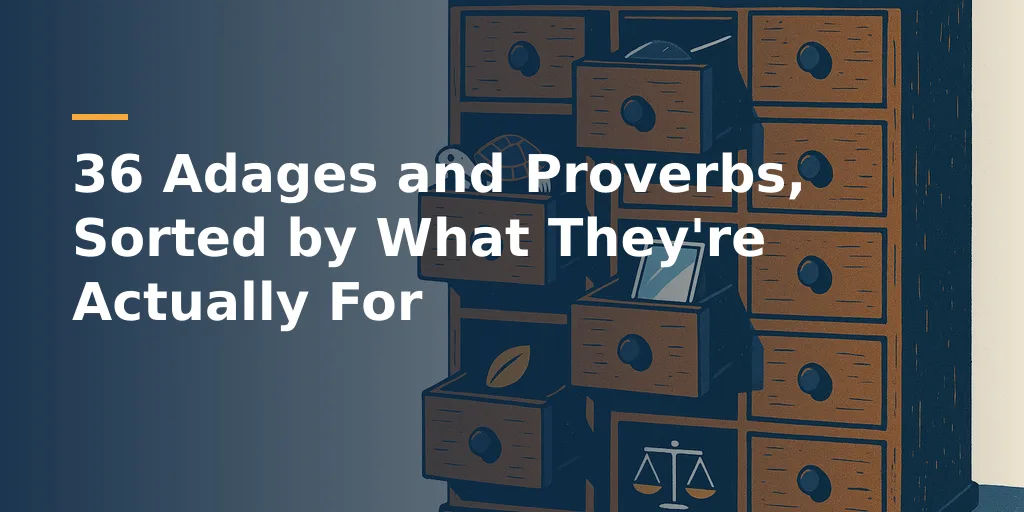
36 Adages and Proverbs, Sorted by What They're Actually For
Thirty-six examples of adages and proverbs below, split into five categories by the situation they suit: warnings, general wisdom, work ethic, love, and money. Each entry gives the line itself, a plain-English gloss, and a note on where it earns its place: a line of dialogue, a chapter epigraph, the opening line of a prologue or epilogue, a planner cover. Pick each line by the purpose it needs to serve.
Warnings
- Look before you leap. Weigh the consequences before you act. Fits a character about to make a rash call, or a caution line on a budgeting journal's cover.
- Curiosity killed the cat. Too much nosiness invites trouble. Works for a subplot where snooping backfires, or a mystery activity book's tagline.
- Don't count your chickens before they hatch. Don't celebrate a win that hasn't landed yet. Suits a character gloating right before the plan collapses.
- The burnt child dreads the fire. One bad experience breeds lasting caution. Good for a character who won't risk trust again after an old betrayal.
- The road to hell is paved with good intentions. Meaning well doesn't excuse the damage done. Fits a well-meaning character whose help makes things worse.
- Better safe than sorry. Caution now beats regret later. Belongs on a safety checklist page in a travel journal, or a character's internal debate.
- Forewarned is forearmed. Knowing the danger ahead lets you prepare for it. Reads right on a prologue that foreshadows what's coming.
- All that glitters is not gold. Appearances can deceive. Drop it into a scene where a character falls for a con, or a treasure-hunt activity page.
Wisdom
- Actions speak louder than words. What you do outweighs what you say. Fits a character whose promises never match their behavior.
- The truth will out. Hidden facts surface eventually. Works as a thriller's back-cover line, or the beat right before a mystery's reveal.
- A watched pot never boils. Fixating on an outcome makes the wait feel endless. Suits a character checking their phone for news that won't come.
- Knowledge is power. Information hands you an advantage. Good for a scholar character, or the cover of a study planner.
- This too shall pass. Hardship passes, even when it doesn't feel that way. Belongs on a grief scene, or a page inside a mindfulness journal.
- Where there's a will, there's a way. Determination finds a route around an obstacle. Reads right on an underdog's arc, or a goal tracker's tagline.
- Honesty is the best policy. Truth serves better than deception, eventually. Drop it into a scene where a character chooses to confess.
Work Ethic
- The early bird catches the worm. Acting first earns the advantage. Fits a hustling character, or a productivity planner's cover line.
- Practice makes perfect. Repetition builds skill over time. Works for a training montage, or the opening page of a habit tracker.
- No pain, no gain. Real progress asks for some discomfort. Suits a fitness journal, or a character pushing through a hard training stretch.
- A stitch in time saves nine. Fix the small problem now, before it becomes a big one. Good for a maintenance checklist inside a planner.
- If a job's worth doing, it's worth doing well. Commit fully or skip it. Belongs to a craftsman character who refuses to cut corners.
- Rome wasn't built in a day. Big achievements take time to build. Reads right on a slow-burn character arc, or a long-term goal tracker.
- Slow and steady wins the race. Consistency beats a fast start. Drop it into a tortoise-like character's arc, or a habit tracker's cover line.
Love
- Absence makes the heart grow fonder. Distance deepens affection. Fits a long-distance subplot, or an anniversary card line.
- Love is blind. Affection overlooks flaws a stranger would spot instantly. Works for a character ignoring obvious red flags.
- Opposites attract. Contrasting personalities can draw two people together. Suits a romance's mismatched pair, or the tagline on a couples' journal.
- The way to a man's heart is through his stomach. Shared meals build affection fast. Good for a cooking-themed romance, or a recipe journal's cover.
- Home is where the heart is. Belonging follows the people you love. Belongs on a found-family arc, or a housewarming card.
- Better late than never. Acting on a feeling matters even delayed. Reads right on a reunion scene, or a long-postponed proposal.
- You never know what you've got till it's gone. Loss reveals what you took for granted. Drop it into a breakup-regret scene, or an anniversary journal's tagline.
Money
- A penny saved is a penny earned. Saving money counts as much as earning it. Fits a budgeting journal, or a frugal character's internal logic.
- Money doesn't grow on trees. Money is limited and has to be earned. Works as a parent's line to a spendthrift character.
- Time is money. Time carries the same value as cash, so don't waste it. Suits a workaholic character, or a productivity planner's tagline.
- You get what you pay for. Cheap choices often cost more later. Good for a character regretting a bargain that fell apart.
- Don't put all your eggs in one basket. Spread risk across more than one bet. Belongs on an investor subplot, or a finance planner's page.
- Neither a borrower nor a lender be. Money entangles relationships you'd rather keep simple. Reads right on a scene where a character's asked for a loan.
- Penny wise, pound foolish. Saving small while losing big. Drop it into a scene where cutting corners backfires expensively.
How to Pick the Right Adage for Your Scene or Page
Same list, two different jobs. A line of dialogue and a journal cover ask different things of an adage, and the checks below sort out which one you're doing.
- Match the adage to who's saying it. A character can deliver a well-worn line without it reading as lazy — people really do talk in clichés. A page with no voice behind it, like a journal cover, needs the line to carry its own weight instead.
- Check the register against the moment. A wisdom line fits a mentor's advice; a warning fits the beat right before a mistake gets made.
- For a product page, look at what's already out there. The low content books guide and the journal and notebook interior templates collection both work from lines exactly like these, so check what's already been overused before picking one.
- Say it out loud once. If it sounds like something you've read a hundred times with no twist, it's filler. Swap it for a less obvious entry above, or build one from scratch below.
Turn a Real Adage Into One for Your Fictional World
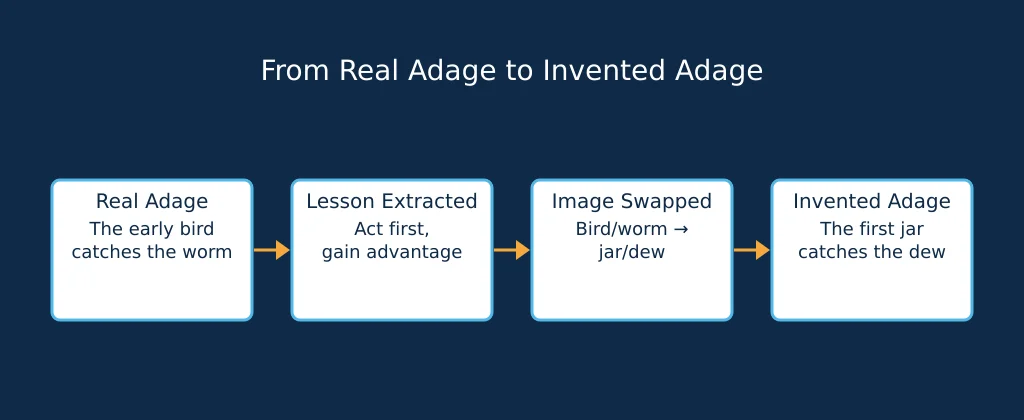
A line from the categorized list above will always read as ours: Earth, now, English. If your story runs on a fictional culture, that's the wrong texture. Here's how to build a saying that reads as theirs, taken through every step on one real adage rather than left as an exercise.
- Start with a real adage you actually need. Pull "the early bird catches the worm" from the work-ethic list above — a line about the advantage of moving first.
- Split it into lesson and image. Strip the picture away and keep the instruction: whoever acts before everyone else gets the advantage. That instruction is the part your invented culture needs to believe.
- Swap the image, not the lesson. Birds and worms mean nothing to a people who've never seen either. If your fictional culture survives by collecting dew off cactus spines before sunrise, the same lesson can ride on a different picture entirely.
- Read both lines aloud, back to back. Rhythm carries as much of an adage's authority as its meaning does. If the new line stumbles where the old one didn't, keep adjusting the words until it lands with the same weight.
Finished result: "The first jar catches the dew." Same lesson as the early bird, same short beat, but the picture now belongs to people who've never watched a bird catch anything.
This swap-the-image method earns its keep when you're building a secondary-world culture, fantasy or science fiction, that needs sayings which read like folklore rather than a modern cliché. It pairs naturally with working out the rest of that culture's motifs sorted by genre and, if you're naming the people who'd say the line, the fantasy character name generator. It's the wrong move for a journal cover or planner page: an invented saying carries none of the recognition a public-domain line does, and a product page rarely has room to explain the image before the sale is lost. For that kind of page, pull straight from the categorized list above, unaltered. Watch for a swap so on-the-nose it reads as a gimmick. If the new image needs three sentences of worldbuilding before it lands, it isn't ready.
Adages FAQ
What is an example of an adage?
"Actions speak louder than words" is a clean one: it states a general truth in a line short enough to recall from memory without trying.
What are some good adages?
The strongest ones are specific enough to picture and short enough to repeat without stumbling. "The early bird catches the worm," "a penny saved is a penny earned," and "actions speak louder than words" all do this: one plain image, one clear lesson, which is exactly why they've lasted this long.
What are common adages?
The ones everyone already half-knows: look before you leap, practice makes perfect, honesty is the best policy. These are lines so familiar a reader finishes them before you do, which is exactly why the picking guidance above matters.
What is an adage for kids?
Adages written for children swap anything abstract for something a kid can picture right away: animals, weather, food. "Slow and steady wins the race" and "don't cry over spilled milk" both work this way: one concrete image, one clear lesson, nothing hidden underneath. That's also what makes them useful for an activity book aimed at a young reader. Skip anything with an ironic or double meaning and you're safe.