What Is Symbolism? (And How It Differs from Metaphor and Motif)
Symbolism is the practice of using a concrete thing, an object, a color, an animal, a place, to stand for an idea too large or too private to state outright. A ring stands for commitment. A storm stands for conflict arriving. The object stays literal on the page while the idea rides along underneath it, and a reader usually picks it up without being told to.
That's the plain answer, and it's the one an AI overview will already have given you. The harder part is knowing where symbolism stops and its two closest relatives start, because a reader who searches the single word "symbolism" usually means one of three related things without realizing it. Symbolism belongs to the wider family of figurative language, the umbrella term for any device that means more than it literally says. Under that umbrella, a symbol, a metaphor, and a motif each work differently.
Symbol vs. Metaphor vs. Motif
A metaphor states that one thing is another thing, directly, inside a sentence: her voice was gravel. The comparison lives in the language, and it ends when the sentence does. A symbol doesn't make that claim outright. It's an object that recurs in the story, carrying its meaning through repetition and placement. Nobody in the book says the mirror is the protagonist's fractured sense of self; the mirror just keeps showing up at the moments that idea matters. For more on the sentence-level device, see the site's metaphor examples.
A motif is a pattern, not a single object. Where a symbol is one thing standing for one idea, a repeated element that runs across an entire work and accumulates meaning through sheer recurrence is what the site elsewhere covers as a motif. Water can be a symbol in one scene and turn into a motif across a whole novel if it keeps returning, in different forms, from the opening page to the last one. This page is about the single object and what it can mean the first time it shows up.
How to Spot a Symbol While You're Reading or Revising
Not every object in a scene is doing symbolic work, and not every object needs to be. Before you decide something in your draft "means something," check it against a few signals that separate an incidental prop from an actual symbol.
- It keeps coming back. A single mention of a mirror is just furniture. A mirror that appears in the opening scene, the midpoint, and the ending has been placed on purpose, whether the writer meant it that way or not.
- It shows up at a structurally loaded moment. Objects mentioned at an opening, a climax, or a closing line get more attention from readers than objects mentioned in passing, so a detail planted there is worth checking for extra weight.
- Its literal explanation doesn't cover why it's there. "She wears her mother's ring because rings keep fingers warm" doesn't hold up as a full account when a story keeps returning to that ring at every emotional turn. The gap between the practical reason and the narrative attention is where the symbol lives.
- It changes state alongside the character. A candle burning lower as a scene gets tenser, or a plant dying alongside a relationship, uses a physical change to track an emotional one without a line of narration saying so.
None of these signals proves intent on its own. Taken together, they're a reasonably reliable way to tell whether an object in your own draft, or someone else's, carries more weight than its plot function requires.
The Big List: 110 Symbols and What They Really Mean
What follows is 110 symbols, sorted into ten categories, each with the meaning it carries most often in Western literary and genre-fiction convention. Use it as a starting point, not a lookup table to copy from directly. A symbol's convention is the first thing a reader guesses, not the last thing your scene needs to say, and the craft section further down gives you three ways to push any entry here past its stock reading before it goes into the manuscript.
Nature & Elements
These are the biggest, oldest symbols available, borrowed from religion and folklore across most cultures. They read most naturally when the object does the work on its own, without a character stopping to explain it.
- Water: Change, cleansing, or the unconscious; a river crossing often marks a turning point. Give your character's water a specific temperature or color so it stops being generic and starts being theirs.
- Fire: Destruction that also clears the way for something new. A campfire reads differently from a house fire; the size and control of the flame tells the reader which one you mean.
- Earth: Stability, the body, and what grounds a character to a place. Have your protagonist plant or bury something in it: the ground can hold what people won't say aloud.
- Wind: Change arriving from outside a character's control, often just before a storm. A single gust at a decision point can substitute for a paragraph about someone changing their mind.
- Sun: Clarity, truth, or a return to normal life after darkness. It risks feeling pat at the end of a hard stretch if nothing else in the scene has actually shifted yet.
- Moon: Cycles, hidden truth, or a self shown only in part. A full moon signals revelation; a new moon signals concealment. Match the phase to what the scene is about to expose.
- Stars: Constancy, distance, or a wish placed somewhere unreachable. Good for a character looking up when looking around has stopped helping them.
- Mountain: An obstacle, a goal, or the scale of a task ahead, and naming a specific mountain, real or invented, does more work than calling it "the climb."
- River: Time passing, or a boundary a character has to choose to cross. One a character refuses to cross can carry as much weight as one they finally do.
- Ocean: Vastness and the unknown, and grief when it appears right after a loss. Its scale makes it a poor fit for quiet, intimate scenes, where a puddle or a bathtub does the same job smaller.
- Stone: Permanence, memory, or a person who won't be moved. A stone carried in a pocket across chapters is a simple way to track a symbol without over-explaining it.
Colors
Color symbolism reaches a reader before it's consciously registered, which makes this the fastest category on the list to overuse.
- Red: Passion, danger, or violence, depending entirely on what's next to it. A red dress and a red stain aren't reaching for the same thing; let context carry the meaning, not the color alone.
- Black: Death, mourning, or the unknown, and in plenty of stories, simple elegance. Its ambiguity means it needs another nearby detail to say which reading you intend.
- White: Purity or emptiness, sometimes both in the same scene. A wedding dress and a blank page use the same color for opposite reasons.
- Blue: Calm, sadness, or distance, often used for a character who's emotionally withdrawn. A blue room can say more about a character's state than a line of dialogue about their feelings.
- Green: Growth, envy, or inexperience, depending on which one your plot needs that page. New growth reads as hope; a green tint on a face reads as sickness.
- Yellow: Optimism, cowardice, or decay, three meanings that rarely coexist without confusing a reader. Pick one lane per scene and stay in it.
- Purple: Royalty, luxury, or the artificial, historically expensive to produce, which is why it still reads as status. It suits the social climber performing wealth more than the aristocrat who's always had it.
- Gold: Value, corruption, or something earned the hard way. A gold object that tarnishes partway through a story can do the character arc for you.
- Silver: A close second to gold, often standing for the runner-up, the moon, or something cold and clean. Also the traditional weapon material against the supernatural in genre fiction.
- Gray: Moral ambiguity, or a flattened emotional state; the color of a scene where nobody's fully right. It's overused shorthand for "complicated," so pair it with a concrete detail.
- Pink: Softness, innocence, or a deliberately ironic contrast when placed against violence or decay. Place it against a bruise, a blade, or a body count and let the mismatch do the talking.
Animals
Animal symbols lean hardest on shared cultural shorthand, which is exactly why the invert branch below gets used on this category more than any other.
- Crow (or Raven): Death, omen, or hidden intelligence; a bird that watches closely. A call arriving right before bad news is one of the oldest tricks in the book, which is exactly why it needs a twist to still land fresh.
- Snake: Temptation, betrayal, or transformation through shedding an old self. A snake that's simply dangerous, with no moral weight attached, is also a valid choice, especially in a thriller.
- Owl: Wisdom, or a watcher who sees what others miss in the dark. Give it a specific behavior, staying just out of reach, say, to make the wisdom concrete.
- Wolf: A threat that hunts in groups, or the wildness inside someone who's been taming themselves. A lone wolf flips the convention and usually signals isolation instead.
- Lion: Courage, pride, or authority, often attached to a character who leads. Its meaning barely shifts across contexts, which makes it a safe but predictable choice.
- Dove: Peace, or an innocence about to be tested. Releasing one at a funeral or a wedding is a scene so familiar it needs a specific detail to avoid feeling borrowed.
- Butterfly: Transformation, especially one that required stillness first. The metaphor is built into its own life cycle, which is also why it can feel thin without a concrete detail attached.
- Spider: Patience, entrapment, or a character quietly building a plan others haven't noticed yet. The web is the more useful image; readers infer the spider even when you only show the threads.
- Fox: Cunning, or a trickster who survives by outthinking bigger animals. Give it to the character whose intelligence is the only weapon they've got.
- Bear: Protectiveness, especially over young, or a temper that's usually dormant. A bear symbol works hardest right before it wakes.
- Lamb: Innocence or sacrifice, frequently both in the same scene. Its meaning depends almost entirely on what's standing next to it holding a knife.
Plants & Flowers
Plant symbolism tends to track growth, decay, and time passing, since the plants themselves are doing exactly that.
- Rose: Love or beauty with a cost, thanks to the thorns underneath. A wilting rose across several scenes can track a relationship's decline without a single line of dialogue about it.
- Lily: Purity or mourning, depending on color and setting; white lilies especially carry funeral associations in Western convention. Pairing one with a wedding is an easy way to invert it.
- Oak: Strength and endurance, often standing in for a family or a place that outlasts its people. A carved initial in the bark is a small, specific way to make an oak yours.
- Willow: Grief and flexibility, the tree that bends under pressure. The tree that bends without breaking suits a character who survives by giving ground.
- Thorn: A cost hidden inside something desirable, or a small, specific pain that won't stop announcing itself. Let it show up as a recurring, minor irritation: a snag on a sleeve, a splinter never quite pulled out.
- Ivy: Something that clings and slowly takes over, often used for an unhealthy attachment or a slow decline. An ivy-covered building can do the work of a paragraph about neglect.
- Wheat: Harvest, abundance, or the reward for patient work. Fits a story's later chapters more naturally than its opening ones.
- Lotus: Rebirth, since the flower rises clean out of muddy water. Give it to a character rebuilding after a specific, nameable low point.
- Sunflower: Devotion, since the flower turns to track the sun. Good for a character orbiting someone else's mood or approval, for better or worse.
- Wilted Flower: Time running out, or affection gone unattended. More effective placed in the background of a scene than announced directly.
- Apple: Temptation and knowledge gained at a cost, a meaning old enough that most readers will supply it themselves. A bitten apple left somewhere unexpected can flag a choice already made.
Objects & Everyday Items
These are the easiest symbols to plant without a reader noticing, since every one of them can sit in a scene doing its literal job at the same time.
- Mirror: Self-perception, truth, or a divided identity, especially when a character can't meet their own reflection's eyes. A cracked mirror is common enough that giving it a specific crack, the shape, the cause, is what keeps it from feeling stock.
- Key: Access, opportunity, or a secret waiting to be unlocked. A key that no longer fits any door a character owns is a small, sturdy image for a chance that's already passed.
- Clock: Time pressure, mortality, or a life running on someone else's schedule. A stopped clock often says more about a story that's stuck.
- Candle: Hope in small supply, or a life burning down. Its light is fragile enough that a single draft or gust can carry real narrative weight.
- Blade: Danger, precision, or a choice that can't be undone once made. Kept sheathed for most of a story, it raises the stakes of the one scene where it's finally drawn.
- Ring: Commitment, or a bond that's since become a burden. A ring that no longer fits is a quieter way to signal a relationship's strain than a line of dialogue about it.
- Door: A threshold between two states, open, closed, or locked, depending on what the plot needs next. A specific door, painted a color, missing its handle, earns its keep more than a generic one.
- Bridge: Connection, or the risk taken to reach it, especially one that might not hold. Burning one behind a character is a cliché precisely because it works.
- Chain: Restriction, obligation, or a past that won't let go. A chain a character chooses to keep wearing is a quick way to invert the stock reading.
- Mask: A hidden self, or a persona put on for other people's benefit. More effective when the reader sees what's underneath it before the story reveals the mask at all.
- Book: Knowledge, memory, or a life recorded and therefore fixed. A book a character can't finish reading says something different than one they've read a dozen times.
Weather & Seasons
Weather symbolism is so common it risks becoming set dressing. Giving it a specific duration or intensity is usually enough to earn its place on the page.
- Storm: Conflict arriving, or emotion a character can no longer contain. Building it gradually across a scene reads as earned; dropping it in all at once reads as convenient.
- Rain: Cleansing, sadness, or renewal, one of the most flexible symbols here and therefore one of the easiest to reach for out of habit. A specific temperature or duration keeps it from feeling automatic.
- Snow: Stillness, isolation, or a clean slate laid over something unresolved underneath. A single set of footprints across snow can carry a whole paragraph of description.
- Fog: Confusion or concealment, useful right before a reveal a character isn't ready for yet. Works best when it lifts at a specific, meaningful point.
- Rainbow: Hope after difficulty, so familiar a symbol that it risks feeling unearned unless the difficulty preceding it was real. Pairing it with something still broken underneath keeps it honest.
- Lightning: Sudden insight, danger, or a moment that changes everything in an instant. Its meaning depends on whether it strikes something the reader actually cares about.
- Spring: New beginnings, youth, or a return to life after a hard stretch. Open a story here, or bring a character back to life partway through one; it rarely does much work stuck in the middle.
- Summer: Fullness, freedom, or a peak a character doesn't yet know is temporary. Often used to make a coming loss land harder by contrast with it.
- Autumn: Decline, maturity, or a harvest that comes with an ending attached. Set the reckoning here, when a character finally answers for a choice made back in spring.
- Winter: Death, dormancy, or hardship endured. A story that opens in winter promises the reader that something will need to thaw.
- Drought: Scarcity, or a feeling dried up. A cracked field and a character running dry emotionally are the same image; pick whichever the scene needs.
Numbers
Numbers work through pattern and repetition, a mechanism different from the sensory symbols above.
- Three: Completeness, or a pattern about to resolve; readers expect a third instance to matter more than the first two. One added detail on the third repetition is often enough to make the pattern feel like it's closing.
- Seven: Luck, completeness, or a spiritual weight borrowed from religious and folkloric convention. String it through a set of trials or a countdown a character is visibly tracking.
- Twelve: A full cycle, borrowed from the months of a year or the hours of a clock. Build the story's structure around a calendar the character can't escape, a year, a clock face, a jury.
- Thirteen: Bad luck in Western convention, useful as a small, ominous detail a character notices and dismisses. Play it straight in horror; invert it almost everywhere else.
- One: Isolation, or a beginning before anything has multiplied. A character standing alone in a scene, whether by choice or circumstance, carries this number without a word said about it.
- Two: A pairing, a choice, or a split; two of anything invites the reader to compare them. Twins are the most literal version of this symbol at work.
- Four: Stability, since four sides or four seasons complete a shape. Build a story's structure around it, four people at a table, four seasons passing, and let the number carry the balance, or its collapse.
- Six: Rarely symbolic on its own. Reach for it when you want a number on the page that a reader won't go hunting for meaning in.
- Nine: Near-completion, a number just short of the round figure it's chasing. The gap between nine and ten is the whole story: a character one step from a goal they can't quite close.
- Forty: A long trial or a period of testing, a meaning borrowed from religious tradition and still legible outside it. Stretch a trial across this many days, or years, and let the number signal how long the character has to survive it.
- Zero: Absence, a void, or a story that starts from nothing. Fits an opening scene more than a climax.
Body & Physical States
The body is where a lot of emotional symbolism ends up anyway, since physical states are one of the few things every character has in common.
- Blood: Guilt, kinship, or life itself, depending on whether it's spilled, shared, or inherited; blood as guilt, as in Shakespeare's Macbeth, is one of the oldest versions of this symbol still in use. Specify whose blood and why it's there before leaning on the symbol alone.
- Eyes: Perception, honesty, or a window into what a character won't say aloud. A character who won't meet another's eyes is doing half your dialogue for you.
- Hands: Action, guilt, or care, depending entirely on what they're shown doing. Shaking hands, folded hands, and bloodied hands are three different symbols wearing the same word.
- Heart: Love, courage, or emotional truth, worn thin by cliché enough that it usually needs a fresh action attached to still register. A heart that skips or stops on the page does more work than the word alone.
- Scar: A past wound made visible and permanent. Its location, and the way a character hides or displays it, says more than the injury that caused it.
- Hair: Identity, especially when cut, dyed, or lost. Hair changed at a turning point is a quick visual shorthand for a character changing underneath it too.
- Tears: Grief, relief, or release, though not always all three at once. A character fighting not to cry often reads as more affecting than one who does.
- Sleep: Escape, avoidance, or a mind processing something it can't face awake. Insomnia flips this into its opposite: a mind that won't let a character rest.
- Blindness: A refusal or inability to see the truth, one of the oldest symbolic uses of a physical condition in literature. Handle it with care, since it stands in for a disability some readers actually live with.
- Fever: A crisis building toward a breaking point, physical illness standing in for an emotional one. Put it under a turning point the character can't think their way out of, only sweat through.
- Hunger: Desire, deprivation, or ambition, depending on what's actually missing from a character's life. It's rarely just about food once it's on the page long enough.
Settings & Places
A place can function as a single symbol inside one scene, or build into something closer to a repeating pattern if it recurs across the whole book.
- Forest: The unconscious, danger, or a place where the normal rules stop applying. A character who enters lost and exits changed is one of the oldest structures in the genre.
- Home: Safety, or its absence once a character can't return to it the way they left it. A home that's changed while a character was away can carry an entire arc in one image.
- Garden: Order imposed on nature, innocence, or a paradise with a cost attached. A neglected garden is a quick way to show a character's life falling out of their control.
- Crossroads: A decision with no way to take both paths. Put it at the story's midpoint, the exact scene where the character finally has to choose.
- Labyrinth: Confusion, a trial, or a problem with no straightforward way through. Build the plot around information the character has to earn step by step to escape it.
- Tower: Isolation, ambition, or a vantage point bought at the cost of connection. A character who climbs one usually has to come back down changed.
- Island: Isolation, or a fresh start cut off from everything that came before. Strand the cast on one when the story needs its numbers cut down to a manageable few.
- Desert: Scarcity, trial, or a stretch of story with nothing to hide behind. Set the scene here when the character has nowhere left to run.
- Cave: Descent, danger, or a hidden truth kept underground until a character is ready to face it. Often marks the lowest point before a story turns.
- Attic: Memory, or a past kept but not dealt with. Put the discovery there and the room does the foreshadowing for you.
- Cellar: Something buried, literally or otherwise, and the fear of what happens when it surfaces. A cellar a character avoids is doing narrative work before anyone opens the door.
Mythical & Archetypal Figures
These are less about atmosphere than about the shape of a character, and several overlap directly with character archetypes covered in more depth elsewhere on the site.
- Phoenix: Rebirth through destruction, since the bird must burn before it can return. The character has to lose everything first; only then does the story let them rebuild.
- Dragon: A guarded threshold, hoarded power, or a fear a character must face to gain what's on the other side. Its size makes it a poor fit for a quiet, internal story.
- Angel: Guidance, or an impossibly high standard a human character can't live up to. Give the angel a flaw the label doesn't admit to, and the symbol earns its keep.
- Devil: Temptation externalized, a bargain, or a character's worst impulse given a face. Bring it in when a story's moral stakes need a face and a name attached to them.
- Trickster: Chaos that ultimately teaches something, a figure who breaks rules to expose them. Fits a side character who destabilizes a plot the protagonist has gotten too comfortable inside.
- Sage: Wisdom offered from outside the plot's main conflict, often at real cost to the figure who gives it. A mentor who dies shortly after teaching a lesson is a pattern old enough to need a fresh reason behind it.
- Shadow Figure: A character's suppressed traits, given a separate body to act them out. Give the antagonist the protagonist's own traits, close enough to make comfort impossible.
- Fool: Truth spoken by someone with nothing to lose by saying it. Often the only character in a story allowed to say the obvious thing aloud.
- Hero: A stand-in for the reader's own aspiration, defined less by strength than by the choice to act. Almost any protagonist qualifies, so the label alone won't carry a scene: give the choice something specific to act on.
- Maiden: Innocence or potential not yet tested by the plot. Giving her more agency than the label implies tends to make her more interesting than playing it straight.
- Ghost: Unfinished business, guilt, or a past that won't stay in the past. Works whether or not the story treats the haunting as literal.
Symbolism in Context: Three Examples from Published Novels
A stock meaning is only useful once you've watched it work inside an actual story. These three widely read examples show a common symbol doing specific work for one particular book, not just gesturing at a theme in general.
Blood in Macbeth
Blood as guilt is one of the oldest versions of this symbol still in circulation, and Shakespeare's Macbeth is the reference most writers reach for first. The play uses it as a stand-in for a crime that can't be undone, a meaning familiar enough that it barely needs restating once the play's been named. It's a reminder that a symbol doesn't need to be subtle to work. It needs to be consistent.
The Mockingbird in To Kill a Mockingbird
Harper Lee makes the symbol explicit. Atticus tells his son, "Shoot all the blue jays you want, if you can hit 'em, but remember it's a sin to kill a mockingbird," and Miss Maudie explains why: mockingbirds are innocent because they only make music and cause no harm. The novel then spends its plot identifying which characters are mockingbirds, harmless people harmed anyway, so the symbol isn't decoration. It's the book's argument, stated once directly and then left to do the rest of the work on its own.
The Green Light in The Great Gatsby
The green light in Fitzgerald's The Great Gatsby works differently again: it recurs across the novel, standing in for a longing aimed at something that stays slightly out of reach. Readers infer the meaning from repetition and placement alone, which is closer to how most symbols in this list are meant to function once you've moved past their dictionary definition.
Three different symbols, three different levels of subtlety, one shared method underneath all of them: pick something concrete, let it recur, and trust the reader to do the rest of the work themselves.
How to Use a Symbol Without It Reading Like a Cliché
Every entry in the list above is a starting point, the meaning a reader already half-expects before your scene has done anything with it. Most guides to symbolism stop right there, at the shared reference itself, without saying what a writer's supposed to do once they know it. Comparing what a symbol means at face value against where those guides run out points to a gap worth filling: a decision rule for what happens next, once you've pulled an entry off a list like this one.
Repeat It — Only If the Reader Can Track It
Repetition is what turns an object into a symbol in the first place, but it only works if the reader can follow it across the pages between appearances. Three uses spread across a short story are trackable. Three uses spread across a four-hundred-page novel need a hook, a consistent detail, a specific color, a specific placement, so the third appearance doesn't have to work as hard as the first one did.
Particularize It to One Character
The fastest way to move a symbol past its dictionary meaning is to tie it to one specific, textured detail about the character carrying it. A key means opportunity, in general. A key that used to open a house that burned down, kept anyway in a coat pocket, means opportunity a particular character is unable to let go of. The general meaning still does the introductory work; the specific detail is what makes the symbol read as belonging to this book and not a hundred others.
Invert It When the Stock Reading Undercuts the Scene
Sometimes the conventional meaning actively works against what a scene needs. A dove at a funeral, played straight, promises a peace the story hasn't earned yet. Giving the dove an interruption, a startle, a gunshot, a moment where it simply flies off before the scene lands, uses the reader's own expectation as the setup and breaks it on purpose. Inversion depends on the reader recognizing the stock meaning first, so it works best on the most familiar entries in the list.
When to Use a Symbol Straight
None of this means every symbol needs bending. If a moment needs a reader to recognize the meaning instantly, genre shorthand in a fast-moving thriller, a title image the whole book is named after, a joke that depends on the reader getting the reference right away, the stock reading is the correct choice. Particularizing takes more than one exposure to land, which is space a single scene, a poem, or a piece of flash fiction may not have. Use the plain meaning when speed matters more than surprise.
Treat every entry in the big list as a first draft of meaning. Pick it, then push it a single particularizing or inverting step away from its stock reading before it goes into the manuscript, unless the moment needs instant recognition more than depth. The tradeoffs run in both directions: particularizing costs space that a short piece may not have, inverting a very familiar symbol risks confusing a reader if it isn't clearly signposted, and every category above reflects Western literary and genre-fiction convention rather than a universal reading, so a symbol that lands one way here can land differently for a reader outside that tradition.
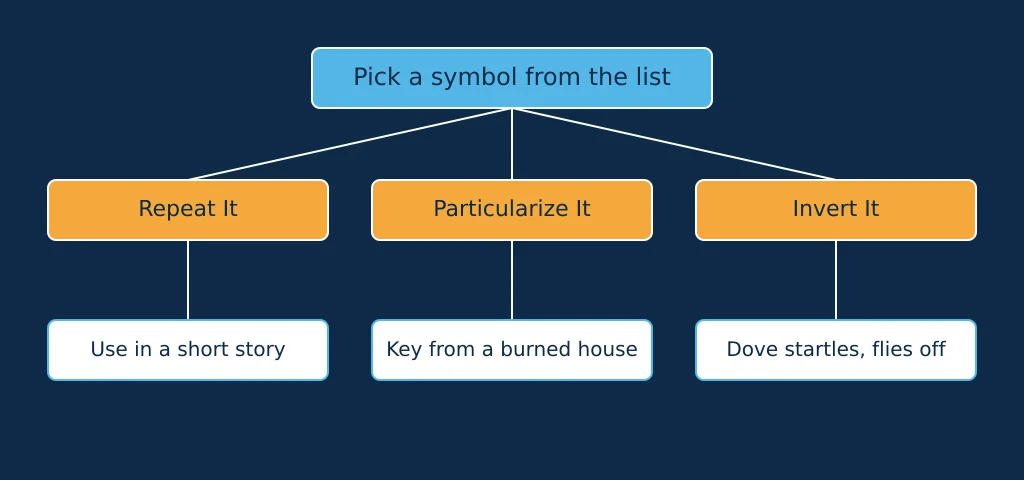
Pick One Symbol From the List and Particularize It Tonight
Open your draft and find the scene where you first suspected an object should "mean something." Pull the closest match from the list above, then name one specific detail, a character's habit, a family history, a physical flaw, that ties the object to nobody else's story but this one. Mark two or three places later in the manuscript where it can recur without you forcing it back into view. That's the whole exercise: one symbol, one particularizing detail, a couple of planned returns. For the technique that carries a symbol on the page, see imagery in fiction, and for the rest of the toolkit around it, the site's guide to literary devices is the next stop.
Symbolism FAQ
What is an example of symbolism?
A lit candle burning down over the course of a chapter, standing in for time a character doesn't have much of left, is a simple one. Check the big list above for entries sorted by category, so you don't have to read a full essay to find one that fits your scene.
What is the meaning of symbolism?
Symbolism means using a concrete thing, an object, a color, a creature, to represent an idea beyond its literal function, letting a reader infer the deeper meaning from repetition and context.
What are 5 examples of symbols?
Water for change, a mirror for self-perception, a crow for an omen, the color red for passion or danger, and a key for opportunity all show up in the list above, each with a note on how to make it specific to your own story.
What are some real-life examples of symbolism?
Symbolism isn't limited to fiction. A red octagon means stop before anyone reads the word printed on it. A white flag signals surrender across languages that don't share a single word in common. A wedding ring, a national flag, a road sign: all of them work the same way a literary symbol does, letting an object carry a meaning a reader or viewer already knows without needing it explained. Fiction borrows the same shortcut, mostly to save a paragraph of explanation.