How to Use the Writing Prompt Generator
Choose a prompt type and a genre, then press Get a prompt. Each press gives you one prompt, and Another prompt under the result does the same without scrolling back up. Leave both menus on “Any” and it works as a random writing prompt generator, drawing from all 406 prompts at once.
Every prompt was written by hand for this page. None of them comes back until you have seen twenty others, so you can keep pressing until something catches. When one does, press Copy and paste it into your document, or just start writing.
The word goal sets how long the piece should be: 100, 500, 1,000 or 2,000 words. The 10-minute sprint is a timer for the first draft. Start it, write until it stops, then type how many words you wrote. The generator works out your pace and, if you set a goal, how many more sprints the piece will take.
Types of Writing Prompts
A prompt works by making one decision for you, so you can spend your attention on the rest. The seven types decide different things.
Story Prompts
A story premise gives you a character, a situation and the problem that starts the story, for example: A court interpreter realizes the witness is lying, and the only way to expose him is to admit she has been mistranslating him on purpose. Your job is everything after that sentence. A premise is the closest thing here to the inciting incident of a full book, so it is the best type to try when you are looking for an idea that could grow.
First Line Prompts
A first line prompt hands you the opening sentence and nothing else: “There are two ways to leave Carver’s Point, and my brother tried both.” The voice, the narrator and the story are yours. First lines are the fastest way to start writing, because the blank page is already gone.
Dialogue Prompts
Dialogue prompts give you a line to use or a conversation to write, such as “I’ll give you one minute to explain, starting now.” Write the minute. They train you to move a scene forward through what people say and what they avoid saying. If you are unsure about quotation marks and tags, the guide on how to format dialogue covers the rules.
Character Prompts
A character situation puts a person under pressure and makes them choose: A character learns that their worst mistake saved someone’s life. The prompt does not tell you who the character is. Deciding that is the exercise, and lists of character flaws and character archetypes help if you want a starting point.
Setting Prompts
Setting prompts give you a place with something already wrong in it, like a desert rest stop where two cars have broken down at the same time. The aim is a scene where the place changes what the characters can do. The setting of a story guide goes deeper into building a place readers believe.
“What If” Prompts
“What if” prompts ask a question and leave the answer to you: What if a will left everything to a person no one in the family had ever heard of? They suit writers who like to start from an idea and find the characters later, and they are the type most likely to grow into a full plot.
Constraint Challenges
A constraint challenge sets a rule for the writing itself: Tell a whole story in five sentences, each exactly ten words long. Rules like this push you away from your usual habits, which is why they work well as a warm-up even when you have a book in progress.
Creative Writing Prompts by Genre
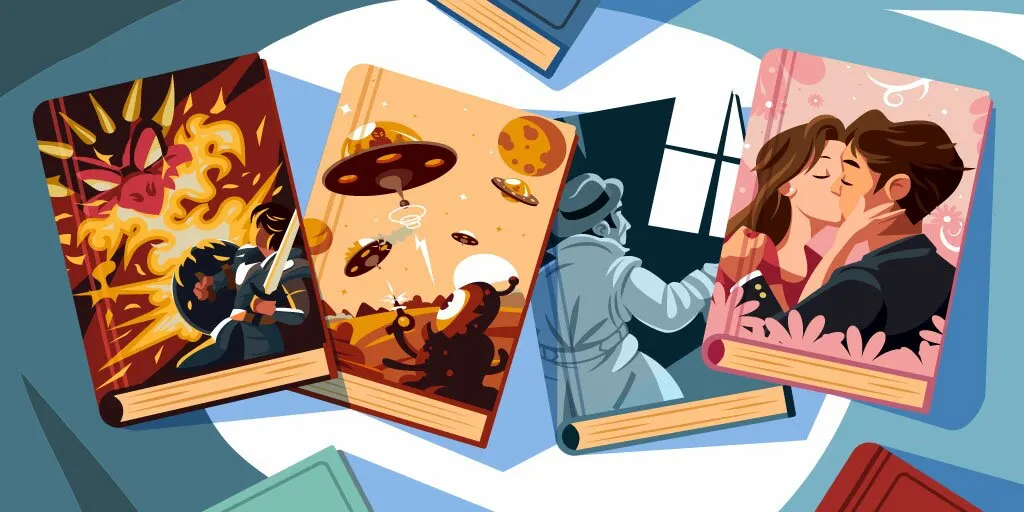
Each type has a set of prompts that work in any genre and a set written for each of seven genres. When you pick a genre, its own prompts come up more often, mixed with the ones that fit anywhere. A few examples from each:
- Fantasy writing prompts: A court mapmaker learns that every border she draws becomes real overnight, and the king wants a new map by morning. Or: What if fairy bargains were enforced by an ordinary court, and your character was a very tired lawyer?
- Science fiction: The first message from another civilization arrives, and it is a polite request to stop broadcasting. Or the first line “The ship’s computer apologized before it told us, which was how we knew it was bad.”
- Romance writing prompts: Two wedding planners are hired for the same wedding by different halves of the couple, and neither will back down. Or the constraint: Write a declaration of love without the word “love”.
- Mystery: A hotel guest reports a theft, but nothing is missing from her room. Something has been added.
- Horror: The search party came back with one more person than it left with, and no one could say which one was new.
- Literary fiction: Two sisters clear out their childhood home and argue over the only object either of them wants: a cheap kitchen clock.
- Historical fiction: During the London Blitz, a museum curator has one night to decide which three objects to save.
Genre prompts lean on what readers of that genre expect: a fake relationship in romance, a locked compartment in a mystery, a house with rules in horror. That is deliberate. Writing inside the shapes your readers already love, and then bending them, is a large part of writing for a genre. If you are still deciding which one is yours, try the same prompt type in three genres and see which draft you want to keep.
How to Turn a Writing Prompt Into a Story
A prompt is a starting point. The draft becomes a story once you add the parts the prompt leaves out.
- Find who wants what. Every prompt hides a character with a goal. Name the goal in one sentence, then name what stands in the way. That obstacle is your conflict, and without it a prompt stays a situation.
- Change one thing. If the prompt feels close but not quite yours, change the place, the age of the character or the relationship between the people in it. A setting prompt set in a laundromat works just as well on a fishing boat.
- Start late. Begin as close to the moment of change as you can. The advice in how to start a story applies to a 500-word exercise as much as to a novel.
- Give the character a body. Small gestures carry more than description. A list of character mannerisms is useful when everyone in your draft just nods and sighs. If the character needs a name, the character name generator has names by genre.
- Write the ending you did not plan. Prompts are low-stakes. Let the draft surprise you, then decide later what to keep.
Some prompts turn out to be bigger than a scene. When that happens, the guide on how to outline a book and the overview of story structures help you work out whether the idea can carry a novel.
Word Goals and the 10-Minute Sprint
The word goal decides the shape of the piece. A 100-word story is called a drabble, and the tight limit forces you to cut everything that is not the point. At 500 words you have room for one full scene. At 1,000 to 2,000 words you can write a complete short story with a turn and an ending. For reference, the Science Fiction and Fantasy Writers Association counts any story under 7,500 words as a short story in its Nebula Awards rules, so every goal here is well inside short-story length.
The sprint timer runs for ten minutes. The point is to draft without stopping to fix sentences; editing comes later, with fresh eyes. When the timer ends, type your word count into the box and the tool shows your pace. If you wrote 250 words, that is 25 words a minute, and with a 1,000-word goal the tool tells you the remaining 750 words take about 3 more sprints. You can pause and resume, and if you stop early, the pace is worked out from the minutes you actually wrote.
The same arithmetic works for a book. Once you know your pace, the words to pages calculator shows what a word count looks like as a manuscript or a printed paperback.
Using Writing Prompts When You Are Writing a Book
Prompts are just as useful in the middle of a long project, when the idea is settled and the writing is what stalls.
- As a warm-up. One sprint on an unrelated prompt before you open your manuscript gets the writing going without the pressure of the real chapter.
- To get past a stuck scene. Apply a constraint challenge to the scene you are avoiding: write it as pure dialogue, or from the point of view of an object in the room. Even if none of it survives, you will know the scene better.
- To explore a character. Put one of your own characters into a character situation prompt that has nothing to do with the plot. How they behave there tells you how they will behave in the book.
- To test a voice. Run the same first line prompt in two narrators and keep the one that sounds like your book.
When the book is done, the book title generator and the pen name generator help with what goes on the cover.
Writing Prompt Generator FAQ
Is this a random writing prompt generator?
Yes, if you want it to be. With the type set to “Any type” and the genre to “Any genre”, every press picks at random from all 406 prompts. Narrow either menu when you want a particular kind of prompt.
Will I see the same prompt twice?
Not within twenty prompts. Every combination of type and genre has at least 22 prompts to draw from, and the generator remembers the last twenty it showed you while the page is open.
Can I publish a story I wrote from one of these prompts?
Yes. The prompts are free to use, including for work you publish or sell, and you do not need to credit this page. In the United States, ideas are not protected by copyright, and neither are titles and short phrases, as the US Copyright Office explains in Circular 33. What you write from a prompt is your own work.
How long should a response to a writing prompt be?
As long as the idea needs. If you are not sure, set a word goal: 100 words for a quick exercise, 500 for a scene, 1,000 to 2,000 for a short story with a beginning, middle and end.
Do writing prompts help with writer’s block?
They help with one common kind of it: not knowing what to write next. A prompt makes that decision for you, and a ten-minute limit keeps the stakes low enough to start. If you are stuck on a specific chapter, a constraint challenge applied to that chapter is usually more useful than a new idea.
Is the writing prompt generator free?
Yes. It runs in your browser, needs no account, and nothing you type is sent anywhere.