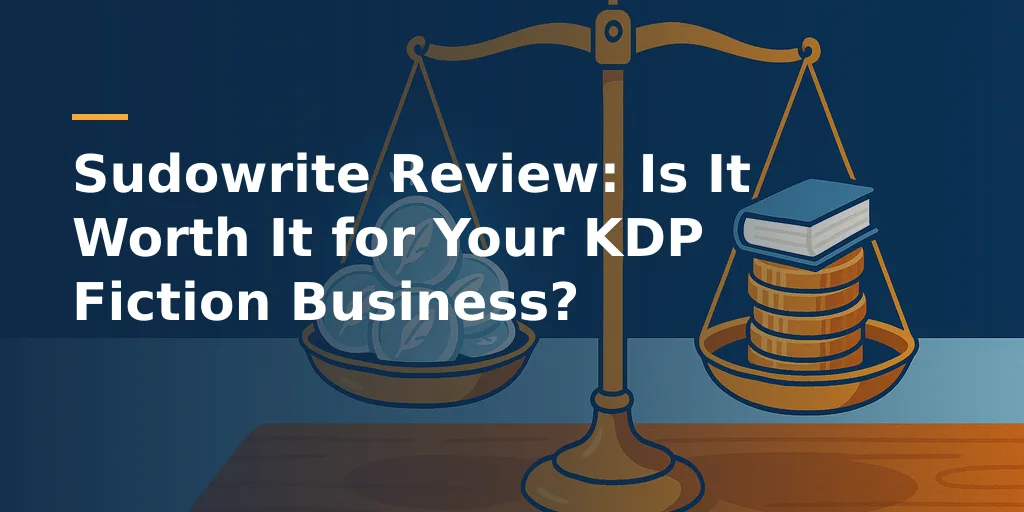
Sudowrite is an AI writing tool built specifically for fiction. It generates prose, expands scenes, brainstorms plot ideas, and includes a dedicated story-context feature, all inside a browser app built for novelists. Whether it's worth paying for is a business question, not a taste question: does the time it saves you turn into more books, more royalties, or more Kindle Unlimited page reads than the subscription costs? For an author who drafts fast or publishes often in KU, the answer usually tips yes. For someone publishing low content books with no prose at all, it's a flat no. This Sudowrite review works out where your own output actually lands.
The Quick Answer: Is Sudowrite Worth It?
Sudowrite earns its subscription for fiction authors whose drafting speed or publishing frequency outpaces a mid-tier plan's monthly cost. That's mostly Kindle Unlimited authors turning out a novel every few months, where extra output converts directly into page reads. Low content and no content publishers have no manuscript for a prose tool to touch. A slow, one-book-a-year writer faces a genuinely marginal call: the annual subscription cost still has to clear real royalties from a single title's sales, not just faster drafting. The section below with the actual numbers walks through why, using three illustrative author profiles checked against royalty and KENP math.
What Sudowrite Actually Does: The Core Writing Tools
Before the pricing and the math make any sense, here's what you're actually paying credits for. Sudowrite splits into six named tools. Each one is aimed at a different point where a draft stalls. Here's what each does, in Sudowrite's own terms.
- Write: generates the next stretch of prose from what you've already written, matching tone and pacing to the surrounding text.
- Describe: takes a line or a noun and returns sensory alternatives, a way to punch up a flat description without leaving the page.
- Expand: takes a compressed passage and stretches it, useful when a scene needs more room to breathe or more beats before the turn.
- Brainstorm: generates a list of ideas for a plot problem, a name, a twist, or a piece of worldbuilding.
- Story Bible: Sudowrite's feature for holding story-level information alongside the draft; check Sudowrite's own documentation for what it covers.
- Canvas: a visual workspace for laying out and rearranging story elements outside the linear manuscript view, closer to a corkboard than a document.
Sudowrite Pricing: Plans, Credits, and What They Cost You
Sudowrite runs on a credit system spread across three tiers. Per Sudowrite's own plan documentation, Hobby & Student costs $10/mo paid annually or $19/mo paid monthly for 225,000 credits, Professional costs $22/mo paid annually or $29/mo paid monthly for 1,000,000 credits, and Max costs $44/mo paid annually or $59/mo paid monthly for 2,000,000 rollover credits. Credits get consumed each time you run a generative tool, and exactly how many a given task costs varies. The practical move is to match your monthly output to a tier's ceiling and watch your own usage dashboard for the first month before you commit to anything higher.
| Plan | Monthly price | Annual price | Credits per month | Best for |
|---|---|---|---|---|
| Hobby & Student | $19/mo | $10/mo (billed yearly) | 225,000 | A first draft or two a year, testing the tool |
| Professional | $29/mo | $22/mo (billed yearly) | 1,000,000 | Series writers publishing several titles a year |
| Max | $59/mo | $44/mo (billed yearly) | 2,000,000 (rollover) | High-output authors or small teams drafting continuously |
Is Sudowrite Actually Good? Where It Helps and Where It Falls Short
"Good" depends on what you're asking it to do. Judged against the job it's built for, generating and reshaping fiction prose, the design choices hold up. Judged as a replacement for editing, or as a fit for every KDP business model, it doesn't.
Where Sudowrite Helps
- Built specifically for fiction, its tools target scene-level tasks such as pacing, description, and dialogue in a way a general chatbot prompt isn't structured around.
- Write extends a scene in the voice already on the page, so the result reads like more of your draft rather than a generic continuation you'd have to rewrite from scratch.
- Describe and Expand handle the two most common stalls in a scene: a description that reads flat, and pacing that moves too fast. Both return usable prose, not a bare list of suggestions.
- Brainstorm turns a stuck plot point into several concrete options you pick from and rewrite in your own voice, instead of one answer you'd have to accept as is.
Where It Falls Short
- Credit use varies by feature and model, and it can add up quickly if you're regenerating the same scene several times looking for the right version.
- It produces raw material you still need to edit, revise, and shape into your own voice before it becomes a finished draft.
- The subscription recurs whether you're actively drafting that month or not. An editing-heavy month still bills you for credit capacity you won't touch.
- Its fiction focus gives it nothing to offer a nonfiction manuscript or a low content and no content books business, where there's no prose for it to work on at all.
Can You Legally Publish a Sudowrite-Assisted Book on KDP?
Yes. Drafting a book with Sudowrite's help doesn't stop you from publishing it on Amazon KDP. What matters is how you declare the AI's role when you upload, and that declaration gets checked at upload.
KDP's AI Content Disclosure Rule
Amazon's content guidelines distinguish AI-generated work from AI-assisted work, and its disclosure expectations for each have changed before. Open KDP's current Content Guidelines from your own dashboard and read the disclosure section fresh before you publish. What a review said about this last year, or even last month, may already be out of date. Check it yourself, every time, before you hit publish.
Does Sudowrite Pay for Itself? Running the Credits Against Your Royalty and KENP Math
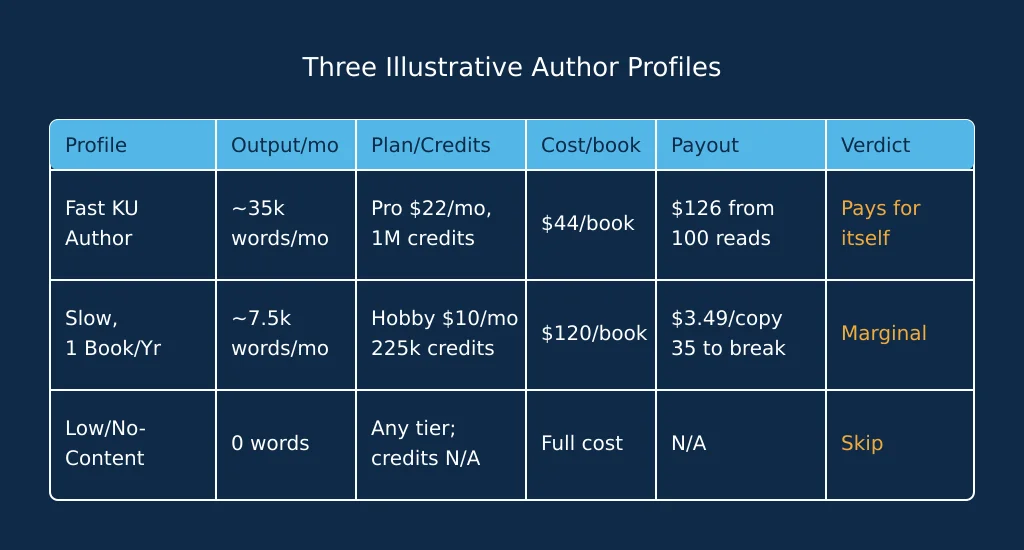
Here's where the subscription cost meets an actual KDP income stream. The table below builds three illustrative author profiles from stated inputs: a monthly output pace, a plan tier, and an example royalty or KENP figure, worked out using BookBird's own royalty and KENP formulas at a stated price and page count. Every number in it is an illustration built from those inputs, not a forecast of your own sales.
Three Illustrative Author Profiles
The royalty side anchors on the 70% ebook royalty tier throughout, since it's the tier most authors land in and the easiest to check yourself; anyone still working out how to price a book will sit there for most ebook price points anyway. The figure below also ignores KDP's per-megabyte delivery fee, which trims a few cents off each 70% sale. Run your own numbers through the royalty calculator for a figure that accounts for it. The KENP side treats its per-page rate as an assumption, not a fact: at an assumed $0.0045 per page, third-party trackers report the rate drifting between roughly $0.0042 and $0.0050 month to month, so check your own KDP dashboard for the current figure before you rely on it. Plan costs come from the pricing table above.
| Profile | Monthly output | Plan & credits | Subscription cost per book | Illustrative royalty/KENP payout | Verdict |
|---|---|---|---|---|---|
| Fast-drafting KU fiction author | ~35,000 words (a 70k-word novel every two months, enrolled in KDP Select) | Professional, $22/mo annual, 1,000,000 credits | $44/book ($22 × 12 ÷ 6 books/year) | ≈$126 from just 100 full read-throughs in the first month (280 pages × $0.0045 × 100) | Pays for itself many times over |
| Slow one-book-a-year author | ~7,500 words/month (one 90k-word novel/year, not enrolled in KU) | Hobby & Student, $10/mo annual, 225,000 credits | $120/book ($10 × 12 ÷ 1 book) | ≈$3.49/copy at 70% royalty on a $4.99 ebook, before delivery fees; roughly 35 copies clears the cost | Marginal, depends on real sales |
| Low/no-content publisher | 0 words of prose (journal or planner interiors only) | Any tier: credits don't apply to the product | Full subscription price, unrecovered | N/A: no prose task exists to offset | Skip |
What the Numbers Say
The pattern holds across all three rows. Fast output or frequent KU publishing turns a subscription into pocket change against the payout. A single book a year makes the subscription a real cost that depends entirely on whether that one book sells. No prose means no reason to pay at all. Rerun this with your own price point, page count, and sales pace using the KDP royalty calculator and the KENP calculator before deciding.
Which KDP Authors Should Buy Sudowrite (and Which Shouldn't)
The table above turns into a plain decision rule once you sort authors by pace rather than genre.
- The fast-drafting KU fiction author: buy. Publishing several novels a year in Kindle Unlimited means every day Sudowrite saves turns into another book earning page reads sooner; a Professional or Max tier is the one to pick.
- The slow, one-book-a-year author: marginal. One manuscript a year puts the full weight on real royalties from real sales. Faster drafting alone won't cover a subscription that a single book has to earn back.
- The low- or no-content publisher: skip. If your KDP business runs on low content and no content books, there's no prose manuscript for Sudowrite's tools to touch.
- The hybrid author who edits more than drafts: lower tier or skip. If you already have full drafts and mostly need line-level punch-up or pacing fixes, the Hobby & Student allowance may cover you without ever touching Professional pricing.
Sudowrite vs. ChatGPT vs. Plotting Software: Which Fits Your Stage
"Best AI for book writers" isn't one tool. It's whichever tool matches the stage your manuscript is actually at.
| Tool | Best for | Story-consistency features | Cost approach | Verdict per situation |
|---|---|---|---|---|
| Sudowrite | Drafting and expanding fiction prose scene by scene | Has a dedicated story-context feature; ChatGPT does not. | Credit-based subscription tiers | Best once you're actively drafting sentences |
| ChatGPT | General brainstorming, research, and open-ended discussion of your plot | None built for fiction specifically; you carry the story details in the conversation | General-purpose subscription unrelated to word count generated | Best for flexible conversation outside a fiction-specific workflow |
| Plotting software (see the Plottr review) | Mapping structure, timelines, and character arcs before you draft | Purpose-built for holding structure visible across a whole series | Priced separately from any AI writing subscription | Best before you draft, when the problem is structure and not sentences |
Test the Math Against Your Own Draft Pace Before You Subscribe
Everything in the payoff table above is illustrative. Your price point isn't necessarily $4.99, your KENP rate isn't fixed at $0.0045, and your draft pace almost certainly isn't exactly 35,000 words a month. Swap in your own numbers before you commit to a tier.
Start with the price and page count you've actually chosen, or expect to choose, and run them through the royalty and KENP calculators linked above. If the payout clears a plan's monthly or annual cost with room to spare, the subscription is an easy yes. If it barely clears it, or doesn't, that's the marginal territory the slow one-book-a-year profile sits in. No amount of good prose from the tool changes that arithmetic.
Sudowrite FAQ
Is Sudowrite actually good?
For the specific job it's built for, yes: stretching a thin scene or punching up a flat description in the voice you've already established. It's not a shortcut to a finished manuscript, and it has nothing to offer a nonfiction or low content project.
Can I legally write a book with AI?
Yes. Using a tool like Sudowrite doesn't stop you from publishing on KDP. What you owe Amazon is accurate disclosure under its current Content Guidelines, which change more often than any review can track, so read them fresh before you upload.
How much is Sudowrite per month?
$10 a month on the cheapest annual plan up to $59 a month for the priciest monthly Max tier, with a Professional tier in between.
What is the best AI for book writers?
There isn't one tool that wins for every stage. Sudowrite fits the sentence-level work of drafting and expanding fiction. A general tool like ChatGPT fits broader brainstorming and research. Plotting software fits structure before you draft a word. Which one deserves a subscription depends on where your manuscript actually is.