What Personification Actually Does to a Sentence
If you're stuck on a storm scene, a ticking clock, or a car that won't start, you don't need a lecture on rhetorical devices. You need personification examples you can lift straight into a sentence and adjust. Personification means giving a human quality or characteristic to something that isn't human, per Cambridge Dictionary's definition: the wind gets a temper, a clock gets patience, a house gets a memory. Done well, it gives a flat sentence energy, sets the mood in one line, and hands a non-human thing a point of view your scene can follow. Find the category that matches your scene, take a line, and swap in your own noun.
How to Find Your Category (Before You Scroll)
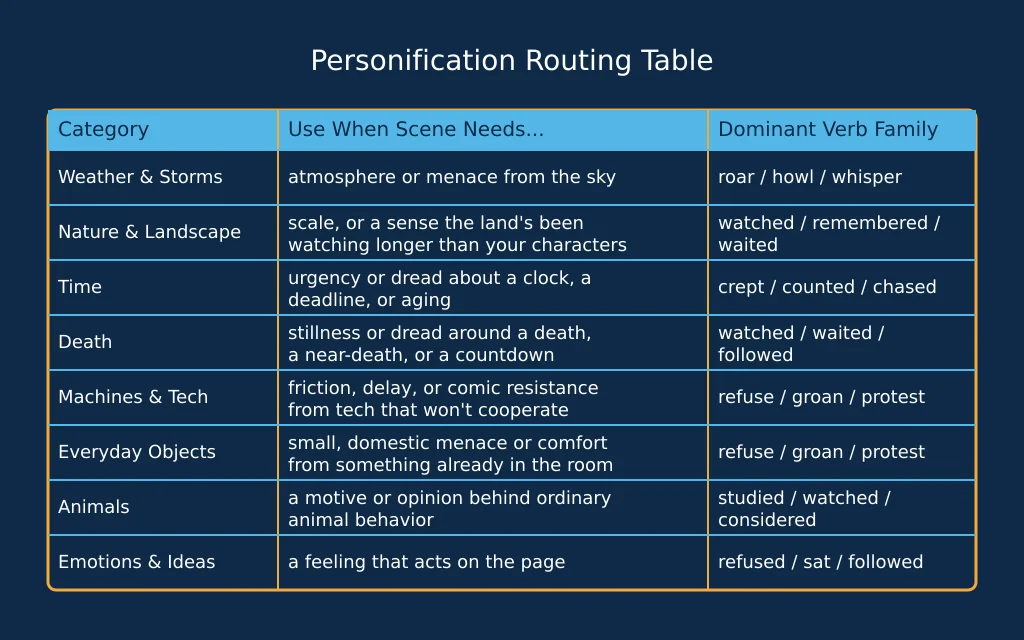
There's no single type of personification that fits every scene. The table below sorts by subject: weather, nature, time, death, machines, objects, animals, and emotion, then points to the verb family that shows up most often in the lines beneath it. That tally isn't a study of personification across published fiction; it's a hand count of the verbs used across the 65 constructed lines in the eight sections below. Three more lines are personification examples in literature, real quotes from Shakespeare and Dickinson, and each one sits as the closing entry in its category.
| Category | Use this when your scene needs... | Dominant verb family |
|---|---|---|
| Weather & Storms | atmosphere or menace from the sky | roar / howl / whisper |
| Nature & Landscape | scale, or a sense the land's been watching longer than your characters | watched / remembered / argued |
| Time | urgency or dread about a clock, a deadline, or aging | crept / counted / chased |
| Death | stillness or dread around a death, a near-death, or a countdown | watched / waited / followed |
| Machines & Technology | friction, delay, or comic resistance from tech that won't cooperate | refuse / groan / protest |
| Everyday Objects | small, domestic menace or comfort from something already in the room | refuse / remember / watch |
| Animals | a motive or opinion behind ordinary animal behavior | studied / watched / considered |
| Emotions & Abstract Ideas | a feeling that acts on the page | refused / sat / followed |
Reach for the Machines or Objects entries when a scene needs friction or delay, since refuse, groan, and protest do that work on their own. Reach for the Death or Nature entries when a scene needs stillness or dread: watched, waited, and remembered carry that weight there. Weather leans toward noise and menace instead, with roar and howl doing most of the work. Two caveats go with the table. It counts only the verbs in this article's own lines, so treat it as a place to start when you're hunting for a verb. And the same verb shifts with context: watched reads as menace in a Death line and as indifference in a Nature line. The table narrows the shelf; it doesn't pick the book. If your scene needs more than a single line of atmosphere, pair whatever you pick here with the notes on building imagery readers can see, hear and feel.
Weather & Storms
Personified weather does half the atmospheric work for you if you give it a temper. These nine personification examples cover wind, rain, fog, heat, and thunder with a mood already built in, so the paragraph around them can stay short.
- The Wind's Temper: The wind howled around the chimney, furious that the house wouldn't let it in.
- The Storm's Threat: The storm growled over the ridge, promising something worse before dawn.
- The Rain's Whisper: Rain whispered against the window long after everyone else had gone quiet.
- The Gale's Roar: The gale roared down the valley and tore the washing line clean off the fence.
- The Fog's Creep: Fog crept along the harbor. It hid the boats one at a time.
- The Thunder's Warning: Thunder muttered in the distance, clearing its throat before it really got started.
- The Snow's Hush: Snow hushed the whole street, laying a hand over every sound.
- The Heat's Grip: The afternoon heat pressed on the porch and wouldn't let anyone move.
- Shakespeare's Storm: In King Lear, Lear shouts orders at the storm as if it could hear him: "Blow, winds, and crack your cheeks! Rage! blow!" The storm becomes something furious enough to argue with.
Nature & Landscape
Land doesn't need a drone shot describing it if it can behave like it's paying attention. These nine personification examples use mountains, rivers, forests, and the sea to give a setting its own attitude toward the people passing through it.
- The Mountain's Indifference: The mountain had watched three generations come and go without bothering to comment.
- The River's Argument: The river argued with every rock in its path and never once lost.
- The Forest's Memory: The old forest remembered every fire that had tried to take it.
- The Sea's Mood: The sea sulked under a flat grey sky, refusing to show anyone its color.
- The Valley's Welcome: The valley opened its arms the moment the road dropped down off the ridge, wide and warm and impossible to resist.
- The Cliff's Warning: The cliff leaned out over the water like it dared anyone closer.
- The Meadow's Laziness: The meadow stretched out lazily in the sun, in no hurry to be crossed.
- The Lake's Secret: The lake kept its bottom to itself and gave nothing away in the daylight.
- The Trail's Hiding: The trail hid under the season's first snow and stayed hidden for months.
Time
A ticking clock is a cliché until personification makes it act like it wants something. These eight examples give minutes, deadlines, and calendars a motive, and the pressure in the scene follows from what the clock does.
- The Clock's Countdown: The clock counted down the last minutes of the meeting like it enjoyed the tension.
- The Deadline's Chase: The deadline chased her through every hallway in the building, always one step behind.
- The Hourglass's Spite: The hourglass ran out on her at the worst possible moment, as if it had planned the timing.
- Time's Theft: Time had already taken the best years and showed no interest in giving them back.
- The Calendar's Stare: The calendar stared back at him, unimpressed by another missed page.
- The Morning's Arrival: Morning arrived early and uninvited, pulling the curtains open before anyone asked it to.
- The Minutes' Retreat: The minutes crept away one at a time, refusing to be held onto.
- Shakespeare's Time: Sonnet 19 speaks to time directly, as a devourer that can blunt even a lion's paws: "Devouring Time blunt thou the lion's paws."
Death
Death shows up in a lot of manuscripts as an event. Personification gives it habits and a timing of its own, which suits scenes with a death, a near-death, or a countdown toward one. These seven examples show what that presence can sound like.
- Death's Patience: Death waited by the hospital door, unhurried, certain she'd come to him eventually.
- Death's Company: Death sat at the back of the room through every visiting hour and never once spoke.
- Death's Attention: For three days Death watched the intersection from the corner before anyone noticed him there.
- Death's Habit: Death followed the old man home from the hospital like an unpaid debt.
- Death's Offer: Death held the door open and let her decide how slowly she wanted to walk through it.
- Death's Silence: At the funeral Death said nothing, which was somehow worse than if he had spoken.
- Dickinson's Carriage: Emily Dickinson's poem opens with Death as a courteous escort: "Because I could not stop for Death, He kindly stopped for me; The carriage held but just ourselves And Immortality."
If Death keeps recurring as a character in your draft rather than a one-line image, the symbolism guide is the next stop for what that presence should mean elsewhere in the manuscript.
Machines & Technology
Machines already seem to have opinions about you half the time, which makes them especially easy to personify. These eight lines give cars, printers, and phones a grudge, so a scene gets its comedy or its friction from an object that won't cooperate.
- The Car's Refusal: The car refused to start, coughing twice out of pure spite before it gave up completely.
- The Printer's Protest: The printer groaned through the first page and jammed on principle at the second.
- The Laptop's Grudge: The laptop remembered every unsaved file and made her pay for it at the worst moment.
- The Phone's Impatience: Her phone buzzed and buzzed, demanding attention like a toddler denied a snack.
- The Router's Sulk: The router sulked in the corner and dropped the signal every time it mattered most.
- The Elevator's Reluctance: The elevator groaned its way up four floors like it was doing everyone a personal favor.
- The Alarm's Insistence: The alarm refused to be ignored, screaming until someone finally got up.
- The Engine's Complaint: The engine protested the whole way up the hill, threatening to quit before the summit.
Everyday Objects
Objects don't need to move to feel alive on the page; these nine lines give doors, keys, and old furniture a mood of their own, for scenes where something small in the room needs to carry weight without a line of dialogue.
- The Door's Reluctance: The door groaned on its hinges and only let her through halfway before catching on the frame.
- The Key's Refusal: The key refused to turn until she asked it nicely a second time.
- The Book's Wait: The book sat on the shelf for years, waiting for someone to finally open it.
- The Bell's Complaint: The bell protested every time the wind caught it, a thin, tired sound against the cold.
- The Chair's Memory: The old armchair remembered him. Long after he'd stopped sitting in it, the shape of him stayed pressed into the cushion.
- The Window's Watch: The window watched the street all night and told no one what it saw.
- The Curtain's Sigh: The curtain sighed shut against the draft, tired of its argument with the door.
- The Lamp's Stubbornness: The lamp flickered its objections before finally agreeing to stay lit.
- The Mirror's Judgment: The mirror gave nothing away, holding its opinion the way old mirrors do.
Animals
Animals already act with intent, which makes personification easy to overdo. These eight examples push past ordinary animal behavior into something with a motive or an opinion attached, useful for a pet, a working animal, or wildlife that needs to feel like it's judging the humans around it.
- The Cat's Verdict: The cat studied him from the windowsill and clearly found him lacking.
- The Dog's Loyalty: The old dog forgave him before he'd even finished apologizing.
- The Crow's Opinion: The crow on the fence watched the whole argument like it was taking notes.
- The Horse's Tolerance: The horse tolerated the new rider for exactly one lap before deciding otherwise.
- The Spider's Plan: The spider rebuilt the web overnight, undeterred by yesterday's broom.
- The Owl's Verdict: The owl blinked once, unimpressed, and went back to ignoring the porch light.
- The Goldfish's Boredom: The goldfish circled the same six inches of tank, bored of the whole arrangement.
- The Fox's Decision: The fox considered the henhouse and weighed its odds. It decided to wait until dark.
Emotions & Abstract Ideas
Fear, hope, and grief already feel like forces bigger than the person having them, which is exactly why personified emotions are some of the easiest lines to write and the easiest to overwrite. These ten treat a feeling as a character with habits, so the emotion acts instead of getting explained in the line right after it.
- Fear's Arrival: Fear walked in without knocking and took the seat closest to the door.
- Hope's Stubbornness: Every reasonable argument told hope to leave. It refused.
- Grief's Weight: Grief sat on his chest every morning before he'd even opened his eyes.
- Love's Patience: Love waited by the phone longer than it should have, and answered anyway.
- Silence's Grip: Silence filled the kitchen. It held on until someone finally broke it.
- Anger's Habit: At every family dinner, anger showed up first and stayed the longest.
- Doubt's Whisper: Doubt leaned in close and asked the same question three times.
- Jealousy's Appetite: Jealousy fed on every text he didn't answer fast enough.
- Guilt's Company: Guilt followed her out of the building and sat down next to her on the bus.
- Curiosity's Tug: Curiosity tugged at her sleeve the entire drive home, refusing to wait for morning.
Using Personification Without Overusing It
Personification earns its place in a draft when it does a job description can't do as fast: giving a reader a feeling about something before you've told them what to feel. It turns into a problem the moment it does the character's emotional work for them. Here's roughly where the line sits.
Pros: When Personification Earns Its Place
Three moments where it pays for itself:
- It compresses mood into one line, so a storm, a clock, or a hallway can set the emotional temperature without a paragraph of description around it.
- It gives a reader a quick, physical sense of an abstract force. Grief that sits on a character's chest lands faster than a sentence explaining what grief feels like.
- It keeps a non-human element consistent across a scene. A car with a "grudge" can misbehave the same way three times running and it reads as character, not coincidence.
Cons: When It Starts to Feel Cute
Three signs it's tipping over:
- Some pairings are worn smooth by overuse. Time as a thief and Death as a patient visitor both still work, but they need a fresh verb or they read as filler.
- It can substitute for the actual emotional beat. If a character's fear is doing all the acting, the character might not be feeling anything on the page at all.
- Stack more than one or two personified things in a paragraph and the prose turns twee, edging toward the overwrought description covered in the guide on avoiding purple prose, where every object in a room has a personality and the actual scene gets lost underneath.
Personification vs. Anthropomorphism, Quickly
The two get mixed up because both give something non-human a human trait, but the real test is whether the thing becomes an actual character. A line like "the wind screamed against the shutters" is personification only: it's a device inside a sentence, not a character in your story. A talking teapot with a name, opinions, and a full arc across a picture book is anthropomorphism, because the object stops borrowing a human trait for one sentence and becomes a character in its own right. Some scenes do both. A car that "refuses" to start in a single line is personification, but if that same car develops a personality your characters argue with by name across a whole chapter, it has crossed into anthropomorphism too. Metaphor is a close cousin worth separating out here: it draws a direct comparison, while personification stays inside a single human-trait swap. The metaphor examples organized by what you're trying to say guide keeps the two apart with examples of its own. Personification itself sits inside the wider set of tools in the figurative language examples guide, next to metaphor, simile, and the rest.
Take One Line and Push It Further
Pick one line from whichever category matches your scene, then rebuild it with your own noun and verb before it goes anywhere near your manuscript. Start from the machine entry above: "The car refused to start, coughing twice out of pure spite before it gave up completely." Swap the subject for whatever's giving you trouble in your draft. Say it's a zipper: "The zipper refused to budge, catching twice out of pure spite before it gave up completely." Same structure, same verb, a completely different object. Run the result past the cons above before you keep it. Does it replace a beat your character should be feeling, or does it set the scene faster than a paragraph of description would? If it's doing the second job, keep it. For where personification sits next to its neighbors, the 154 literary devices reference covers the rest.
Personification, Answered
Four quick follow-ups.
What is 3 personification?
Three quick ones, pulled straight from the categories above: "The wind howled around the chimney." "The clock counted down the last minutes of the meeting like it enjoyed the tension." "Fear walked in without knocking and took the seat closest to the door." Each gives a non-human thing a human action.
Can you give me some funny examples of personification?
The comic ones tend to come from machines and objects: petty, low-stakes resistance from things the reader already half-believes are out to get them. Try the printer that "groaned through the first page and jammed on principle at the second," or the lamp that "flickered its objections before finally agreeing to stay lit."
What is a good personification?
A good one uses a specific, physical verb attached to a feeling. "The sky looked angry" is weak; "the sky spat rain at the windshield" does the same job with an actual action attached. If you can picture the non-human thing doing the verb, it's probably working.
What are the 8 personifications?
If the question means the eight ways this list sorts its examples, they're weather and storms, nature and landscape, time, death, machines and technology, everyday objects, animals, and emotions and abstract ideas. That's this article's own structure for finding a usable line fast, not a fixed taxonomy of the device.