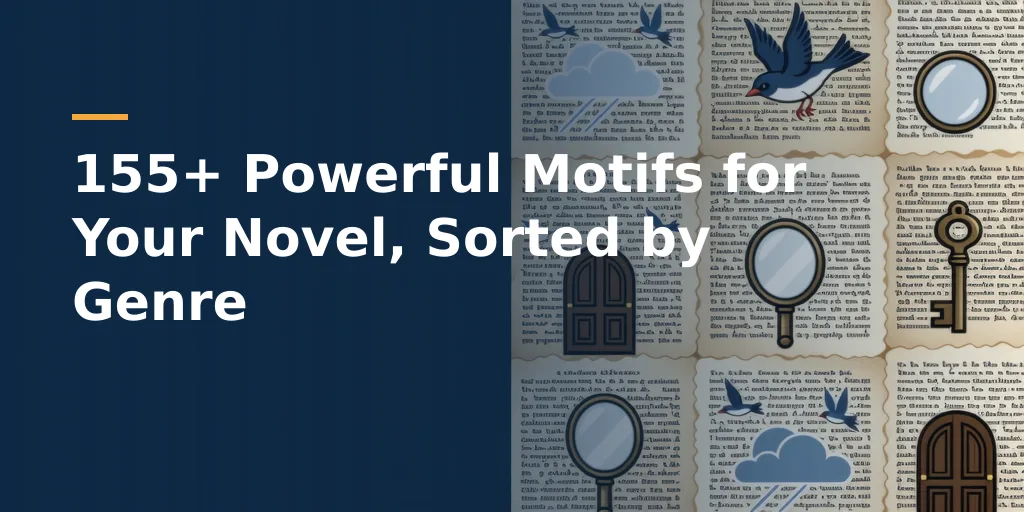
You have noticed the same object turning up in three chapters — a key, a bird, a burnt loaf of bread — and you want to know whether that is a tic or a technique. It is a technique. Motifs in literature are concrete elements that repeat across a story and pick up meaning as they go: an object, an image, an action, a phrase, a sound, a colour, a kind of weather. Below you get the definition, the motif vs symbol distinction, a three-question test that rejects candidates your book cannot support, and 167 motifs sorted by genre with the association each one already carries.
What Is a Motif? The 30-Second Version
The definition first, because everything below — the test, the lists, the placement advice — leans on it.
What Is a Motif in English and Literature?
A motif in literature is a recurring concrete element that returns at intervals and gathers meaning through the repetition. The definition does not change between an English lesson and your own manuscript. Two properties settle what is a motif and what is not: it has to be concrete, and it has to repeat. Blood is a motif; guilt is not. A stopped clock is a motif; mortality is not. It can take the form of an object, an image, an action, a sound or a line of dialogue — a repeated adage a character keeps reaching for works exactly this way.
Repetition is the whole mechanism. As a rule of thumb, an element needs about three appearances before a reader registers a pattern rather than a detail. Twice reads as coincidence. Three times, spaced across the book, and the reader starts carrying the element forward, expecting it, and reading each new appearance against the last.
Motifs sit alongside plot, character and setting in the standard elements of a story, but they behave differently from all three. Plot happens once. A motif keeps happening, and its job is to make the reader compare one part of your book with another.
What Is a Motif in Music and Visual Art?
Ask what is a motif in a music class and the answer shifts: there it is a short melodic, harmonic or rhythmic idea that recurs through a composition and can be varied, inverted or handed to another instrument. In visual art and design it is the single unit of ornament that tiles across wallpaper, textile or a border. Both senses share the literary logic of a small unit repeated and gaining weight, and everything from here on is about prose fiction.
Motif vs. Theme vs. Symbol: The Difference in One Table
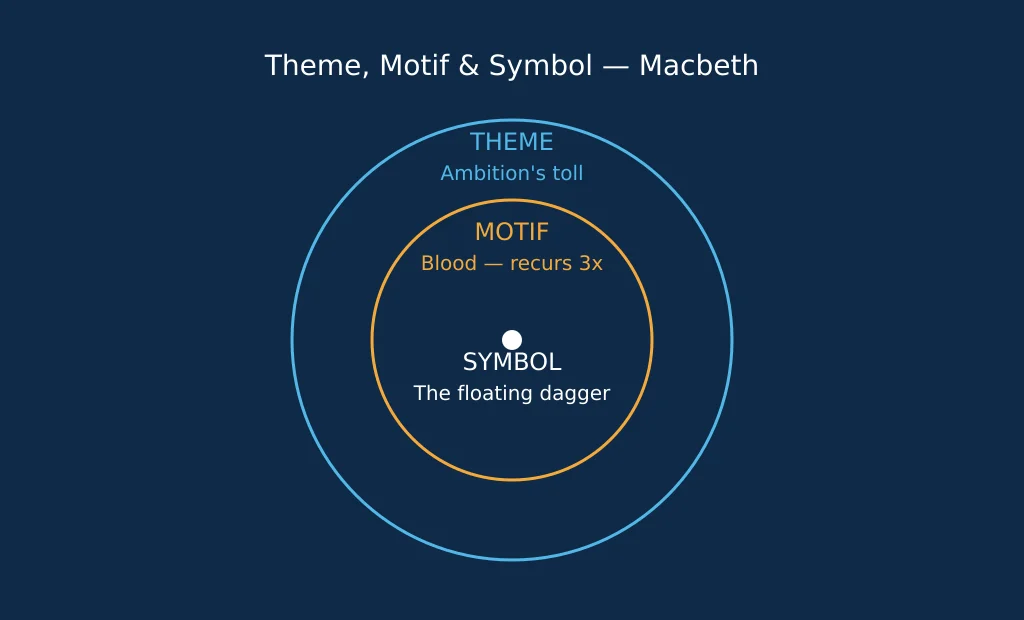
These three get used interchangeably in workshop notes and they are not interchangeable. Here they are inside a single work, Macbeth, so the contrast is visible rather than theoretical.
| Term | What it is | How often it appears | Example from Macbeth | What it does for the reader |
|---|---|---|---|---|
| Theme | An abstract idea the work keeps testing. Not an object, never fully stated | Present everywhere, visible nowhere in particular | What ambition does to the person who acts on it | Gives the reader something to argue with after the book closes |
| Motif | A concrete element that returns and changes meaning as it returns | Three times minimum, usually more, spread across the work | Blood — reported from the battlefield, on the murderers' hands, and still there in Lady Macbeth's sleepwalking | Builds a pattern the reader tracks without being instructed to |
| Symbol | A single thing that represents something larger than itself | Can work in one appearance | The floating dagger Macbeth sees before the murder | Compresses meaning into one image at one moment |
The motif vs symbol distinction comes down to repetition. A symbol represents something larger in one appearance and stays a symbol however loaded it is. The motif represents nothing on its own; it accumulates. Blood does not represent guilt the first time Shakespeare mentions it — that reading is built by the later appearances. And a theme is never a motif, because you cannot put an abstraction in a character's hand.
Drafting a story of your own? Draft scenes from your outline in Sudowrite, an AI writing tool built for fiction that keeps a story bible of your characters. Free trial, no card needed. (affiliate link)
Before You Pick One: The 3-Question Test
The banks below are long, and that is a hazard. A motif example picked because it sounded evocative will sit on the surface of your draft like a sticker. Run any candidate through these three questions before you plant it anywhere.
- Does it already exist in your story's world? Look at the story setting, the era, the characters' jobs and habits, the local weather. A motif you can recur without importing anything will not announce itself. If your protagonist is a night-shift nurse, corridors and hand-washing are already there; standing stones are not.
- Can it change meaning at least once? This is the test most candidates fail. The third appearance has to mean something different from the first, or the repetition is just a refrain. Ask what event in your plot could flip the element's value — a gift becoming a debt, a shelter becoming a trap. Reversals of this kind run on the same machinery as the types of irony, where the reader knows something the object's owner does not.
- Does it point at something your book is already arguing about? If you cannot connect the element to a question the plot keeps raising, it is decoration. Pretty is not a reason.
A motif that fails all three questions reads as ornament bolted on in revision, and readers notice bolted-on repetition much faster than they notice a book with no motif at all.
On quantity: one or two motifs carried the whole way through beats six sprinkled. Two is comfortable — one attached to the protagonist's interior problem, one to the external situation. If you are choosing at the planning stage rather than in revision, decide before you outline your novel, and mark the beats where each appearance lands so you are not hunting for a place to put it later.
167 Motifs Sorted by Genre (and What Each One Signals)
Each entry names the element, the association the genre has already trained readers to bring to it, and one place in a draft where it can surface. Motifs in literature cluster by genre out of habit, not law — a horror motif in a romance is a legitimate choice, as long as you know what you are borrowing.
Romance Motifs (25)
- Mirrors: self-assessment: is this face lovable? Once before the first meeting, once after.
- Hands: consent and restraint; an accidental brush, then an offered palm somebody takes.
- Doors: access one character grants another; one doorway shut in act one, open at the end.
- Letters: confession under cover; an unsent draft early, reread years later.
- Seasons: feeling mapped onto the calendar; one location in spring, the same in winter.
- Food shared: intimacy under negotiation over who cooks; one dish at the courtship and the reconciliation.
- Rain: closeness imposed from outside; the meeting, then the reunion.
- Keys: trust made practical; a spare refused early, used unasked near the end.
- Thresholds: where romance decisions get made; three porch conversations, only the last one crossed.
- Gardens: commitment that survives absence; one greenhouse thriving or failing with the relationship.
- Dancing: choreographed intimacy performed in public; badly at a wedding, privately in a kitchen.
- Rings: a claim everyone can see; one bought but never given, one pocketed.
- Buttons and fastenings: permission granted at close range; the same stubborn coat button, months apart.
- A borrowed coat: possession transferred quietly; lent early, kept for good at the end.
- A shared song: private history nobody else hears; hummed absently, later played on purpose.
- Cups of tea or coffee: care performed without a speech; one character finally gets the order right.
- Candles: attention paid on purpose; an awkward first dinner, then a power cut.
- Cut flowers: courtship on display and its cost; bought, refused, then growing untended.
- Handwriting: the body's fingerprint on paper; a margin note early, an unsigned line late.
- Beds and bedding: commitment measured in inches; one bed on two nights months apart.
- Umbrellas: closeness with an excuse attached; close on a character who now carries two.
- A signature scent: presence outlasting the person; on a scarf, then in an emptied room.
- Mending and sewing: love in maintenance mode; one torn garment stitched twice, better the second time.
- Lent books: the wish to be understood without explaining; a copy returned with new margin notes.
- Fruit: appetite made socially acceptable; a market stall early, bruised fruit nobody eats late.
Thriller and Suspense Motifs (25)
- Clocks: tension turned into arithmetic the reader can do; one timepiece at the setup and in the last scene.
- Locked rooms: information deliberately withheld; return to one door three times, open it once.
- Phones: lifeline and leash together; battery percentages, then a number that stops ringing out.
- Water: control lost to something unfightable; a pool early, a flooded cellar at the crisis.
- Glass: protection you can see through and lose instantly; crack the same partition further each time.
- Maps: somebody's belief that the world is knowable; drawn, corrected, then wrong.
- Scars: evidence of an event the character will not narrate; explained falsely, then truly.
- Staircases: escape reduced to two directions; a confrontation stopped halfway up the same flight.
- Cars and headlights: pursuit before anyone speaks; the car parked, later found empty with the door open.
- Elevators: agency suspended in a room that moves; the doors open on a floor nobody requested.
- Passports and ID cards: an identity that can be swapped; packed early, photographed by somebody else later.
- Cash in bundles: a transaction built to leave no record; one bag counted twice, lighter the second time.
- Security cameras: being seen without being helped; recording, dead, then played back.
- Sirens: help arriving for somebody else; distant early, absent when it is needed.
- Tunnels: a character committed to one direction; entered willingly, then under duress.
- Fog: information withheld at the level of the senses; one road clear, then with a shape standing in it.
- Razor wire and fences: somebody already decided who belongs inside; one fence line seen from both sides.
- Departure boards: a closing window of escape; fewer usable options at each visit to the station.
- Bandages: a body kept going rather than healed; taped, then re-taped worse.
- Restraints: agency removed physically; cable ties introduced casually, later used on the protagonist.
- Radio static: contact failing mid-sentence; a lost station early, a message too broken to act on late.
- Rooftops: exposure with nowhere further to go; visited for the view, returned to as an exit.
- Suitcases and go-bags: a character who already planned for the worst; hidden, then taken by the wrong person.
- Kitchen knives: violence entering ordinary space; used to cook before one goes missing from the block.
- Empty parking lots: a place chosen because nobody will see; busy first, deserted at the meeting that matters.
Fantasy Motifs (25)
- Swords: inherited obligation as much as violence; drawn early, broken at the midpoint, reforged or refused.
- Crowns: legitimacy under question; set on the wrong head at the midpoint.
- Forests: law running out at the treeline; one wood by daylight, then in winter with a lying guide.
- Blood: lineage and price at once; an oath-taking early, an inheritance dispute late.
- Birds: news travelling faster than characters can; one species arriving just before each reversal.
- Bridges: a decision that cannot be half made; built, held against an enemy, burned.
- True names: leverage held over the owner; a character misnamed early, correctly named at the climax.
- Fire: hearth or destruction depending who lit it; a warmed room before a burned building.
- The road: a life measured in distance rather than years; the same milestone passed in both directions.
- Wells: something old kept beneath the settlement; drawn from daily, looked into properly once.
- Standing stones: an order predating the current kingdom; one circle visited twice with different company.
- Chains: service enforced rather than chosen; the same links on a prisoner, a gate, a wrist.
- Bells: a community told what to do; rung for worship, then for alarm, silent when they should sound.
- Cloaks: identity you can put on and take off; borrowed in chapter two, handed to somebody new at the end.
- Gates: who controls entry; opened for the protagonist early, closed against them later.
- Horses: trust placed in something that can bolt; broken to the saddle, lost at the worst moment.
- Wolves: appetite organised in numbers; tracks in snow first, teeth close enough to count later.
- Stars: fixed guidance in a shifting world; navigate by one, then let a new power rename it.
- Ice: a surface that holds right up until it does not; the lake crossed early, cracked at the midpoint.
- Bread and salt: guest-right, which makes refusal a threat; honoured once, broken outright after.
- Masks: a court where faces are policy; worn at a festival, met on an enemy.
- Tattoos and marks: belonging you cannot resign from; hidden under a sleeve, later cut away.
- Feast tables: power performed with food; the hall full, then half empty, then looted.
- Towers: knowledge or captivity kept above everybody else; climbed early, sealed late.
- Coins: a ruler's face in every pocket; spent without thought, then refused.
Horror Motifs (25)
These pair directly with the structural advice in our guide to writing horror — pick one motif for the house and one for the body.
- Teeth: the body's weapon and its first betrayal; a loose tooth early, a set found where none should be.
- Dolls: a human shape with no person inside it; moved between rooms, then multiplied.
- Mould and rot: a house digesting itself while the family pretends otherwise; one damp patch spreading measurably.
- Wallpaper: something covered over; peeled to older paper, then to what is behind that.
- Animals gone wrong: rules that changed before any human noticed; one dog first, the herd later.
- The basement: where a family stores what it will not discuss; the door, the smell, the descent.
- Reflections: a self out of alignment; one dark screen or shop window, reused.
- Silence: a warning the character cannot name; the birds stop, each gap shorter than the last.
- The attic: inheritance stored in boxes; the hatch early, the light that never works up there late.
- Meat and butchery: the line between body and food dissolving; a kitchen counter, then a field after slaughter.
- Wet footprints: presence proved and unaccountable; indoors on three nights, nearer the bedroom each time.
- Nursery rhymes: innocence weaponised; half remembered, then finished by the wrong voice.
- Family portraits: ancestors watching a repeat performance; one frame straightened, later missing a figure.
- Failing flashlights: fear as a countdown the reader can feel; one torch dimmer in each scene it appears.
- Corridors: movement without choice; a hallway paced and measured, then longer than it was.
- Bathtubs: the body at its most defenceless; filled, drained, filling again by nobody.
- Cold breath: a physical law politely breaking; kept to one room, colder at each visit.
- Boarded windows: somebody prepared for this before you arrived; one window nailed from the inside.
- Scarecrows: watchfulness without eyes; the same field passed daily, the figure repositioned.
- Bones: a story that finished before the characters arrived; small ones first, bird then dog.
- Tape recordings: testimony from somebody unavailable for questioning; played in instalments, worst part last.
- Empty cradles: a future removed; the nursery immaculate, then used.
- Skin: the boundary the horror intends to cross; peeling sunburn early, something shed whole later.
- Wasp nests: a threat with organisation and no motive; the papery nest found, then opened.
- Cut phone lines: isolation as somebody's decision; a dead handset first, a working phone nobody answers last.
Mystery and Crime Motifs (25)
Use these with the clue-planting sequence in our guide to writing a mystery story, so the motif and the evidence chain reinforce each other.
- Cigarettes: waiting made physical, and evidence with a filter on it; one brand left where it should not be.
- Weather turning: shifting conditions for concealment; the same forecast at the discovery and at the arrest.
- Photographs: a fixed claim about one moment; cropped, enlarged, then shown to a witness who lies.
- Dogs: what people cannot hide from a nose; one animal finds something, then refuses to go in.
- Ledgers: motive spelled out in columns; balanced in chapter three, altered by chapter twenty.
- Alcohol: the detective's private compromise with the job; refused early, poured double late.
- Uniforms: authority granted rather than earned; respected first, worn by an impostor later.
- Keys: access that narrows the suspect list; copied, returned, then found on the wrong keyring.
- Newspapers: public pressure applied to a private investigation; one headline wrong, then vindicated.
- Case files: institutional memory with pages missing; one folder thickening while a section thins.
- Fingerprints: presence that cannot be argued with; unidentified, matched, then explained away plausibly.
- Notebooks: thinking the reader can audit; one page reread with a new line beneath it.
- Address books: a network in handwriting; one entry crossed out, the investigator's own name found later.
- Pawn tickets: need converted into a paper trail; the slip found, then exposed as forged.
- Drains and culverts: where a town puts whatever it wants gone; one outflow searched badly, then properly.
- Locks and lockpicks: entry chosen over invitation; one door opened three ways by three people.
- Gloves: the intention to leave nothing behind; worn in warm weather, discarded near a scene.
- Unanswered doorbells: a fact about a household rather than a moment; the same door knocked on across three days.
- Timetables: an alibi breakable by arithmetic; the departure cited, then found cancelled that week.
- Playing cards: money, hierarchy and lying practised socially; the same table with one player absent.
- Bleach: the smell of a scene already tidied; a kitchen, then a van.
- Police scanners: the city's other crimes running parallel to this one; ignored twice, suddenly relevant.
- Headstones: the official version of a life; the dates questioned, the plot opened.
- Abandoned vehicles: a journey interrupted; reported, towed, searched too late.
- Receipts: a timestamped confession of location; produced in interview, then found misdated.
Literary Fiction Motifs (26)
- Trains: lives running to other people's timetables; the line heard from a house, boarded once.
- Hands: work, class and age in one description; one pair followed across decades.
- Windows: watching without participating; one pane from inside, from outside, then boarded.
- Insects: indifferent persistence at the edge of human plans; ants at a meal, a wasp in a bedroom.
- Unfinished buildings: intentions that outlived their funding; the site fenced off, then quietly inhabited.
- Illness: time made visible inside a household; one symptom mentioned casually, later organising everybody's day.
- A family saying: inherited belief nobody examines; a child parrots the phrase, then uses it against a parent.
- Letters unsent: what a character cannot risk saying; one envelope added to and never posted.
- Tides: change that is certain and entirely indifferent; one stretch of shore at different water levels.
- Fields and crops: labour measured by season rather than hour; sown, harvested, sold to somebody else.
- Dust: time accumulating where nobody attends; one surface cleaned less often at each visit.
- Radio broadcasts: the outside world speaking into a private room; three characters hearing one programme differently.
- Inherited clothes: family history worn on the body; one coat handed on twice, altered each time.
- Fences and property lines: ownership as a daily negotiation with neighbours; the fence repaired, moved, then formally disputed.
- Rivers: a life continuing past the characters; one bend in childhood, the same bend after a funeral.
- Laundry on the line: domestic labour performed where neighbours can assess it; one line full, then bare.
- Rust: maintenance stopped rather than damage done; the same gate across years.
- Wage envelopes: work priced by somebody else; the same ritual at the same kitchen table.
- A piano: ambition once held for somebody; played early, sold in the final chapters.
- A single tree: a witness with a longer memory than anyone in the book; climbed early, felled late.
- Spectacles: seeing as something that needs equipment; cleaned, cracked, then replaced with stronger lenses.
- Overgrowth and weeds: attention withdrawn; one verge or yard across three summers.
- Bicycles: independence bought cheaply; ridden hard, then rusting against a wall.
- An empty chair: absence formally observed; a place set at three meals spread across the book.
- Fish and fishing: patience practised instead of conversation; one trip with a companion, one alone.
- Cold hearths: a household economising; the grate laid, lit once, then swept and left.
Cross-Genre Motifs That Work Anywhere (16)
- Storms: pressure arriving from outside anybody's control; one system building, breaking and clearing across three chapters.
- Birds: freedom, omen or surveillance depending on the species; pick one and place it at every act break.
- Mirrors: self-knowledge whether or not it is accepted; avoided, studied, then covered.
- Thresholds: commitment points; three scenes at one doorway, a different outcome each time.
- Seasons: change without a narrator announcing it; one place revisited, only the alterations described.
- Light and dark: knowledge and its withdrawal; one lamp relit by somebody other than its owner.
- Hunger: need the character refuses to state aloud; one meal refused, one eaten far too fast.
- Hair: identity a character can change without permission; cut by choice, later by another hand.
- Shoes: class, journey and mileage at once; new, resoled, then left at a door and never collected.
- Smoke: something happening out of sight; on a horizon first, on somebody's clothing later.
- Scissors and cutting: a decision executed physically rather than announced; the same blades on cloth, then on hair.
- Stains: an event refusing to be tidied away; scrubbed, hidden under furniture, pointed out by a visitor.
- Pocket talismans: loyalty kept close and private; touched at each moment of fear, lost once.
- Music from another room: a life proceeding without the protagonist in it; the same tune from three rooms.
- A borrowed catchphrase: a phrase from one voice colonising another; somebody else says the line at the climax.
- Knots and rope: control asserted with hands; taught early, cut rather than untied at the end.
4 Motif Examples From Novels You Have Already Read
Every motif in literature works the same way, so each motif example below is treated purely as mechanics: what recurs, roughly where, and how the last appearance differs from the first.
- The Radley place in To Kill a Mockingbird (Harper Lee). The gate and the oak with the knot-hole return throughout, because the children pass them going to and from school. The property line starts as a dare nobody takes, then it produces gifts, then the knot-hole is filled with cement. One crossing point moves from threat to communication to closure without Lee stating that it has. Bank entry: gates.
- Blood in Macbeth (William Shakespeare). Blood runs from the first battle reports through the murder, the banquet and Lady Macbeth's sleepwalking. Early on it belongs to the language of valour: a bleeding captain describes a hero. Later it is the thing that will not wash off, and the same substance that certified courage now certifies guilt. The element never changes; its value inverts. Bank entry: blood.
- The mockingjay pin in The Hunger Games (Suzanne Collins). Madge gives Katniss the pin after the reaping, when she says her goodbyes, and Katniss wears it as her district token into the arena. Across the trilogy the same object becomes a piece of political signalling other people deploy. Note the mechanism in this motif example: the object stays identical while its audience widens. Bank entry: pocket talismans.
- The anniversary notes in Gone Girl (Gillian Flynn). Amy's treasure-hunt clues recur as an annual marital ritual and then as staged set pieces inside the present-day plot. Introduced as a game with affection behind it, each successive note reads more like an instrument aimed at Nick. Same format, same handwriting, opposite function. Bank entry: letters unsent.
How to Plant a Motif in a Draft You Have Already Written
Most writers arrive here with a manuscript, not a plan. The reliable route is not writing a new object into chapter one; it is finding the repetition you produced unconsciously and strengthening it.
- Run a find-and-count pass. Search your draft for concrete nouns you suspect you overuse: rain, hands, door, smoke, window, keys, mirror. Note how many hits each gets and where they cluster. Writers repeat what their subconscious thinks the book is about, and anything with four or more scattered appearances is already halfway to a motif.
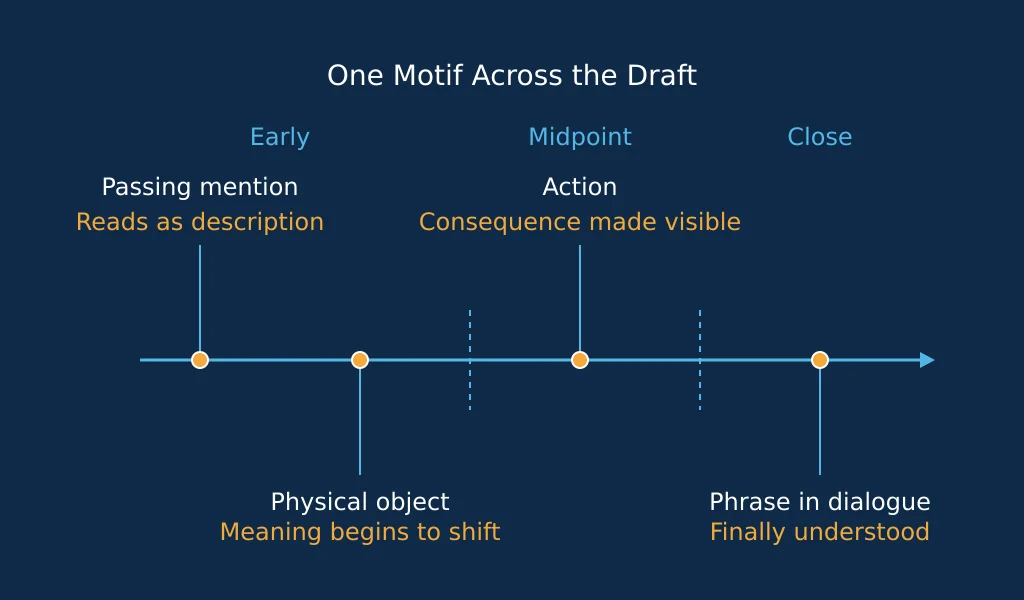
- Choose the placement pattern. Introduce it early and unremarked, so it reads as description; return at the midpoint with the meaning altered by whatever has happened in between; close on it changed, damaged, given away or finally understood. Mark the exact chapters first.
- Vary the form each time. Let the first appearance be a passing mention, the second a physical object somebody handles, the third an action, the fourth a phrase repeated in dialogue. Same element, four different forms.
- Cut what does not earn its place. An element appearing exactly twice reads as an accident, so delete one instance or add a third. Past roughly seven unvaried appearances it becomes a verbal tic. Both figures are rules of thumb — read the passages aloud and trust the ones that feel insistent.
- Track it across chapters. Recurrence is hard to hold in your head over 90,000 words. A scene-card view in something like Plottr lets you tag every chapter where the motif appears and see the gaps, which matters most in the sagging middle third.
Pros and Cons of Choosing a Motif From a List
Pros
- It gives a shapeless draft a spine. Three fixed appearances create a through-line the reader feels even when your plot logic is still wobbly.
- It makes cover, title and blurb decisions easier. Once you know your recurring object, you have a title candidate and a cover image that will not fight the text.
- It helps genre readers place your book fast. A reader who meets a stopped clock in chapter two has already guessed what kind of experience they signed up for.
- It gives revision something specific to do. "Add resonance" is not an instruction; "bring the coat back in chapter 19, damaged" is.
Cons
- A list-picked motif can sit on top of the story instead of growing out of it. The fix is question one of the test: only adopt elements already present in your setting, era or character's daily work.
- Over-familiar choices such as mirrors and storms read as cliché when their meaning never changes. The fix is to force one reversal — the mirror that reassured in chapter three has to be unbearable by chapter thirty.
- Too many motifs cancel each other out, because a reader tracking six patterns tracks none. The fix is a hard cap of two, with the second attached to a different character.
- Heavy-handed placement makes the reader feel managed. The fix is the first appearance: it must pass as ordinary description, with no emphasis and no character remarking on it.
Pick Three Motifs From Your Genre's Bank, Then Cut Two
Scroll back to the bank for the genre you are actually writing in and shortlist three entries your manuscript could already support. Run each through the three questions: does something in the story give this element a reason to be there anyway, does the association readers bring to it point at what your book is about, and can it come back a third time without a character stopping to explain it? Most writers find two of the three drop out on the spot, and that is the point — the cut does the choosing, so the survivor is the one your material was already asking for.
Now open your draft and mark three places where that motif can appear without anything being rearranged around it, with the first often sitting in a prologue and the last echoed in an epilogue. The first appearance carries no weight at all: a door is a door, a storm is weather. The second is where a reader notices the rhyme, and the third is where the association does its work without a line of commentary from you. If you cannot find a natural second placement, the motif failed the test after all — take the next candidate and try it against the same three questions.
Frequently Asked Questions About Motifs
Short answers to what writers actually type into the search box.
What is an example of a motif?
The motif example everybody has already read is blood in Macbeth. It appears in the battle reports, on the hands of the murderers, at the banquet and in Lady Macbeth's sleepwalking scene, and its meaning moves from a mark of valour to a stain that cannot be washed off. That is the full mechanism: one concrete element, repeated at intervals, carrying a different weight at the end than at the start.
What is the definition of a motif?
A motif is a concrete element in a work — an object, image, action, phrase, sound, colour or type of weather — that recurs and gathers meaning through that recurrence. Two properties are required: it has to be something you can point at, and it has to repeat. Remove either one and you have a symbol, a detail or a theme instead.
What are some good motifs?
The good ones are whichever elements your own book already contains. From the bank above: keys and thresholds for romance, clocks and locked rooms for thriller, crowns and true names for fantasy, mould and silence for horror, cigarettes and ledgers for crime, trains and a family saying for literary fiction. Storms, birds, mirrors, hunger and shoes travel across every genre. Pick one that survives the three-question test and drop the rest.
What are motifs in English?
In English classes and English literature generally, motifs are the repeated concrete elements a text keeps returning to, distinguished from themes, which are the abstract ideas those repetitions serve. In an exam answer you name the motif, quote two or three appearances, and explain what changed between them. In music the word means a short recurring melodic or rhythmic idea; in visual art it means a repeated element of an image or ornament.
How many times does something have to repeat to be a motif?
Three times is the working rule of thumb. Two appearances read as coincidence and a reader will not connect them; three creates a pattern that gets noticed and carried forward. Four or five spread evenly across a novel is comfortable. Past roughly seven appearances with no variation in form, the element stops feeling like a pattern and starts feeling like a habit you failed to edit out.
Can a book have more than one motif?
Yes, and most novels do, but two carried properly beats six sprinkled. If you run two, give them different jobs: one attached to the protagonist's internal problem, one to the external situation or the antagonist. Let them touch once, in the scene where the two storylines collide, and keep each one's appearances a few chapters apart so neither drowns the other.