You already know what a scene needs to do to a reader before you know what to call it. Maybe it needs dread, or a laugh, or a reveal that lands like a gut-punch. Look up literary devices in literature the usual way and you hit an alphabetical wall, with no hint of which term does the job in front of you. Alliteration and anadiplosis solve completely different problems; you don't have time to test a dozen entries before finding the one built for your scene. This page sorts 154 devices by what they do to a reader, not by what letter they start with. Pick your effect. Then pick your device.
What Counts as a Literary Device (and What Doesn't)
A literary device is a specific, nameable technique a writer chooses on purpose to produce an effect: a phrase built to repeat a sound, a comparison built to reframe an idea, a plot beat built to withhold information until it lands hardest. It's a tool, picked up and used on purpose. Before you use any literary devices list, including this one, that line matters, because plenty of terms that sound like devices are really something else wearing a device's name.
Dread is the mood a scene produces. Pathetic fallacy, a ticking clock and a run of short sentences are three different devices that can produce it. Free verse is a form: a set of expectations about how a poem sits on the page, saying nothing about any particular technique inside that layout. Ask which type of literary device is doing the work in a given passage, and moods, genres and outcomes drop out of the running fast.
Literary Device vs. Literary Element vs. Technique
A literary element is something every story has, named or not: setting, plot, character, theme, point of view. You don't choose whether your novel has a setting. A literary device is optional and specific. You choose whether to open in medias res, and you choose whether to use anaphora in a particular paragraph. Technique sits between the two, usually describing a broader craft approach, like writing in present tense or in first person. When in doubt, ask if you can point to the exact sentence where it happens. If you can, it's a device.
Why Sort Devices by Effect
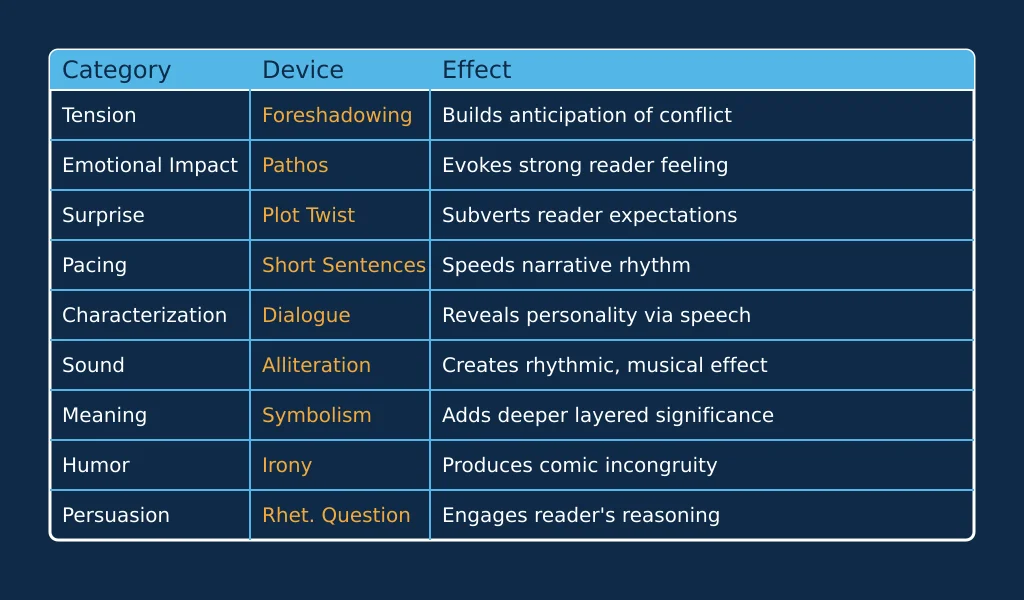
Nine effect clusters sit behind this list: tension, emotional impact, surprise, pacing, characterization, sound, meaning, humor and persuasion, the last of which is where a well-chosen adage dropped into dialogue earns its keep. Open the cluster that matches what your scene needs. Every entry underneath was chosen for that job.
The most widely cited alphabetical rundown, Grammarly's "105 Literary Devices" list, runs to 105 terms and opens with Allegory, Alliteration, Allusion, Amplification and Anadiplosis before working through the rest of the alphabet. This page carries 154. The extra entries aren't padding: splitting irony into its own subtypes and pulling the sound devices out from the rhetorical ones turns one long index into nine short, usable shortlists.
If you already know the term you want and just need the definition confirmed, the self-publishing and writing glossary handles that faster, with a plain A-Z index and no sorting required.
Nine effect clusters map to hundreds of devices, but the pattern stays simple: a ticking clock builds tension by racing a deadline, pathos wins sympathy by putting a character's loss on the page directly, and understatement gets a laugh by describing disaster as a footnote.
Tension & Suspense
Tension asks one question, over and over: what happens next, and will it be bad? The nineteen devices below keep a reader leaning forward through scenes that could otherwise sag.
- Foreshadowing: Planting an early detail that pays off later, so an ending feels earned when it finally lands. A character mentions once that a gun in the study won't fire straight; by the climax, that detail decides who lives.
- Cliffhanger: Ending a chapter at the moment of highest uncertainty, before the outcome of a threat is known. The chapter closes on a doorknob turning; the next one starts somewhere else entirely.
- Red herring: A clue planted to mislead the reader toward a wrong conclusion. The nervous neighbor looks guilty for six chapters and turns out to be hiding something unrelated to the crime.
- Chekhov's gun: The rule that any object given prominent attention early needs to matter later, or it shouldn't be there. A locked drawer that gets a paragraph in chapter one had better get opened before the book ends.
- Ticking clock: A hard deadline placed on the action, so every scene is measured against time running out. The bomb is set for midnight; every line after that carries the deadline underneath it.
- MacGuffin: An object or goal that drives the plot mainly by being wanted, regardless of what it actually is. The briefcase's contents barely matter; what matters is everyone chasing it.
- Periodic sentence: A sentence that withholds its main clause until the end, forcing the reader to wait for the point. "Through the flooded street, past the overturned car, she finally saw him."
- Cumulative sentence: A short statement followed by added details that build pressure as the sentence continues. "She ran, boots slapping wet pavement, breath tearing, the siren closing behind her."
- Cataphora: Referring to something before naming it, so the reader holds an unresolved reference in mind. Though it terrified the whole camp, the wolf never came closer than the treeline.
- Unreliable narrator: A narrator whose account can't be fully trusted, which keeps the reader uncertain about what's actually true. Every claim they make needs a second look.
- False protagonist: Presenting a character as the story's lead, then removing them early. A likable narrator dies at the end of chapter three, and the story keeps going without them, unsettling the reader's sense of who's safe.
- Aporia: Expressing doubt about what to say next, real or performed, which signals to the reader that something serious is at stake. "I don't know how to tell you what happened in that house."
- Epizeuxis: Repeating a word immediately, with nothing between, for raw emotional intensity. "Run. Run. Don't stop."
- Pathetic fallacy: Giving the weather the emotional temperature of the scene, so a storm builds outside while an argument builds inside a room.
- Juxtaposition: Placing two contrasting elements side by side so each intensifies the other. A birthday cake and a body, on the same page.
- Aposiopesis: Breaking off a sentence deliberately before it's finished, leaving the rest for the reader to imagine. "If you'd just told me sooner, I could have—"
- Hyperbaton: Reordering words out of their normal sequence to slow a reader down and weight the last word standing. "Dark was the house, and darker still the door."
- Anadiplosis: Repeating the last word of one clause at the start of the next, so a sentence climbs toward its point. "Fear leads to anger. Anger leads to the knife in his hand."
- Caesura: A deliberate pause inside a line, often marked by punctuation. A comma placed mid-line forces the reader to stop, breathe, and feel the weight of what just got said.
Emotional Impact
Emotional impact devices skip the explanation of what a character feels and make the reader feel it directly, before reasoning catches up. Pathos anchors the category; a full guide to pathos goes deeper on that single device. Metaphor and simile do quieter work throughout the list below, and 33 figurative language examples sorted by effect covers the rest of that comparison family.
- Pathos: An appeal to the reader's emotions, usually through a character's suffering or loss, built to generate sympathy. Reach for it in a scene that needs sympathy more than explanation, like a character finding out bad news alone.
- Personification: Giving human qualities to something non-human, so the reader senses a relationship with it. "The house groaned every time someone climbed the stairs."
- Imagery: Language built from concrete sensory detail: sight, sound, smell, taste, touch. It gives the reader something to feel physically inside a scene. Reach for it whenever a description reads flat; one sensory beat usually fixes it.
- Anthropomorphism: Giving an animal or object full human behavior, thought or speech, further than personification's borrowed qualities. A rabbit worried about its mortgage is anthropomorphized; a rabbit merely watching sadly is personified.
- Metaphor: Stating that one thing is another to transfer its qualities directly, with no "like" or "as" softening the comparison. "Grief was a stone in her chest."
- Simile: Comparing two unlike things using "like" or "as." "Grief sat in her chest like a stone."
- Hyperbole: Deliberate exaggeration used to convey the intensity of a feeling rather than the literal facts. "I've told you a thousand times."
- Bathos: An unintentional or comic drop from something serious into something trivial, often when a writer reaches for pathos and overshoots into absurdity. A funeral eulogy that compares the deceased to a sandwich lands as bathos.
- Apostrophe: Directly addressing someone absent, dead, or something non-human as if it could answer, raising the emotional register sharply. "Oh, grief, why do you visit at 3 a.m.?"
- Connotation: The emotional or cultural association a word carries beyond its literal meaning. "Home" and "residence" describe the same place but land very differently.
- Synesthesia: Describing one sense in terms of another, which makes an image feel more vivid and strange than a straightforward description. "Her voice was the color of rust."
- Zoomorphism: Giving a human or object animal qualities, often to make a character feel more primal or threatening. "He grinned, all teeth, like something that hunted at night."
- Oxymoron: Pairing two contradictory terms in one phrase to capture a feeling too complicated for a single word. "Bittersweet." "Deafening silence."
- Paradox: A statement that seems to contradict itself but reveals a truth once you sit with it. "Less is more" earns its keep because the contradiction forces a second look.
- Epistrophe: Repeating a word or phrase at the end of successive clauses, building emotional weight through accumulation. "I miss her voice. I miss her laugh. I miss her."
- Extended metaphor: Sustaining a single metaphor across several sentences or a whole passage. A chapter comparing grief to weather keeps returning to storms and clearing skies across several pages.
- Amplification: Repeating an idea while adding more detail each time, swelling its emotional weight. "She was tired. Not tired from the day, tired from years of days just like it."
- Diacope: Repeating a word or phrase with a few words between the repetitions. "Careful. He'd always been careful, until tonight."
Surprise & Revelation
Surprise and revelation devices hand the reader information they didn't have, right when it does the most damage or the most good, with no flashback required. Several of the entries below are irony's own subtypes, and the different types of irony gets the full breakdown if that's the one you need. Building toward a full reveal takes more than one device; writing a mystery that lands its twist covers that construction work separately.
- Dramatic irony: The reader knows something a character doesn't, which creates tension in every scene where that gap matters. The audience knows the killer's in the house; the character doesn't.
- Situational irony: The outcome of a situation is the opposite of what was expected. The fire station burns down.
- Peripeteia: A sudden reversal of fortune for the protagonist, good to bad or bad to good, at a story's turning point. A general who's spent the whole war winning finds, in one battlefield decision, that he's lost everything by nightfall.
- Anagnorisis: The moment a character recognizes the truth about themselves, another character, or their situation. A detective realizes, mid-interrogation, that the account she's been building the whole case on was her own alibi.
- Deus ex machina: An unlikely, external force resolves a plot's central problem at the last minute. In Stephen King's "Mr. Harrigan's Phone," from the collection If It Bleeds, the narrator says: "I called Mr. Harrigan, and in the dark earth of Elm Cemetery, in the pocket of an expensive suit coat now speckled with mold, I know Tammy Wynette was singing." Reach for the device carefully; readers often feel cheated by a rescue the story never earned.
- Twist ending: A final revelation that recontextualizes everything the reader has already read. A narrator revealed on the last page to have been dead the whole time recasts every earlier chapter without changing a word of them.
- Volta: A sudden turn in argument, tone or perspective, most associated with a sonnet's structure. Eight lines praise a lover's beauty, then line nine turns to admit the beauty won't last.
- Epiphany: A character's sudden flash of insight, usually about their own life. A character who's spent a novel blaming everyone else finally understands, alone in a parking lot, that the failure was his.
- Metafiction: A story that draws attention to its own fictional nature. A narrator stops mid-chapter to admit she's been lying to the reader about how the book will end.
- Cosmic irony: A situational irony so large it feels engineered by fate rather than by chance. A man survives a plane crash only to be struck by the wreckage of the ambulance sent to collect him.
- Structural irony: Irony sustained across an entire work through a narrator who doesn't understand their own story the way the reader does. A narrator insists throughout that he's the hero while every scene he describes proves otherwise.
- Poetic justice: An outcome in which virtue is rewarded and vice punished. A con artist who's spent the book swindling strangers gets swindled out of the exact sum, by someone he trained.
- Anticlimax: Building toward a major event and resolving it as something small or absurd. An army marches for three chapters toward a final battle that ends in a single, undramatic surrender letter.
- Paralipsis: Drawing attention to information by claiming to pass over it. "I won't even mention what he did with the money."
Pacing & Momentum
Pacing devices control how fast time seems to move on the page, whether that's skipping a decade in a sentence or stretching a single second across a paragraph.
- In medias res: Opening a story in the middle of the action, before any setup, then filling in context afterward. A novel that opens mid-chase and explains why, later.
- Flashback: Interrupting the present timeline to show an earlier scene directly. A single scent in chapter twelve drops the reader straight into a memory from twenty years earlier, told as if it's happening now.
- Flashforward: Jumping ahead to show a future scene before returning to the present timeline. A chapter opens on a funeral before the reader has met the person who dies, then rewinds to explain how it happens.
- Frame story: A story told inside the frame of another story. A grandmother's bedtime story turns out to be the whole novel, book-ended by a granddaughter listening in the present.
- Asyndeton: Dropping conjunctions between items or clauses, which speeds up a sentence's rhythm. "She packed, she left, she never looked back."
- Polysyndeton: Stacking conjunctions between every item instead, slowing a sentence down and giving each item equal weight. "And the rain came, and the wind came, and the roof went with it."
- Ellipsis: Omitting a stretch of time between scenes entirely, trusting the reader to fill the gap. The chapter ends mid-argument; the next opens five years later, no bridge sentence in between.
- Zeugma: Using one word to govern two clauses at once, for compact, quick effect. "She stole his heart and his wallet."
- Montage: Compressing a sequence of related but separate moments into one fast, stitched-together passage. Three paragraphs, three training sessions, a single sentence of narration tying them together: a year passes in half a page.
- Iterative narration: Narrating something that happened repeatedly as though it happened once, compressing months into a paragraph. "Every Sunday, my father would drive us past the old house without saying why."
- Circular narrative: A structure that ends where it began, often with the same image or line. A novel opens and closes on the same sentence: "The house was already empty when she got there."
- Parataxis: Short, simple, coordinated clauses with little subordination, reading fast and flat on purpose. "He opened the door. The room was empty. He left."
- Hypotaxis: Sentences built from layered subordinate clauses, slowing the reader down and adding complexity to a single moment. "Although the storm had passed, and though the streets still flooded, she went back for the dog."
- Digression: Stepping away from the main narrative line on purpose, then returning. A war novel pauses for two pages to describe a soldier's childhood dog before returning to the front line.
- Retardation: Delaying an expected event or climax on purpose. A rescue that's fifty pages away gets held up by a flat tire, a wrong turn, and a stranger who won't stop talking.
Characterization & Voice
Characterization devices reveal who someone is through how they talk, what they notice and what they call things, instead of a paragraph of direct description. Archetype anchors the category, and 20 literary archetypes breaks the major recurring types down individually if you need the deeper list.
- Archetype: A character type recognizable across cultures and eras because it recurs so often: the mentor, the trickster, the reluctant hero. Reach for one when a character needs to feel familiar fast, before the story has time to explain them.
- Foil: A character whose traits contrast with another's, making both more distinct by comparison. A reckless character next to a cautious one sharpens both.
- Colloquialism: Informal, everyday words or phrases marking a character's speech as casual, regional or generational. "Y'all." "Gonna."
- Malapropism: The mistaken use of a word in place of a similar-sounding one, usually for comic or characterizing effect. A landlord boasts about the building's "excellent ventriloquism" when he means ventilation.
- Epithet: A descriptive phrase attached to a name or used in its place, like "the Boy Who Lived," doing character work every time it recurs.
- Idiolect: An individual character's unique, personal pattern of speech. One character always prefaces disagreement with "to be fair"; nobody else in the book talks that way.
- Dialect: A regional or social variety of language used in dialogue. A character who says "ain't" and drops final g's reads as coming from a specific place, without the narrator ever naming it.
- Interior monologue: Presenting a character's unspoken thoughts directly on the page. A character calmly answers a question aloud while thinking, right underneath it, that the answer is a lie.
- Free indirect discourse: Blending a character's voice into third-person narration with no quotation marks or tag announcing whose thought it is: "She would not cry. Not here, not in front of them." The sentence reads like narration but sounds like her.
- Stream of consciousness: Rendering a character's thoughts as a continuous, often unpunctuated flow. Thoughts run together with no punctuation to slow them, matching how panic actually feels.
- Sobriquet: A descriptive nickname used instead of a character's given name, like "the Iron Lady," carrying an implied judgment each time it's used.
- Aptronym: A name that reflects or comments on a character's nature, often ironically. A cowardly character named Valentine Bold.
- Doppelgänger: A double or near-identical counterpart to a character. A character meets someone who looks exactly like them and behaves like everything they've suppressed.
- Confidant: A character who mainly receives another's private thoughts. A best friend who exists mainly to hear the protagonist's plan out loud, so the reader hears it too.
- Chorus: A character or group who comments on the action from outside it. Neighbors comment on a family's decline from their porches, never entering the story directly.
- Soliloquy: A character speaking their thoughts aloud while alone. A character left on stage admits, out loud, a plan nobody else in the play has heard yet.
- Aside: A character's brief remark, meant for the reader or audience rather than the other characters in the scene. "This will end badly," muttered, then the conversation continues as if nothing was said.
- Direct address: A character or narrator speaking straight to the reader, breaking the usual distance between page and audience. The narrator of Jane Eyre turns to address the reader directly at the moment of her marriage, a single sentence that does more character work than a paragraph of explanation would.
- Vernacular: The natural, everyday language of a particular group or place. Characters in a fishing town call the tide "the pull," a word a guidebook would never use.
Sound & Rhythm
Sound devices in literature build meaning from how language sounds out loud. They show up constantly in poetry, and poetic forms built on these sound devices get their own dedicated page, but plenty of these work quietly in prose too.
- Alliteration: Repeating the same consonant sound at the start of nearby words. "The wind whispered through the wheat, wild and wandering."
- Assonance: Repeating vowel sounds within nearby words, without matching the consonants around them. "The lonely road moaned under a low, cold moon."
- Consonance: Repeating consonant sounds anywhere in nearby words, not just at the start. "Pitter patter."
- Onomatopoeia: A word that imitates the sound it describes. Buzz. Crash. Hiss.
- Anaphora: Repeating a word or phrase at the start of successive clauses, building rhythm through return. "She remembered the rain. She remembered his voice. She remembered nothing after that."
- Euphony: Language arranged to sound pleasant and smooth, usually through soft consonants and long vowels: "The moon swam low and slow over silver water." Reach for it when a passage needs to sound calm no matter what it describes.
- Cacophony: Language arranged to sound harsh and jarring, through hard consonants and clashing sounds bunched together: "The truck's brakes cracked, clanged, and screeched to a stop." Reach for it when a scene's violence should sound as rough as it feels.
- Meter: A regular pattern of stressed and unstressed syllables giving a line its rhythmic backbone. Mark the stresses in "the CAT sat STILL be-SIDE the DOOR" and the beat becomes audible. The same rise and fall of language, shaped by sentence length and stress even without formal meter, is usually called cadence.
- Rhyme: Matching end sounds between words, most familiar at line ends in poetry but usable anywhere sound needs to echo, like "moon" and "June." A pattern of end rhymes repeated across a whole poem, labeled with letters like ABAB or AABB, is called its rhyme scheme.
- Sibilance: A concentrated repetition of "s" sounds, suggesting hissing, whispering or unease depending on context: "The silver snake slid silently through the grass."
- Internal rhyme: A rhyme that lands inside a single line: "I drove the road alone, and the cold made me moan." It works in prose too, tucked into a sentence where a reader won't expect an echo.
- Slant rhyme: A near-rhyme where the sounds are close but not exact, like "moon" and "gone," for a subtler echo than full rhyme.
- Polyptoton: Repeating a word in different grammatical forms within the same passage. "With eyes wide open, opening onto nothing."
- Elision: Omitting a sound or syllable, often marked with an apostrophe, to fit a rhythm or mimic natural speech. "E'er." "'Tis."
- Enjambment: Continuing a sentence past the end of a poetic line with no pause, so the meaning spills into the next line: "She reached the door and thought / of everything still burning behind her."
- End-stopped line: A line that closes on a natural grammatical pause instead of spilling into the next, the reverse of enjambment: "She reached the door. It was already open."
- Refrain: A line or phrase repeated at intervals throughout a poem or song, returning the reader to the same anchor point each time, like "and still the river ran" after every stanza.
- Isocolon: Parallel clauses of matching length and grammatical structure, creating a balanced, almost musical rhythm. "Quick to promise, quick to forget."
- Parallelism: Repeating a grammatical structure across a sentence or passage, so the repeated parts read as belonging together: "He walked in tired, ate in silence, and left without a word."
- Anacoluthon: A sentence that shifts grammatical structure partway through, breaking its own pattern for a jarring, off-rhythm effect: "The letter I'd written to her, it just sat on the counter for weeks."
Meaning, Symbol & Theme
These devices let a story carry a second layer under the surface action, something a reader senses even when no character states it outright. Motif does the heaviest lifting here across a whole manuscript, and 155+ motifs sorted by genre is the deeper page if that's specifically the one you need.
- Allegory: A story operating on two levels at once, where characters and events stand in for a separate, usually abstract meaning underneath. A farm run by animals who overthrow their farmer works as a barnyard story and as a commentary on revolution, at the same time. Reach for it when the story itself needs to argue a point without a narrator ever stating it.
- Symbolism: Using an object, color or image to represent an idea beyond its literal meaning. A wilting plant standing in for a dying relationship.
- Motif: A recurring image, phrase or idea that returns across a work, building meaning through repetition rather than a single instance. A crow that appears at every death in a novel turns an ordinary bird into a warning the reader learns to read. Reach for a motif when one image needs to carry weight a paragraph of explanation would otherwise have to do.
- Allusion: A brief reference to another work, person or event, trusting the reader to bring the outside meaning in without explanation. Calling a betrayal "a real Judas move" does the work of a whole paragraph in four words.
- Conceit: An extended, often surprising comparison sustained across a whole passage or poem, more elaborate than a single metaphor. A poem comparing two lovers to a drafting compass, one leg fixed while the other roams, carries that single image through every stanza.
- Metonymy: Referring to something by a closely associated term rather than its own name. "The crown," for the monarchy.
- Synecdoche: Referring to a whole by naming one of its parts, or a part by naming the whole. "All hands on deck," for the crew.
- Leitmotif: A recurring phrase, image or theme tied consistently to one character or idea. Every time a villain enters a scene, the narration mentions the smell of matches, and the reader learns to brace before he speaks.
- Epigraph: A quotation placed at the start of a book or chapter that hints at its theme before the story itself begins. A war novel opening with a line about grief tells the reader what kind of war story this will be before chapter one starts.
- Parable: A short, plainly told story that exists to teach a specific moral or spiritual lesson, with little interest in character detail beyond that point. A shepherd who leaves ninety-nine sheep to find one lost one teaches a lesson about value more than a story about the shepherd himself.
- Intertextuality: A work that engages directly with other texts, borrowing, echoing or arguing with them. A modern retelling of a myth that keeps the original names but changes who survives asks the reader to notice exactly what's different.
- Double entendre: A phrase with two valid meanings, one on the surface and one underneath it, often risqué. "I'd love to see your etchings" works on the page exactly the way it works at a party.
- Objective correlative: A specific external object or event that stands in for an emotion, evoking it without the writer naming the emotion directly. A character folds the same shirt for the third time in a scene instead of screaming, and the folding does the screaming's job.
- Anachronism: Placing something outside its correct time period, used deliberately to comment on the present through the past, or the reverse. A knight in a medieval battle checks his wristwatch, and one small detail undoes the whole illusion of the period.
- Memento mori: A recurring reminder of mortality worked into a story's imagery. A skull on a desk. A clock without hands.
- Antanaclasis: Repeating a word within a sentence while shifting its meaning the second time. "She could not bear to bear his name any longer."
- Portmanteau: A new word formed by blending two existing ones, often used to build a fictional world's own vocabulary. A fantasy world's toxic sky-fog, called "smaze" by its people, blends smoke and haze into a word the reader learns to dread.
- Neologism: An entirely invented word, naming something the existing language doesn't have a word for yet. A fantasy series needs a term for a magic system nobody's named before, so the author invents one, and the world feels a little more real for it.
- Kenning: A compressed, metaphorical compound standing in for a simple noun, inherited from Old English and Norse poetry. "Whale-road," for the sea.
- Euphemism: A mild or indirect phrase substituted for a harsh one, revealing exactly what a character or culture can't say plainly. "Passed away," instead of died.
Humor & Irony
Humor devices create distance between what a reader expects and what actually lands, which is most of what makes something funny on the page rather than just described as funny.
- Satire: Using humor, exaggeration or ridicule to criticize a real target: a person, institution or social habit. A story about a bureaucracy so devoted to paperwork that it files a form requesting permission to file forms satirizes exactly that kind of institution. Reach for it when a target needs mocking harder than a straight argument could manage.
- Parody: Imitating the style of a specific work or genre closely enough to mock it. A detective novel that follows every convention of the genre so closely, and so seriously, that the seriousness itself becomes the joke.
- Verbal irony: Saying the opposite of what you mean, understood as intentional by the reader and often the other characters. "Great weather," said during a downpour.
- Litotes: Expressing a point by negating its opposite, understating something to actually emphasize it. "Not bad," for excellent.
- Understatement: Deliberately describing something as smaller or less serious than it actually is. Calling a disaster "a bit of a setback."
- Comic relief: A character or moment providing humor specifically to release tension built up by a serious scene around it. A gravedigger cracking jokes in the middle of a tragedy gives the audience a breath before the next blow lands.
- Pun: A play on words exploiting multiple meanings or similar sounds for a joke. "The novelist refused to fix her broken pen; she said the plot had already lost its point."
- Sarcasm: A sharp, often mocking form of verbal irony, delivered with clear intent to wound or mock. "Oh, brilliant plan," said right after the plan fails, is sarcasm doing verbal irony's job with extra edge.
- Epigram: A short, clever, often paradoxical statement designed to land as memorable wit. "The cure was worse than the disease it invented."
- Spoonerism: Swapping the initial sounds of two words for comic effect. "A well-boiled icicle," instead of a well-oiled bicycle.
- Caricature: Exaggerating a character's most distinctive traits until they become comic or grotesque. A politician drawn as all teeth and no chin, every speech reduced to one gesture, repeated until the exaggeration is the point.
- Travesty: A grotesque, deliberately debased imitation of a serious work or subject, more extreme than parody. A solemn funeral rite performed over a dead houseplant, played completely straight, turns reverence into farce.
- Mock-heroic: Treating a trivial subject with the grand, elevated conventions of epic poetry. A poem describes a card game in the language of an epic battle, with "trumpets" announcing a hand of cards.
- Non sequitur: A statement that doesn't logically follow from what came before, used for absurdist comic effect. "The car wouldn't start, so I became a vegetarian" lands precisely because the two halves don't connect.
- Deadpan narration: Narrating extreme or absurd events in a flat, matter-of-fact tone. A narrator describes a house collapsing in the same flat tone used to describe making toast. Reach for it when the absurdity should do all the work, with no narrator commentary pointing at the joke.
Persuasion & Rhetoric
Persuasion devices come from oratory, built originally to win an argument out loud, which is why so many of them are classic rhetorical devices in their own right. On the page, they make a line of dialogue or narration feel more convincing, more quotable, or both.
- Rhetorical question: A question asked for effect, not to get a spoken answer; the audience is meant to answer it silently, the way the speaker intends. "Do you really think that's going to work?" reads as an accusation, not a question. Reach for it when a flat statement needs the extra push of the reader arguing themselves into agreement.
- Antithesis: Placing two contrasting ideas in parallel structure to sharpen both. "She built her fortune quietly and lost it loudly."
- Chiasmus: Mirroring a phrase's grammatical structure in its second half, without repeating the exact same words. "By day she taught the children patience; by night, they taught her hope."
- Tricolon: A series of three parallel words or clauses, landing with more rhythm and authority than two or four would. "She rebuilt the house, rebuilt the business, rebuilt herself."
- Aphorism: A short, memorable statement of a general truth. "A secret told twice is no longer a secret."
- Antimetabole: Repeating words in reverse grammatical order across a phrase, closely related to chiasmus but built on repeating the exact same words. "You can take the writer out of the small town, but you can't take the small town out of the writer."
- Hypophora: Asking a question and then immediately answering it yourself, controlling the argument instead of leaving it open. "What convinced the jury? A single unanswered question, left hanging for three days."
- Syllogism: A three-part logical argument: a general premise, a specific premise, and a conclusion that follows from both. "Every bestselling thriller has a ticking clock. This manuscript has one. Therefore, it reads like a bestseller." Reach for it when a character's logic needs to sound airtight even while a premise is shaky.
- Enthymeme: A shortened syllogism with one premise left unstated. "He's a writer, so of course his apartment is a mess" skips the unstated premise that writers keep messy apartments and trusts the listener to supply it.
- Analogy: Comparing two different situations to explain or argue a point. Calling a plot outline a skeleton other scenes hang flesh on makes an abstract structure suddenly concrete.
- Tautology: Needless repetition of the same idea in different words, sometimes used deliberately for legal precision or rhetorical emphasis. "Free gift." "Null and void."
- Procatalepsis: Raising and answering an objection before the audience has a chance to raise it themselves. "You might think this plan is reckless. It is, and here's why it's still the right one."
- Ethos: An appeal to the speaker's credibility or character. A narrator who mentions, early, that she spent ten years as a nurse earns the reader's trust before she diagnoses anything.
- Logos: An appeal to logic and reason. An argument built entirely on dates, numbers and a chain of if-then statements convinces through the structure of the reasoning itself.
Devices That Show Up Under More Than One Heading
A few devices earn a place in two sections at once, so they're worth checking twice if the first entry didn't fit your scene.
- Caesura sits under Tension & Suspense above, but it's also a sound device, useful whenever a poem or a rhythmic prose line needs a forced pause.
- Dramatic irony, situational irony, cosmic irony and structural irony live under Surprise & Revelation; verbal irony sits under Humor & Irony, since it works through tone more than plot.
- Amplification and Diacope are filed under Emotional Impact here, but both are repetition devices and would sit just as naturally under Persuasion & Rhetoric or Sound & Rhythm.
- Antanaclasis and Polyptoton both repeat a word while shifting its form or meaning; one is filed under Meaning, Symbol & Theme, the other under Sound & Rhythm.
- Epigram and Aphorism both compress an idea into one memorable line. Epigram leans comic and sits under Humor & Irony; Aphorism leans serious and sits under Persuasion & Rhetoric.
- Free indirect discourse and Interior monologue both give access to a character's private thoughts. Both are filed under Characterization & Voice, but either could sit under Emotional Impact depending on what the passage is doing.
Choose One Effect for Your Current Scene, Then One Device
Open your draft and name, in one word, what the current scene needs to do to the reader. Dread. Sympathy. A laugh. A gut-punch reveal. Go to that section only and ignore the other eight. Pick one device from the shortlist. Three stacked together, anaphora, alliteration and epizeuxis in the same paragraph, reads like a writing exercise. Use the device, then read the paragraph back without knowing its name, and check whether the effect actually landed on the page. That's the whole point of a reference sorted by effect: a toolbox built for the job at hand. If the first device doesn't land, that's fine. Go back to the same section and try the next one down the list before you reach for a different effect entirely.
Literary Devices FAQ
These are the exact counts people search for, and none of them describe a fixed, official list, since types of literary devices get grouped differently depending on who's counting and why.
What are 12 types of literary devices?
There's no single official list of twelve. Grouped by function the way this page does, you get nine effect clusters instead: tension, emotional impact, surprise, pacing, characterization, sound, meaning, humor and persuasion. Any twelve-item taxonomy you've seen elsewhere maps onto two or three of those nine, since most published lists split one cluster into several named types.
What are the 25 literary devices?
Twenty-five is just where some lists happen to stop counting. Add chiasmus and litotes to any core set of common devices and you're already there. A moving target, like every round number in these lists.
What are the 8 main literary devices?
Most "main eight" lists boil down to metaphor, simile, personification, hyperbole, alliteration, irony, symbolism and foreshadowing, the devices taught earliest because they're the easiest to spot in a single sentence. This page covers all eight, plus roughly a hundred and fifty more for when a sentence needs something sharper.
What are the 20 literary devices?
Same story as twenty-five. Twenty is a round number, not a boundary. Whichever twenty you've been handed, cross-check them against the effect clusters here and you'll find every one of them sitting under Tension, Meaning, Sound or one of the other six headings.
What's the difference between a literary device and a literary element?
An element is something every story has by default, like setting or point of view. A device is a specific technique a writer chooses to use, like anaphora or a frame story, and could just as easily leave out.