What Is a First Draft, Really?
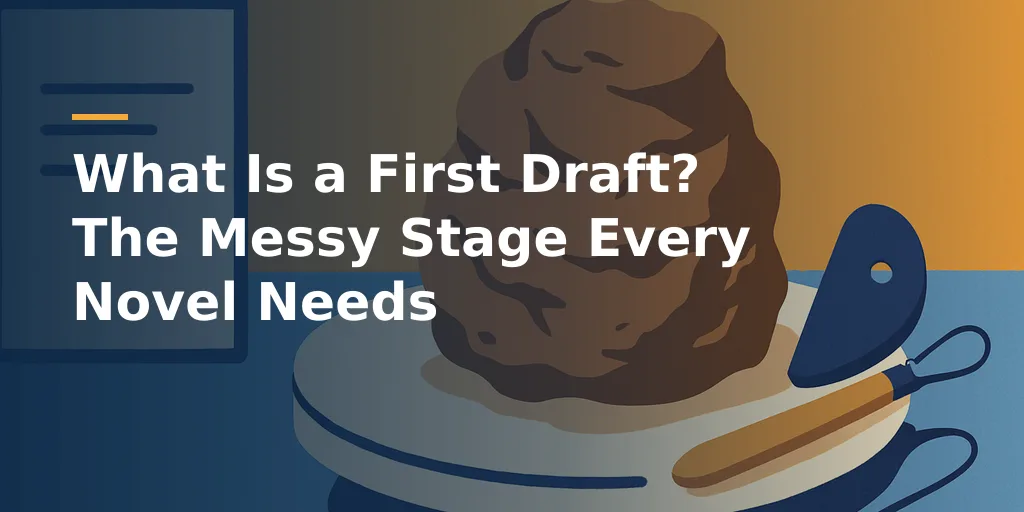
A first draft is the first complete version of your manuscript, start to finish, before anyone edits a line of it. It's the raw material for everything that comes after. If what you've written so far feels rough, uneven or a little embarrassing, that's not a sign something's wrong. A first draft is supposed to read like that.
The One-Sentence Definition
Put simply: a first draft is a complete, unedited version of your whole story, every scene present in some form however weak a few of them are. Completeness matters more than quality at this stage. A draft, broadly, is a preliminary version of a piece of writing, a large collection of words that will definitely need editing before anyone else sees it. A first draft just applies that idea to an entire novel: get every scene down once before you touch a single sentence.
Why It's Supposed to Look Like a Mess
Plot holes are beams that haven't been connected yet. Characters act inconsistently because you haven't met them properly yet. Bird by Bird, Anne Lamott's book on writing, includes a chapter titled "Shitty First Drafts," and the title alone is where a lot of writers first hear that a first draft is allowed to be bad.
That's permission, not a requirement. A first draft built from a tight outline can come out fairly clean on the sentence level and still count as a first draft, because what makes a draft "first" isn't how rough the prose sounds. It's whether every scene exists yet, plot holes and inconsistent characters included if they show up, whether or not you've decided on a prologue or epilogue yet. Fix that axis and the sentence-level mess can sort itself out later, in revision.
What Do You Call a First Draft? Zero Draft, Rough Draft, and Discovery Draft
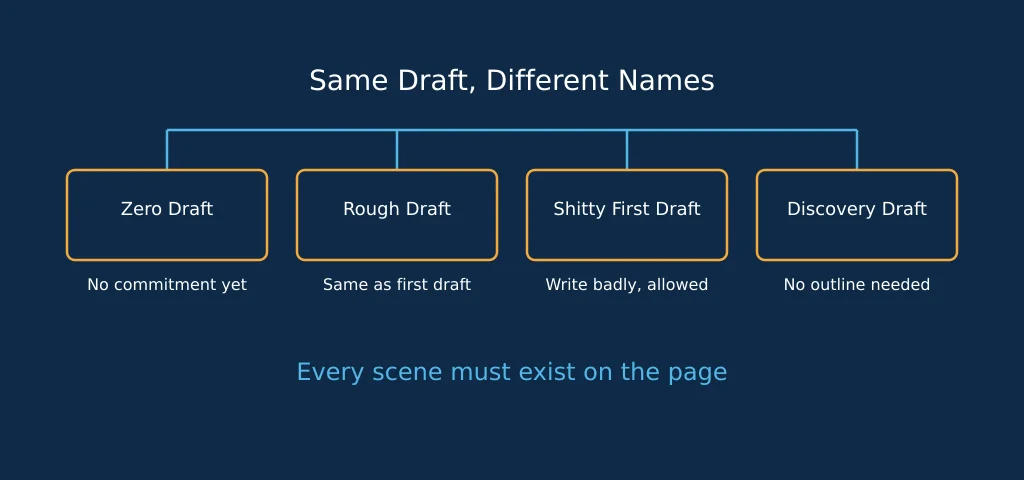
Ask five writers what to call this stage and you'll get five different terms, sometimes for the exact same manuscript. None of them is more official than the others. Each one just flags something slightly different about where the draft came from or how rough it still is.
- Zero Draft: the version written before the "real" first draft, often used to test an opening scene, a voice or an idea with no commitment to keeping any of it. Some writers throw the whole thing away.
- Rough Draft: often used interchangeably with first draft. The two labels usually mean the same stage, emphasizing how unfinished the pages still are.
- Shitty First Draft: the term most associated with Anne Lamott's Bird by Bird, shorthand for giving yourself permission to write badly on the way to a finished manuscript.
- Discovery Draft: the preferred term for discovery writers, or pantsers, who skip outlining. Plot and character get worked out during the writing itself, scene by scene.
Whichever label fits your manuscript, the test underneath all four is the same: every scene needs to exist on the page in some form. How clean the prose reads can wait for revision.
How Two Published Authors Actually Drafted
Fast or slow, planned or discovered, a messy first draft is normal at every point on that spectrum. These two examples show how differently the stage can look while still producing a finished, published novel.
- Stephen King: In On Writing, King describes drafting with no outside help or interference, resisting the urge to hand a first draft to a friend before it's finished. The manuscript stays his, and only his, until the story's told all the way through.
- J.K. Rowling: For Harry Potter and the Order of the Phoenix, Rowling worked from a handwritten plot spreadsheet covering chapters 13 through 24, planning that stretch of the book on paper before drafting it. Not every writer plans that far ahead, but the option's there.
Both Bird by Bird and On Writing appear on our list of best books on writing.
Fast-Drafting vs. Slow-Drafting: Which Gets You to 'The End'?
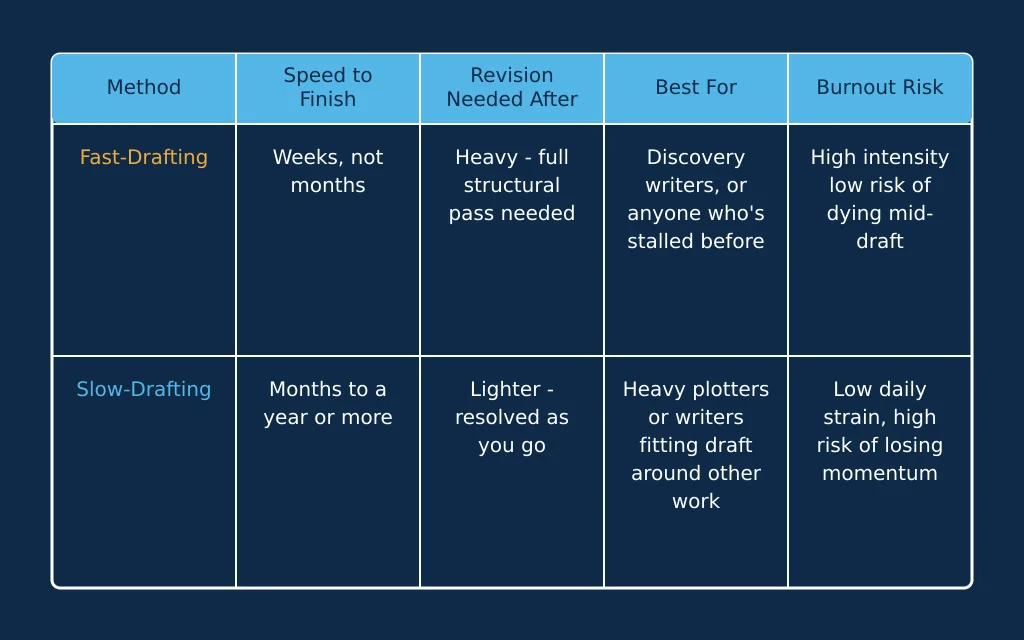
Two drafting methods dominate, and choosing the wrong one is a common reason a first draft process stalls out before it's finished. Fast-drafting means writing the whole manuscript in a short, intense window, days or a few weeks, with little slowing down to fix anything along the way. Slow-drafting means a fixed daily or weekly word or scene count, sustained over months, often alongside a job or another project already in revision. One widely used fast-draft benchmark is 50,000 words by the end of a month, about 1,667 words a day.
| Method | Speed to Finish | Revision Needed After | Best For | Burnout Risk |
|---|---|---|---|---|
| Fast-Drafting | Weeks, not months | Heavy, since scenes skipped or left unresolved need a full structural pass | Discovery writers, and anyone who has stalled on a project before | High short-term intensity, low risk of the project dying mid-draft |
| Slow-Drafting | Months, sometimes a year or more | Lighter, since problems get caught and partly resolved as you go | Heavy plotters, and writers fitting drafting around other work | Low day-to-day strain, high risk of losing momentum if the count slips |
Each of those ratings comes from reasoning through how the two methods behave: pace of output, how much gets left unresolved by skipping ahead versus resolving as you go, and how each interacts with a plotted or an unplotted process. None of it is a survey result. Fast-drafting means plowing through scenes without stopping to solve plot problems. Speed to finish is high, but revision afterward has to do double duty, fixing prose and fixing structure at the same time. Slow-drafting resolves problems scene by scene as they come up, keeping the revision load lighter later, provided the pace holds. Miss enough weekly counts in a row and a slow draft can stall the same way an unplotted fast draft runs out of steam.
The verdict splits by writer type, not by which method looks tidier on paper. A discovery writer, or anyone who's abandoned a manuscript before, does better fast-drafting against a short deadline: momentum is the whole point, and a finished rough draft is what actually turns into a published book. A heavy plotter, or a writer fitting the draft around a job and a family, does better slow-drafting on a fixed weekly count, especially after outlining before you draft using something like a Save the Cat beat sheet. Either way, the method that keeps you moving to the end beats the one that produces a tidier draft.
Fast-Drafting: Pros and Cons
Weighed against slow-drafting, fast-drafting trades a tidier process for raw speed. Here's what that trade looks like beyond the table above.
- Momentum carries you through scenes you'd otherwise agonize over, because there's no time to stop and second-guess a chapter that isn't working yet.
- A full manuscript exists fast, which matters most for a discovery writer who needs to see the whole shape before fixing any single part of it.
- A scene left as a bracketed placeholder note during the sprint has to be built from nothing at the structural pass. There's no existing version to tighten, only a note describing what should have happened.
- Fast-drafting the way King describes it, with no outside readers until the draft's done, only works if you can actually protect that stretch of weeks from everything else.
Slow-Drafting: Pros and Cons
Slow-drafting trades speed for control, provided the weekly count holds. Its own trade-offs run in the other direction.
- A fixed weekly count is sustainable for months, which suits anyone drafting around a job, a family or another manuscript already mid-revision.
- Plotting the story first, the way Rowling worked out a chapter-by-chapter spreadsheet before writing them, means fewer scenes get discovered wrong and rewritten twice.
- Miss a week against a plotted outline and the gap doesn't stay contained to that week. Every scene after it shifts pacing until the outline itself gets adjusted to absorb the loss.
- Momentum is fragile here: miss the weekly count often enough and the draft can stall entirely, the same failure mode fast-drafting is built to avoid.
How to Get Through Your First Draft: 6 Steps
Every step below is a decision about the manuscript: what to write next, what to skip, when to stop. None of it's about your desk, your calendar or how many hours you can find this week. That's a different kind of advice, and this site isn't the place for it.
- Give yourself permission to write badly. The sentence you're stuck on right now just has to exist so tomorrow's sentence can follow it.
- Silence the inner editor until the draft is done: no rereading yesterday's chapter, no fixing a typo you noticed three scenes ago, no polishing before the whole thing exists once.
- Set a single weekly target. Pick a number, scenes or words, that you can hit most weeks even on a bad week, and track that weekly count consistently.
- Stuck on a scene? Skip it. Leave a bracketed note for what's supposed to happen there and move to a scene you can actually write today; a reader stuck specifically on their opening gets a fuller answer at how to start a story.
- Track progress against the target you set for the week. A finished, rough scene always counts toward it.
- Stop. Before you open the manuscript again to revise, put it down entirely and rest, which the next section covers in full.
Your Draft Is Done: Now Let It Rest Before You Edit
The moment you type the last line, close the file. Don't open it again that day, and ideally not that week. As a rule of thumb, two to four weeks of distance is usually enough to read your own draft the way a stranger would, catching the plot hole you were too close to see while writing it.
Once you're back in the manuscript, the work changes completely. You're deciding what to cut, what to reorder and what needs a full rewrite, before handling the line-by-line pass after that. The distinction between those two kinds of revision, structural rewriting and the sentence-level pass, is exactly what copy editing vs. proofreading covers once you're ready for it.
First Draft FAQ
What does a first draft mean?
It means the first complete pass through a manuscript, every scene written once, before any editing happens. It's simply a stage in the process. A first draft can be strong or it can be a mess; either way, the term means the same thing: the whole story exists in some form for the first time.
What is a first draft called?
Several things, depending on who's talking. Zero draft, rough draft, shitty first draft and discovery draft all describe roughly the same stage, each with a slightly different emphasis on how it got written.
How long should a first draft take?
There's no fixed length, but the two dominant approaches sit at opposite ends. Fast-drafting can produce a full manuscript in a few weeks, close to the widely used fast-draft benchmark of 50,000 words by the end of a month, about 1,667 words a day. Slow-drafting stretches the same manuscript over months on a fixed weekly count. Both eventually get you to "the end."
How many drafts does a novel usually need?
More than one, almost always. As a rule of thumb, expect at least one structural revision, a line edit and a final proofread after the first draft, sometimes more rounds of each if the first draft came out especially rough.