What Is Pathos? The Fiction Writer's Definition
You've written the scene where the dog dies, the letter arrives, the diagnosis comes back. It does everything a scene is supposed to do on paper, and your beta reader still says, "I don't know, it just didn't hit me." That gap between what happens and what a reader feels is a pathos problem. It's fixable once you know what's actually missing.
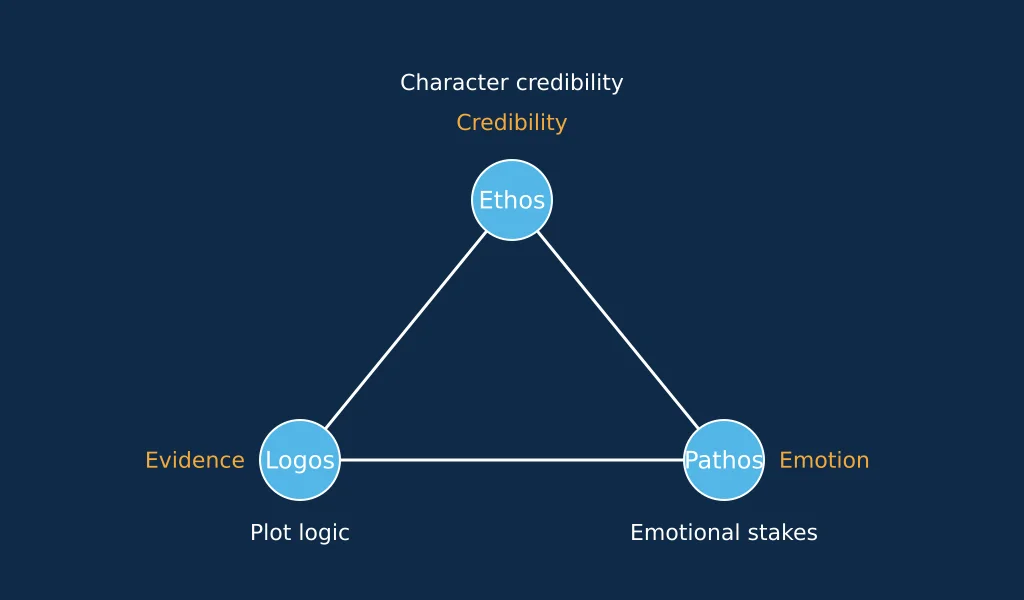
Pathos is the rhetorical appeal to emotion, one of Aristotle's three modes of persuasion in his Rhetoric, alongside ethos (the appeal to credibility) and logos (the appeal to logic). Aristotle wrote about this in the language of persuasion, and fiction borrowed the mechanism wholesale. A speechwriter reaches for pathos to make an audience feel something before they decide anything. An author uses the same lever for a different job: to make a reader care what happens next, one scene at a time.
Pathos and pity aren't quite the same thing, though readers often arrive at the word expecting them to be. Pity is the emotional response, the feeling a reader has once a scene has done its work. Pathos is the technique that produces it: sensory detail, private thought, a stake made specific, a choice that costs something. You build pathos into a scene; pity is what happens to the reader afterward. That's the working pathos definition worth keeping in front of you while you draft.
The Greek Origin, in One Sentence
The word comes from the Greek pathos, meaning suffering or deep feeling, the same root that gives us "pathetic" and "empathy." Aristotle's Rhetoric sets out three modes of persuasion, ethos, pathos, and logos, as the tools a speaker uses to move an audience, and pathos has kept that job description for well over two thousand years.
How to Pronounce Pathos
Cambridge Dictionary gives the pronunciation as /ˈpeɪ.θɒs/ in UK English and /ˈpeɪ.θɑːs/ in US English. Said out loud, that's roughly "PAY-thoss" in Britain and "PAY-thahss" in the US. The stress lands hard on the first syllable either way, and the second syllable stays short.
Pathos vs. Ethos vs. Logos: Which One Fiction Actually Uses
Ethos, logos, and pathos each persuade by trading on something different: credibility, evidence, or emotion. Ethos is a structural engineer opening an article on bridge maintenance with twenty years of inspection reports before she recommends anything. Logos is the policy essay citing crime statistics and asking the audience to follow them. Pathos skips both of those and puts a reader inside a room, asking them to feel first and reason second.
A persuasive essay usually needs all three working together. Credibility earns trust, evidence earns agreement, emotion earns urgency. A novel doesn't have to win an argument. Nobody's arguing with a scene. They're just feeling it.
Ethos and Logos Show Up in a Novel Too
Ethos survives in fiction as character credibility, the reason a reader trusts what a character says or does. A detective who's wrong about small things early in a mystery earns the reader's trust when he's right about something big later. That's ethos built scene by scene, without a single stated credential. Logos survives as plot logic, the internal consistency that makes a reader believe cause led to effect. A magic system that follows its own rules, or a mystery where every clue could plausibly have been noticed by the reader, is logos at work. Pathos still does the heaviest lifting in most fiction. A scene that ignores ethos and logos entirely can feel manipulated no matter how strong the emotional beat is.
What an Essay Does With a Fact, and What a Scene Does With the Same Fact
Take a single piece of information: a hospital loses patients each year to a preventable error. An op-ed states the number, cites the source, and asks a reader to support a policy change. A novelist takes the same fact and gives it to one patient's family in one room on one afternoon. The reader isn't persuaded by the number. They feel the room, because the fact now belongs to people they've spent a paragraph with.
Fiction runs almost entirely on pathos for exactly that reason. A novelist rarely announces that a character is sympathetic. She gives the reader an interior moment, a sensory detail, a stake, a sacrifice, and lets the feeling arrive on its own. The four levers below are how that delivery happens, sentence by sentence.
Drafting a story of your own? Draft scenes from your outline in Sudowrite, an AI writing tool built for fiction that keeps a story bible of your characters. Free trial, no card needed. (affiliate link)
Four Craft Levers That Build Real Pathos into a Scene
Four moves do most of this work, and the list below includes interiority, sensory detail, stakes, and sacrifice. Every author leans on some mix of these without naming them; each one gets its own worked example, a flat line next to the version rewritten to carry more feeling.
Interiority
Interiority is the private thought or reaction a character has that the reader gets to overhear. It's the difference between watching someone receive bad news and knowing, a half-second before they do, exactly what they're bracing for. Drop one line of private thought into the beat right before or right after the external action.
Flat: Tom saw the ambulance parked outside his house and ran up the driveway. Lifted: Tom saw the ambulance parked outside his house and ran up the driveway, already rehearsing what he'd say if it was his father this time. The second version gives the reader Tom's dread before the front door even opens. The line looks like telling, which is exactly why it's often the first thing cut in revision. Keep it anyway: one clause of private thought gives the reader access to a mind they can't otherwise reach. Pushed too far, interiority turns into a character narrating her own feelings on every page, and the reader stops trusting any of it. Because interiority depends so heavily on whose head you're in, it's worth knowing your point of view choice cold before you try to deploy it.
Sensory Detail
Sensory detail is the specific, physical texture of a moment: what it smelled like, what it felt like against skin, the exact sound a door made. Stephen King put it plainly in On Writing: description is what makes the reader a sensory participant in the story.
Flat: The hospital room was sad. Lifted: The hospital room smelled like the inside of a plastic bag. Naming "sad" tells the reader what to feel and gets nothing back. The smell gives the reader something to feel with their own body. Pick one sense tied to the character's emotional state, and let that single detail carry the feeling; one vivid image can evoke more than a paragraph of adjectives ever will. Stacking three senses when one would do is the failure mode the Pros and Cons section names below, and it dilutes the exact feeling it's meant to sharpen. This lever is one of several covered in depth on this site's page about types of description, worth a look if sensory detail is the one you reach for least.
Stakes
Stakes are what the character stands to lose if the scene goes badly, named specifically enough that the reader can picture the exact thing at risk. Ask the draft one question before you write the beat: does the reader understand exactly what's being risked, or are they left to infer it from tone alone?
Flat: Elena was scared for her brother. Lifted: Elena watched the foreman's clipboard travel down the line of names, and she already knew which one she'd trade her own place to erase. Naming the one object at risk, a single name on a list, does more work than a general statement of fear. In Suzanne Collins' The Hunger Games, Prim's name is drawn at the reaping, and Katniss volunteers as tribute to take her place: the same shift, from fear in general to one name that can be lost. A stake can be external, a life. It can just as easily be internal, a belief the character can't afford to give up. Named too vaguely, or announced without being shown, a stake reads as manipulation, a scene demanding fear it hasn't earned yet. Stakes and sacrifice are related levers that both grow out of conflict, and the split between internal vs. external conflict is worth knowing before you draft either one.
Sacrifice
Sacrifice is what a character gives up, on purpose, to protect or get something else. It converts an emotion into an action the reader watches happen.
Flat: Daniel offered his brother the last seat on the lifeboat. Lifted: Daniel put his brother's hand on the oar, stepped back onto the sinking deck, and told him to row. The flat version reports a decision already made. The lifted version puts the reader inside the moment the choice becomes physical: a hand moved, a body stepped back, a door closing on the chance to change his mind.
The how-to: make the cost visible in the same beat as the choice. A sacrifice summarized after the fact, mentioned in a single line once it's already over, doesn't cost the reader anything, because they never watched it happen. Write the physical action the choice requires, the hand let go of, the door closed, the seat given up, and let the reader watch the character do it in real time. Skip that step and sacrifice collapses into the same flat reporting the lever was supposed to fix.
Rewriting a Flat Scene for Pathos: Before and After
Most pathos examples show a finished paragraph and stop there; this one shows the paragraph changing. The scene below is invented for this demonstration, not pulled from any published book. It goes through two passes, one lever at a time, so you can watch each one change the paragraph on its own before they combine.
The Flat Version
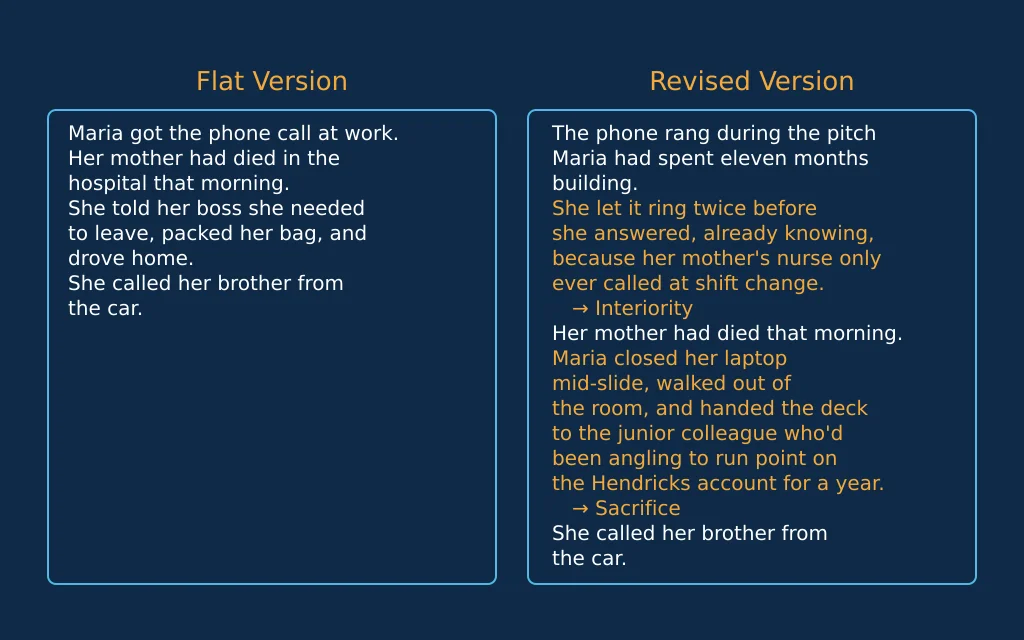
Maria got the phone call at work. Her mother had died in the hospital that morning. She told her boss she needed to leave, packed her bag, and drove home. She called her brother from the car.
Pass One: Adding Interiority
The phone rang during the pitch Maria had spent eleven months building. She let it ring twice before she answered, already knowing, because her mother's nurse only ever called at shift change. Her mother had died that morning. She told her boss she needed to leave, packed her bag, and drove home. She called her brother from the car.
One clause did the work: already knowing, because her mother's nurse only ever called at shift change. That line puts the reader inside Maria's dread before the fact lands. They brace alongside her. Nothing else in the paragraph changed. The phone call is still the same phone call, the drive home is still the same drive. The scene reads differently anyway, because the reader now knows something Maria hasn't said out loud yet.
Pass Two: Adding Sacrifice
The phone rang during the pitch Maria had spent eleven months building. She let it ring twice before she answered, already knowing, because her mother's nurse only ever called at shift change. Her mother had died that morning. Maria closed her laptop mid-slide, walked out of the room, and handed the deck to the junior colleague who'd been angling to run point on the Hendricks account for a year. She called her brother from the car.
The added sentence does something the interiority line alone couldn't: it shows Maria giving something up. Eleven months of work, walked away from mid-presentation, and handed to the one colleague who wanted it most, that's a specific, irreversible cost, chosen in the same beat as the loss it's answering. The pitch is gone the moment she hands it over, and nobody else in the room benefits from her absence by accident. The flat version's "she told her boss she needed to leave" is true. It just doesn't cost her anything the reader can see. Pass Two gives the reader a cost they can point to.
Both passes work the same way: add one lever, read the paragraph back, then decide if the scene needs a second.
Pathos Across Genres and Forms
Pathos in literature doesn't confine itself to literary fiction. The same four levers apply across horror, poetry, and thriller, though each genre asks for a different mix.
- Horror: in Stephen King's Pet Sematary, the dread of what Louis Creed might do next lands harder because the reader has already spent chapters caring about his son Gage. A reader attached to a character reads every creak in the house as a personal threat. Build that attachment before the danger arrives. It's the backbone of writing horror that actually unsettles.
- Haiku and short poetry: Matsuo Bashō's most famous poem gives the reader an old pond, a frog, and the sound of water, nothing else. No feeling is named anywhere in it. The reader supplies the stillness themselves, since the image leaves room for more than one reading. This lever is the whole engine behind haiku poetry, where the form itself demands restraint.
- Mystery and thriller: in Gillian Flynn's Gone Girl, the reader spends half the novel liking a character they probably shouldn't trust, and that discomfort is what keeps the pages turning past the point logic alone would carry them. Attach sympathy to the person your reader is supposed to suspect, and certainty stops feeling safe.
The mix changes by genre, but the levers stay the same four. Dread lives in the body, so horror leans hardest on sensory detail and interiority. Poetry compresses everything into image, cutting stakes and sacrifice down to one implied gesture; thriller and mystery lean on stakes, built around what a character risks by trusting the wrong person. Knowing which lever a genre favors just means picking where the emotion should start.
Pros and Cons of Leaning on Pathos
Pathos does real work in a manuscript: it buys reader attachment before a plot has asked anything of them. Overused, it creates two specific failure modes, both worth naming before they show up in a draft.
- Pro: it builds reader attachment, which is what makes a scene memorable weeks after the book is closed.
- Pro: it earns emotional payoffs later. A death, a betrayal, or a reunion lands harder in chapter thirty if the reader was given reasons to care back in chapter three.
- Con: melodrama, which shows up when a scene announces stakes it hasn't earned. A character crying over a loss the reader hasn't been shown enough to feel comes across as manipulation. To catch it, look backward for the scene that built the reason to care. If you can't point to one, the tears are doing work the manuscript hasn't done yet.
- Con: purple prose, piled-on sensory detail that dilutes the feeling it's meant to sharpen. To catch it, watch for more than one metaphor doing the same emotional job in a single paragraph. Keep whichever one lands hardest, and cut the rest.
Both failure modes are easy to fix once they're named. Melodrama needs an earlier scene doing the work the crying scene assumes already happened: one beat of stakes or interiority a few chapters back, and the same tears read as earned. Purple prose just needs restraint. Trimming a paragraph down to its single strongest sensory detail almost always makes the emotion land harder. Both cons trace back to the same test: has the manuscript already earned this emotion somewhere earlier?
Open Your Work-in-Progress and Find the Flattest Scene
Don't apply this to the whole manuscript at once. Pick one scene, maybe the one a beta reader flagged or the one you already suspect isn't landing, and run it through the four levers one at a time.
- Interiority: is there a private thought the reader should be overhearing and currently isn't?
- Sensory detail: is there one sense tied to the emotion, and is anything else in the paragraph competing with it?
- Stakes: named specifically, or only implied through tone?
- Sacrifice: what does the character give up, and is that cost visible in the same beat as the choice?
Rewrite the scene once with just one lever added. Read it back before you touch a second. Once you understand how one clause of interiority or one visible cost changes a paragraph, you'll start noticing where your own scenes are still missing it. Pathos, built this way, is a set of decisions you can make on a single paragraph.
Pathos FAQ
A few questions come up often enough to answer directly, including how the word is actually said out loud.
What does pathos mean?
Pathos means the rhetorical appeal to emotion: the technique a writer or speaker uses to move an audience to feel something before they reason their way to a conclusion. Aristotle grouped it with ethos and logos as one of three ways to persuade, but fiction uses it for a different job. Fiction hands an author a way to make the reader care what happens on the next page, and pathos, built through interiority, sensory detail, stakes, and sacrifice, does that work one scene at a time.
What are pathos, logos, and ethos?
They're Aristotle's three modes of persuasion, first set out in his Rhetoric. Ethos appeals to the speaker's credibility: why should this audience trust this speaker at all? Logos appeals to logic and evidence: does the argument actually follow? Pathos appeals to emotion: how does the audience feel about what's being said? A persuasive essay usually leans on all three together. Fiction leans almost entirely on the third: a scene's job is to make a reader feel something, full stop.
What is an example of pathos?
The clearest example in this article is the Maria rewrite: a woman gets a call at work, and the flat version just reports the facts of that call. Adding one clause of interiority, already knowing before she answers, because the nurse only calls at shift change, gives the reader her dread before the news arrives. Adding one sentence of sacrifice, closing her laptop mid-pitch and handing eleven months of work to a colleague, gives the reader a cost. Neither addition changes what happens in the scene. Both change how much the reader feels while it happens.
How do you pronounce "pathos"?
Cambridge Dictionary gives two standard pronunciations: /ˈpeɪ.θɒs/ in UK English, said roughly "PAY-thoss," and /ˈpeɪ.θɑːs/ in US English, said roughly "PAY-thahss." Both put the stress hard on the first syllable, and both keep the second syllable short and clipped. If you've only ever read the word on the page, that gap between spelling and sound is exactly why it still trips people up out loud today.
Can a scene have too much pathos?
Yes. Two failure modes show up most often: melodrama, when a scene asks for feeling it hasn't earned, and purple prose, when sensory detail piles up past the point of restraint. Look for the earlier scene that built the reader's reason to care, and look at how many metaphors are doing the same job in one paragraph. Both point you toward the fix, cutting back to the single strongest detail or line.