What Foreshadowing Actually Does
Foreshadowing is a hint planted early in a story that only makes sense once a later event pays it off. It only works if the reader doesn't notice it's a clue until the payoff lands, and that's exactly where it tends to go wrong. Plant it too openly and the twist reads as spoiled before it arrives. Bury it too deep and the same twist reads as a cheap trick pulled from nowhere, or a plot hole nobody set up. Neither failure is about talent. It's a calibration problem: how loud is this specific clue, and how far does it sit from the scene that cashes it in? That's the question this piece answers, with a rubric you can run against a clue you've already written.
Foreshadowing vs. Spoiler vs. Red Herring vs. Flash-Forward
Foreshadowing isn't prediction. A prediction states an outcome outright. Foreshadowing supplies a detail that only resolves into an outcome in retrospect, once the reader already knows how the story ended. Situational irony works on a similar delay, since its reversal only shows once the outcome lands. That delay is what separates a planted clue from the three devices below.
| Device | What It Reveals and When | How the Reader Should Feel | One Example |
|---|---|---|---|
| Foreshadowing | A detail planted early that only clicks once a later scene pays it off | curious in the moment, satisfied on reread | the green light Nick sees in chapter one of The Great Gatsby |
| Spoiler | The outcome itself, stated before the story earns it | cheated, deflated | a blurb or review that names the ending outright |
| Red Herring | A clue that points the reader toward the wrong answer on purpose | misdirected, then surprised | a suspect who acts guilty in a mystery and turns out innocent |
| Flash-Forward | A future scene shown directly, out of chronological order | anticipatory, waiting to see how the story gets there | a cold open at the funeral before the story flashes back to day one |
Red herrings share territory with certain types of irony, since both rely on the gap between what a reader expects and what actually happens. Foreshadowing is the only one of the four built to be invisible on a first pass. The other three announce themselves; foreshadowing has to hide.
Direct and Indirect Foreshadowing, With Examples
There are two types of foreshadowing, and knowing which one you've written makes the obviousness rating and the distance check easier to apply.
Direct (Overt) Foreshadowing
Direct foreshadowing states the clue almost as an announcement. The narrator or a character tells the reader something matters, even if the meaning stays unclear. Say your narrator writes a line like this: "I didn't know it then, but that phone call would change everything." That's foreshadowing pushed toward the loud end of the scale, with no ambiguity about which detail to remember. It works fine where readers expect to see the mechanism, as in thrillers and some commercial fiction. It reads as clumsy in a quieter, literary register.
Indirect (Covert) Foreshadowing
Indirect foreshadowing plants the same information without flagging it. No comment, no emphasis, just a detail sitting in the scene doing double duty. Take the green light in chapter one of The Great Gatsby. Nick describes it plainly: "Involuntarily I glanced seaward—and distinguished nothing except a single green light, minute and far away, that might have been the end of a dock." The text itself never calls this foreshadowing; that reading is something a reader builds over the rest of the novel, not a label the book supplies. What matters for your draft is the mechanism: the detail is dropped early, without commentary, and left to accrue meaning on its own. It sits close to dramatic irony, but the two work differently: dramatic irony gives the reader knowledge a character lacks, while foreshadowing withholds the meaning from both until the payoff.
Four Ways to Plant a Clue
Stories lean on a small set of recurring methods to plant a clue. Each one lands at a different point on the obviousness scale coming up next, which is worth knowing before you pick one for your own scene.
- Narrator Aside: the narrator drops a brief, forward-pointing comment mid-scene, then moves on without dwelling on it. Readers register it as color first, plot later. Usually a 4: openly stated, so it needs real distance from its payoff.
- Symbolic Object: an object appears once, gets described in slightly more detail than the scene requires, then returns transformed at the payoff. The description does the planting; nobody has to comment on it. Typically a 2, since it survives on image alone.
- Dialogue Echo: a line one character says early gets repeated, closely or exactly, by someone else at the climax. The repetition cues the reader, not the line's content. Usually a 3.
- Structural Rhyme: a scene's shape (who enters, what goes wrong, how it ends) recurs later with the outcome reversed or intensified. Readers feel the echo before they can name it. A 2 or 3, subtle by design.
Symbolic objects are a subset of a much bigger toolkit; for the fuller picture of how objects carry meaning across a whole manuscript, see the guide to symbols and what they mean.
The Obviousness Scale: How Loud Should Your Clue Be?
Obviousness isn't something you measure in someone else's novel. It's a rating you give your own clue, using a fixed rubric, so two writers looking at the same sentence land on roughly the same number.
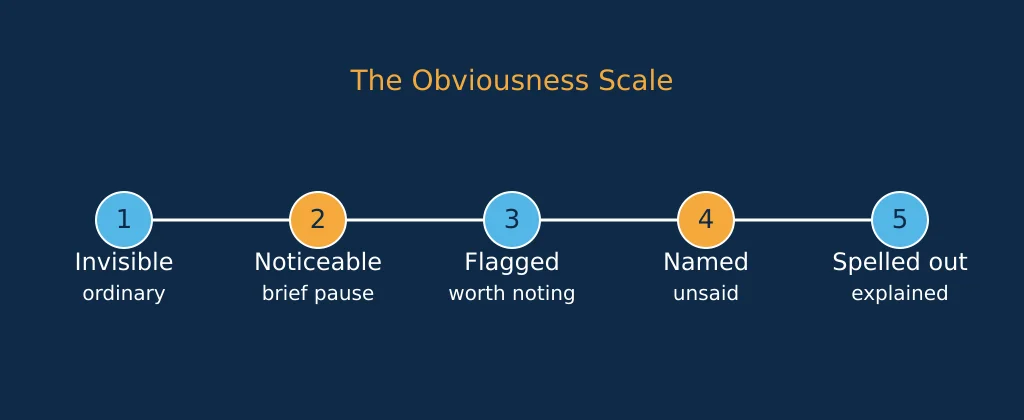
The Five Levels
- Invisible until reread: the clue reads as ordinary detail, and only a second pass reveals it was ever there.
- Noticeable, not loaded: a reader might pause for half a second, but nothing signals that it matters.
- Flagged: repetition, unusual description, or a beat of narrator attention marks the detail as worth remembering.
- Named: a character or narrator states outright that the detail matters, without saying what it means.
- Spelled out: someone in the story says what the detail means and what it points to.
Why Distance Changes the Reading
Distance to payoff is countable. Count the chapters or scenes between where you planted the clue and where it resolves; that part's just arithmetic. Obviousness is a judgment call against the five levels above, not a fact pulled from the page. Here's the rule for all five levels. A clue rated 1 or 2 can sit right next to its payoff, even in the same scene, since nothing marked it as significant in the first place. A clue rated 3 needs real separation: at least two or three chapters, enough for the detail to slip from immediate memory without vanishing entirely. A clue rated 4 or 5 needs six chapters or more before it pays off, enough distance for the detail to fade from short-term memory altogether.
Benefits and Drawbacks of Heavy Foreshadowing
Heavy foreshadowing cuts both ways: it can deepen a manuscript or gum it up, depending on how it's used.
Benefits
- It builds tension. A reader who half-registers that something's off keeps turning pages to find out what.
- It rewards a reread, since a second pass through a well-planted manuscript reveals a whole second layer of meaning the first pass missed.
- It ties a book together thematically. Recurring images and echoed lines make a manuscript feel designed rather than assembled scene by scene.
Drawbacks
- Overdone, it telegraphs the twist. A reader who spots the pattern too early stops being surprised and starts waiting for you to catch up.
- Too many planted details drag the pacing, slowing a scene down with weight that hasn't paid off yet.
- It can over-signal. Stacking three obvious clues on the same twist reads as the author not trusting the reader to catch one.
The Planting-and-Payoff Checklist
This is the test itself: run every clue you know you planted through these five steps, one clue at a time. It assumes you already know roughly where the payoff scene sits, which is a lot easier if you did some work outlining your book before you started drafting.
- Identify the clue. Name the exact sentence, image, or line, one findable spot in the manuscript, not a general feeling that "something's there."
- Rate its obviousness, 1 to 5, against the scale above. Be honest: if a beta reader could underline it and say "wait, that meant something," it's at least a 3.
- Count the distance to payoff. That's the number of scenes or chapters between the plant and the moment it resolves. A prologue clue paying off in the climax might be forty chapters away. A clue planted and paid off in the same scene is zero.
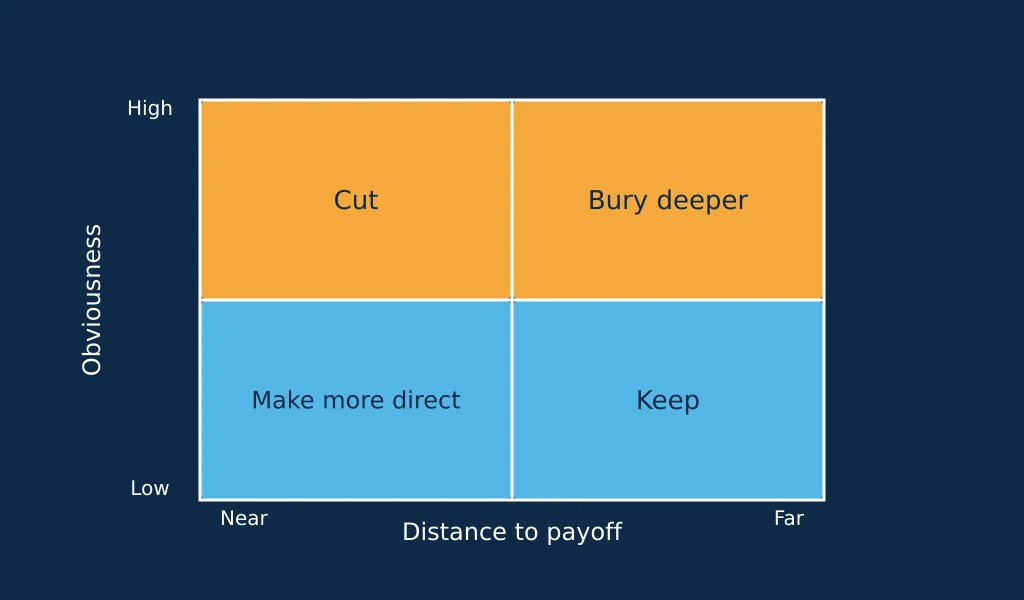
- Apply the rule. A 1 or 2 can sit close, even in the same scene. A 3 needs at least two or three chapters. A 4 or 5 needs six chapters or more before the payoff lands.
- Decide. Cut it if it's obvious and close. Bury it deeper if it's obvious but you want to keep the beat, which usually means stripping the line that flagged it. Keep it if the rating and the distance already match the rule. Make it more direct if it's subtle and close and readers keep missing it.
Here's a constructed example with all five steps run in full. Say your draft mentions a locked drawer once in chapter two, and the payoff (what's inside it) lands in chapter four.
- Step 1: the clue is the sentence describing the drawer, chapter two.
- Step 2: obviousness. The narrator doesn't comment on it, but it's the only piece of furniture described in the scene. Call it a 3.
- Step 3: distance. Two chapters.
- Step 4: apply the rule. A 3 needs at least two or three chapters of distance. Two chapters sits right at that floor. It's thin, but technically inside the range.
- Step 5: decide. Bury it deeper. Cut the extra description that flags the drawer as significant, drop it to a 2, and it can survive at two chapters' distance without reading as a giveaway.
Run this pass on every planted clue once the draft is finished, before final proofing or before you upload to KDP. If you're still drafting and haven't written the payoff scene yet, wait. There's nothing to test a plant against until the payoff exists.
It's a heuristic, not a formula. Genre shifts it: mystery readers tolerate a more overt clue in hindsight than literary fiction readers do, and writing a mystery story often means deliberately playing fair with a level 3 or 4 clue rather than hiding everything at a 1. The checklist also only catches clues you already know you planted; a payoff with no plant behind it at all needs a separate read-through to catch. And it doesn't replace what a beta reader's first pass tells you about whether a clue actually registered, since a writer rating their own clue always reads it with more foreknowledge than a first-time reader ever will.
One More Pass: Count Your Plants Before You Query or Publish
One clue per twist is usually enough. Two, spaced well apart and rated differently, still work. Three or more pointing at the same twist starts to feel like the manuscript doesn't trust its reader, even if each one individually passes the checklist above. Count them per twist, not just per chapter: it's easy to plant a clue in the setup, forget about it, and plant a near-identical one again in act two.
Most plants belong in the setup beats anyway. That's the stretch mapped out in the Save the Cat beat sheet, where a reader's attention is still loose enough to let a detail pass without weight. Run the checklist section by section during your final revision. A clue that's too obvious is a quick fix at the drafting stage and a much bigger one once the file's already live. If you want the fuller device list this piece pulled one entry from, the wider list of literary devices covers the rest.
Foreshadowing FAQ
What is an example of foreshadowing?
Here's a constructed one: a character mentions early on that they've never liked the water, in passing, with no weight attached. Three chapters later, the plot puts them on a boat. The early line only reads as a plant once the boat scene forces the reader to remember it.
What is foreshadowing in simple terms?
A hint now that pays off later: a detail that means little when it appears and a lot once the story reaches the event it pointed to.
Does foreshadow mean predict?
No. A prediction names what will happen. Foreshadowing only hints, and the hint makes sense in hindsight: the locked drawer in chapter two means nothing until chapter four opens it — which is also the line that separates a genuine foreshadowed detail from a MacGuffin or a red herring, as this Chekhov's Gun vs. MacGuffin vs. Red Herring comparison lays out.
What are some examples of foreshadowing?
A storm mentioned once in an early chapter that becomes the literal storm during the climax. A character's offhand comment about never trusting elevators, paid off two acts later when they're trapped in one. An object described in a touch more detail than the scene needs, then returned to once it matters. Run any of them through the checklist above to see whether its obviousness and its distance match.