What Is Dramatic Irony? (And What This Page Actually Untangles)
Dramatic irony is what's happening when you, the reader or viewer, already know something a character on the page doesn't, and you keep reading precisely to watch them catch up. That's the mechanism in one sentence: the situation in which the audience of a play knows something that the characters do not know, as Cambridge Dictionary defines it. The same logic holds for a novel or a film just as easily as it holds for a play.
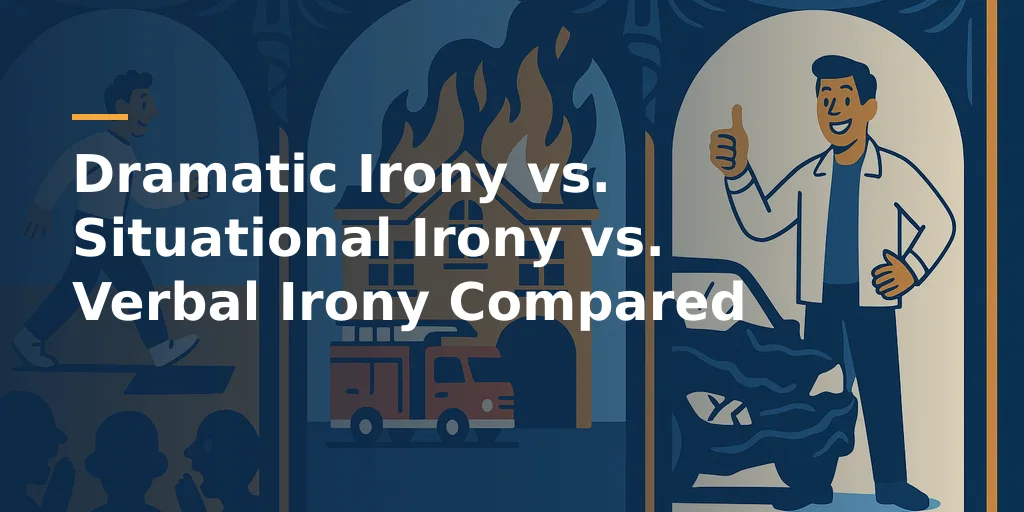
The trouble usually isn't the definition. It's telling dramatic irony apart from its two cousins once a real example lands in front of you. A fire station burns down, and that feels ironic somehow, but is it dramatic irony or something else entirely? A character mutters "oh, perfect" through gritted teeth, and that's clearly sarcasm, but sarcasm isn't automatically the same thing as verbal irony. This page draws the line between all three: dramatic, situational and verbal irony, and it closes with a diagnostic test you can run on your own draft or on whichever example just started an argument.
Dramatic, situational and verbal aren't the only labels irony collects. If you want the wider set, cosmic irony, Socratic irony, historical irony and the rest, the full list of irony types covers those separately. This page stays narrow on purpose, because narrow is what actually settles an argument about one specific example.
Dramatic Irony vs. Situational Irony vs. Verbal Irony at a Glance
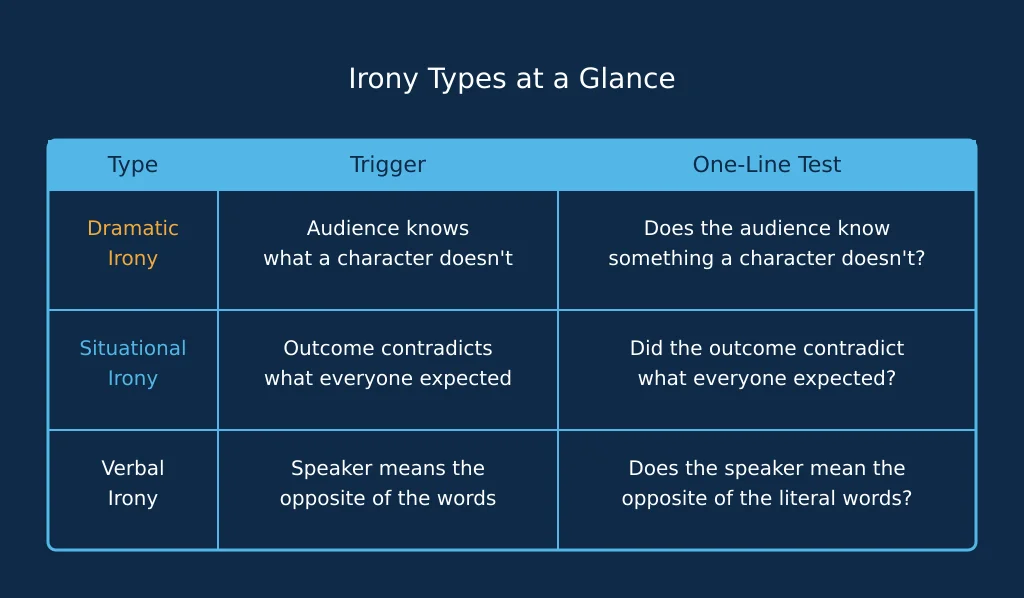
Here's the difference between dramatic irony and situational irony, plus verbal irony, in a shape you can screenshot. Dramatic irony is about who knows what. Situational irony is about what actually happens against what everyone expected. Verbal irony is about what someone says against what they actually mean. Line the three up and most of the confusion falls away.
| Type | Who has the missing information | When it's revealed | Effect it creates | One-line test |
|---|---|---|---|---|
| Dramatic Irony | The audience or reader | Before the character finds out, if the character ever does | Tension, dread, or dark comedy | Does the audience know something at least one character doesn't? |
| Situational Irony | No one; the irony is in the outcome itself | At the moment the outcome happens | Surprise, dark humor, sometimes tragedy | Did the outcome contradict what everyone reasonably expected? |
| Verbal Irony | The speaker, and usually the audience too | Immediately, in how the line lands | Wit, understatement, or sarcasm's edge | Does the speaker mean the opposite of the literal words? |
That right-hand column is also the direct answer to the question that probably sent you here: what is the difference between dramatic irony and situational irony? Dramatic irony needs a gap between what the audience has been shown and what a character knows. Situational irony needs no such gap. Everyone in the scene can know exactly what's going on, and situational irony still works, because the irony lives in the outcome itself, not in anyone's ignorance.
Dramatic Irony, Defined and Shown
Dramatic irony earns the most space here for a reason: it's the type built at the planning stage of a manuscript, often planted in a prologue that hands the reader knowledge a character won't have for chapters, and it's the one most often confused with situational irony. Here's the full definition, then two examples showing the mechanism at work.
The One-Sentence Definition
Dramatic irony, defined plainly: the audience knows something important that at least one character does not, and the story's tension or dark comedy comes from that gap. It doesn't rely on suspense about what happens next. It relies on the reader already knowing.
Example: The Partner the Reader Knows Is Lying
Say your draft has a character walking into a room where, two chapters earlier, the reader watched a business partner confess to embezzling company funds. The character trusts that partner completely. The reader doesn't, not anymore. Every friendly word the partner says now lands differently for the reader than it does for the character. That gap is dramatic irony doing its job. Shakespeare's Romeo and Juliet is the play most often reached for when this device is taught, built on the same kind of gap between what the audience has seen and what a character still believes.
Example: The Poisoned Drink
Picture a thriller scene where the reader has already watched the antagonist slip something into a drink two chapters back. Now the antagonist hands that same drink to the protagonist, smiling, making small talk. The protagonist has no reason to hesitate. The reader has had two chapters to dread this exact moment. That's dramatic irony, and it's a point-of-view decision as much as a plot one. Othello is the play most often cited for this same setup, a trusted figure secretly working against the protagonist. The gap only exists because you chose what the narration would show the reader before the character caught up, and that's worth deciding while choosing a point of view, early in the process.
Situational Irony, Defined and Shown
Situational irony doesn't need anyone kept in the dark, and that's exactly what separates it from dramatic irony. Here's the definition on its own terms, followed by one example.
The One-Sentence Definition
Situational irony, defined in plain terms: an outcome that contradicts what everyone watching reasonably expected, with no character misled and no one saying anything they don't mean. The irony sits entirely in what happened. Nobody's knowledge is doing any work here.
Example: The Marriage Counsellor's Divorce
Imagine a marriage counsellor who has spent fifteen years helping other couples save their relationships, and who then files for divorce herself. Nobody misled anybody here. She knew her own marriage. Her clients knew theirs. The irony isn't a secret coming to light; it's the sheer contradiction between her professional expertise and her personal outcome, sitting in plain view for everyone, including her. O. Henry's short story "The Gift of the Magi" gets taught alongside this same shape: an ending built on outcomes that undercut each other.
Verbal Irony, Defined and Shown
Verbal irony gets confused with sarcasm more than either of the other two mix-ups on this page. They're related. They're not identical, and the difference is worth pinning down before the examples.
The One-Sentence Definition
Verbal irony, defined plainly: a speaker's words mean something different from what those words literally say, often the exact opposite, and the audience is expected to catch the gap without help. Nobody has to be fooled for it to work.
Sarcasm is verbal irony aimed at a person, built to needle them. Plain verbal irony can exist with nobody in the room to needle at all. A character muttering "perfect weather for a picnic" during a sudden downpour, alone, with no one around to hear it, is being ironic without being sarcastic. There's no target for the jab.
Example: The Rival Called "Reasonable"
A character who keeps calling a rival "reasonable" right after each unreasonable thing that rival does is running a pattern worth knowing: repeat a generous-sounding label often enough, in a context that keeps undercutting it, until the audience hears the opposite of what the words claim. Mark Antony's funeral oration in Shakespeare's Julius Caesar is the standard example taught for verbal irony sustained across an entire speech, using this same repetition trick at a larger scale.
Verbal irony sits close to a lot of other wordplay a fiction writer keeps in the same toolkit. Figurative language examples is worth a look next if the line you're drafting needs to do double duty as characterization too.
The Three-Question Test: Which Irony Is It?
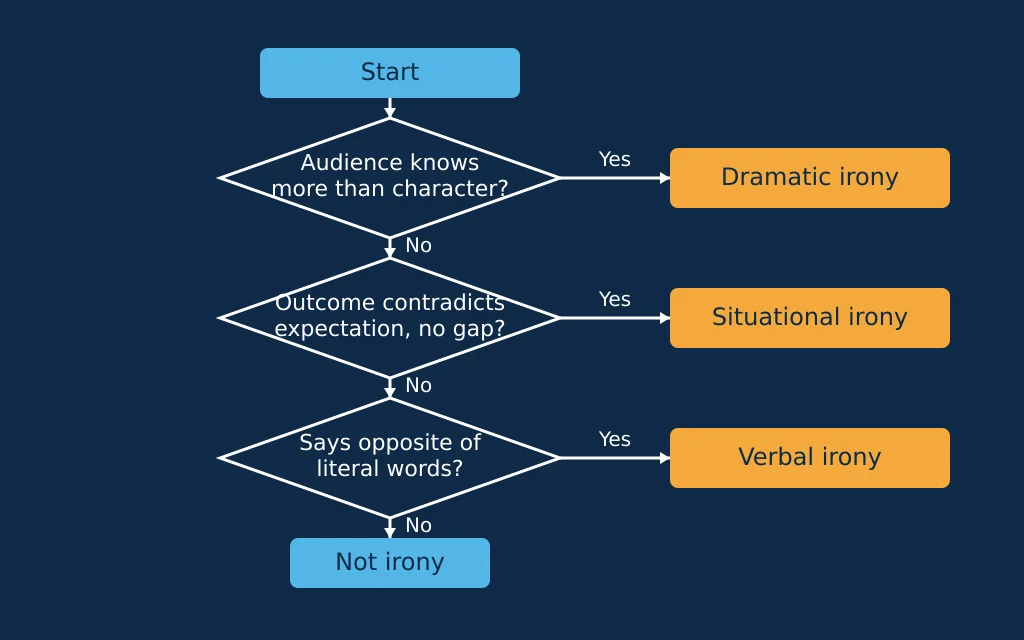
Three canonical definitions are now on the table: dramatic, situational and verbal. Turning each one into a yes or no question gives you a test you can run on anything, a homework prompt, a scene in your own draft, or a claimed example that isn't actually ironic at all.
The Three Questions, In Order: Telling the Types of Irony Apart
- Does the audience, or the reader, know something that at least one character in the scene doesn't? A yes here means dramatic irony. Stop; you don't need the other two.
- Does the outcome contradict what everyone involved reasonably expected, with nobody misled and nobody speaking in code? A yes here means situational irony.
- Is someone saying something that means the opposite of their literal words? A yes here means verbal irony, whether or not there's mockery riding along with it.
These questions run in this order for a reason. Dramatic irony and situational irony are the pair readers confuse most often, since both can involve an ending that catches someone off guard. Asking about the audience's knowledge first settles that pair fast: dramatic irony always needs a gap between what the audience knows and what a character knows. Situational irony needs no such gap.
If you're actively drafting, ask the audience-knowledge question first every time. Dramatic irony has to be built while you're still outlining, since it depends on what you show the reader before a character finds out. Situational and verbal irony are usually chosen later, at the sentence or scene level, during revision. If you're just trying to label something you already read or watched, start with whichever question matches the confusion you actually have.
One limit worth naming: this test assumes you already know how the scene or story ends. It can't classify a scene you're still drafting unless you already have at least a rough outline of what the audience will eventually be shown.
Applying the Test to Five Confusing Cases
Five cases, run through the same three questions, in the same order, every time.
- A fire station burns down. There's no audience secret here: everyone in the scene, and anyone reading about it, learns about the fire at the same time. But the outcome contradicts what you'd reasonably expect of the one building designed to prevent exactly this kind of disaster. Situational irony, resolved on question two.
- Rain falls on a wedding planned for months as an outdoor event. Same pattern. Nobody's hiding anything; the couple and the guests all know exactly as much as each other, and the outcome simply contradicts the planning. Situational irony again.
- A political candidate campaigns hard on a promise to cut taxes, wins the election, and then raises taxes in the first budget. No one in the scene has been kept in the dark: voters heard the promise, the candidate knows the new numbers, and reporters have access to both. The outcome simply contradicts what everyone had been led to expect. Situational irony, resolved on question two, the same way as the fire station and the wedding.
- A character mutters "oh great, another Monday" while nothing about the morning has actually gone wrong. No knowledge gap. No outcome to speak of. Just a line of dialogue that means the opposite of what it says. Verbal irony, on question three. Whether it's also sarcasm depends on whether there's someone standing there to needle.
- A horror movie shows a character on the phone, warned that the calls are coming from inside the house, while the audience has already watched the intruder walk through that same house minutes earlier. This one resolves on question one: yes, the audience knows something the character on the phone doesn't. Dramatic irony, and the test stops there. Questions two and three never get asked, because the first one already answered yes.
Case one is worth a second look, because the same event can flip labels depending on where the knowledge gap sits. As written, nobody in the fire-station scene knows more than anyone else, which keeps it situational. Add one detail: a firefighter left a space heater running before the crew went home, shown to the reader on the page, while the fire chief has no idea that's the cause. Question one now gets a yes. Same fire. Same building. A different question answers it, because the gap moved from the outcome to somebody's knowledge.
Notice, too, that the test named the dominant type present in each case rather than every trace of irony a close reading could dig up. A sarcastic line delivered inside a scene where the audience already knows more than the character does is technically carrying both verbal and dramatic irony at once. The test tells you which one is doing most of the work, not which ones are theoretically present.
Using All Three Without Confusing Your Reader
Knowing which type you're looking at is half of it. The other half is choosing which one earns its place in the scene you're drafting, because each carries a different payoff and a different way of wearing out its welcome.
| Type | Best use in your manuscript | Risk if overused |
|---|---|---|
| Dramatic Irony | Building dread or comic tension across a whole scene or arc, since the reader already knows the stakes before a character catches up | Readers who've been ahead of a character for too long lose patience with them, and the tension flattens into predictability |
| Situational Irony | A twist ending, a chapter closer, or a piece of backstory that reframes what came before it | Leaned on too often, it starts reading like authorial manipulation, and each twist costs less than the last |
| Verbal Irony | Quick characterization through what a character says against what they clearly mean, especially in dialogue-heavy scenes | A character who's ironic in every line starts to sound like the same joke repeating, and sincerity loses its contrast |
Dramatic irony in particular is one of the load-bearing tools behind writing a mystery, where deciding what the reader knows and when they know it is most of the job. If irony is just one tool you're cataloguing on your way to a bigger toolkit, literary devices sorted by effect covers the rest of them.
Run Your Own Scene Through the Three-Question Test
Pull up the scene that sent you looking for this in the first place, or the one you're currently stuck on, and run it through the same three questions, in the same order, right now.
- Start with question one if you're drafting: does the reader already know something your point-of-view character doesn't? Decide that now if your outline hasn't already. Sentence-level fixes come too late for this one.
- Start with question two if you're looking at an ending or a twist. Does the outcome contradict what your reader and your characters reasonably expected, with nobody keeping a secret to make it land?
- Start with question three if you're staring at one line of dialogue. Is the character saying the opposite of what they mean, and is there a target for the mockery or not?
- If two questions both come back yes, name whichever type is doing the most work in that specific moment. That's the label to use. Everything else present is secondary.
- If the test keeps sending you back to the outline rather than to one scene, that's the right instinct. Outlining a book before you lock in a knowledge structure saves you from rewriting three chapters around information the reader wasn't supposed to have yet.
Dramatic Irony: Frequently Asked Questions
What is dramatic irony and examples?
Dramatic irony is the situation where the audience knows something a character doesn't, usually built by showing the reader information a scene's protagonist hasn't caught up to yet. A working example: a reader who's already seen a character's rival confess to sabotage, watching that same rival shake the protagonist's hand two chapters later, all smiles.
What best describes dramatic irony?
A gap in knowledge: the audience is simply ahead of at least one character in the story, and the story plays that gap for tension or dark comedy.
Why is this dramatic irony?
Because question one comes back yes: the audience has been shown something specific that at least one character in the scene hasn't learned yet, and the tension or humor comes from watching that gap close. It isn't coming from a surprising outcome, and it isn't coming from a misleading line of dialogue. Both of those would point to one of the other two types instead.
What is the difference between dramatic irony and situational irony?
Dramatic irony needs a knowledge gap between the audience and a character. Situational irony needs no such gap at all, just an outcome that contradicts what everyone reasonably expected. A character can know everything relevant in a scene and the irony still lands in situational irony, because it's the event itself doing the work rather than anyone's ignorance.