Chekhov's Gun, MacGuffin, and Red Herring: The One-Line Difference
A Chekhov's gun is a detail your story plants on purpose and must pay off later. A MacGuffin is the object or goal every character wants, one your reader never needs explained, because the plot runs entirely on that wanting. A red herring is a deliberate false lead: a detail planted to point your reader somewhere wrong before the truth arrives. All three get introduced early. What separates them is what your story owes the reader by the last page, and that's worth sorting out before you send your draft anywhere.
What Is Chekhov's Gun? (And Why Is It Called That?)
Chekhov's gun is the rule that any element you introduce with real narrative weight has to matter later. If your protagonist notices a locked drawer in chapter one, your reader files that away. If nothing comes of it, the attention they spent noticing was wasted, and a wasted plant reads like a mistake even when it wasn't one.
The Rule Chekhov Actually Wrote
The formulation most often quoted goes something like this: if you say in the first chapter that there's a rifle hanging on the wall, it has to go off by the second or third chapter. If it isn't going to fire, it shouldn't be hanging there at all. That's the whole rule, and it's stricter than most craft advice gets: it demands the detail be used, regardless of how meaningful it already feels.
Where the Rule Comes From
It traces to Chekhov's own writing advice, quoted from his letters rather than from any single play. You don't need to have read him to apply it. You need a drawer, a key, a scar, a line of dialogue your reader will remember, and a plan for what it does later. The locked-drawer scene further down runs the same test against a detail invented for this article, no playwright required.
Drafting a story of your own? Draft scenes from your outline in Sudowrite, an AI writing tool built for fiction that keeps a story bible of your characters. Free trial, no card needed. (affiliate link)
What Is a MacGuffin?
A MacGuffin is the object or goal that gets characters moving without your reader ever needing to understand it. Letters, a briefcase, a treasure map: what it actually is matters less than what it makes everyone do. Swap the object for a different one and the story barely changes, because the object was never the point.
Where the Term Comes From
The term traces to Angus MacPhail and was adopted by Alfred Hitchcock, who defined it simply as the thing the characters care about and the audience doesn't. That functional definition is still the one worth keeping at your desk; the coinage history isn't.
How to Spot One in Your Draft
The clearest test is whether your reader could swap the object for a different one without changing a single choice your characters make. Casablanca runs the clean version of this: in the film's plot, a petty crook named Ugarte boasts to Rick about letters of transit he obtained by murdering two German couriers, papers that let their bearers travel freely across German-occupied Europe and on to neutral Portugal. The audience never needs the bureaucratic logic behind the letters. They only need to know everyone wants them, which is a clean illustration of what a plot actually is: a chain of choices, with the object there only to start the chain moving.
What Is a Red Herring?
A red herring is a detail planted on purpose to mislead your reader, or your detective, about what actually matters. It borrows the same trust a Chekhov's gun spends: your reader remembers a planted detail and expects it to matter, and a red herring uses that expectation against them before setting it right.
What It Does to the Reader
Harry Potter and the Philosopher's Stone runs this exact play. Harry spends most of the book suspecting Snape of plotting to steal the Stone and even of trying to kill him, before the climax reveals that Professor Quirrell, working with Lord Voldemort, is the real threat, and that Snape had been protecting Harry the whole time. The suspicion is the red herring. It's planted early, reinforced across the book, and resolved as false by the end, the one step a red herring can't skip in any genre.
Playing Fair With Misdirection
Mystery and thriller readers expect misdirection; it's part of the deal they signed up for, and writing a mystery story means learning to plant a red herring your reader can forgive once they see how it worked. Literary fiction extends even less patience for one left dangling. A false lead that never gets explained there tends to read as an oversight the writer never caught.
Chekhov's Gun vs. MacGuffin vs. Red Herring at a Glance
All three devices ask your reader to notice something early. What differs is what your story owes the reader by the end, and that's easiest to see side by side.
| Device | What It Does | Does It Need Explaining? | What Happens If You Cut It | Example |
|---|---|---|---|---|
| Chekhov's gun | Plants a detail early and pays it off later | Yes, the reader has to understand the payoff | Cut the plant and you have to cut the payoff scene with it | The locked drawer holding the second will, worked through below |
| MacGuffin | Gets characters moving toward the same goal | No, and over-explaining weakens it | The chase stops, but the story around it can survive | The letters of transit in Casablanca |
| Red herring | Misleads the reader on purpose, then gets exposed | Yes, the false lead has to be explained away | Nothing lost from the plot, but the misdirection goes with it | The suspicion cast on Snape in Harry Potter and the Philosopher's Stone |
One Locked Drawer, Three Devices: A 3-Question Test for Your Draft
Here's the same detail run through all three devices, so you can see exactly what changes. None of this comes from a published book. It's a scene built to isolate the choice you're actually making the moment you plant something in Act One.
The Same Drawer, Written Three Ways
Say your draft opens with your protagonist finding a locked drawer in a dead relative's house. What you do with it next decides which device you've built.
As a Chekhov's gun: the drawer gets opened by Act Three, and what's inside changes what your protagonist does next. Maybe it holds a second will, and that will is why she confronts her brother in the final chapter. The reader remembers the drawer because it eventually matters.
As a MacGuffin: the drawer just needs to stay locked and wanted. Two other characters want what's inside badly enough to fight over it, and your plot runs on that want. You don't have to explain what's inside, or even show it opened, for the chase to work.
As a red herring: the drawer looks like it holds the answer to the mystery your protagonist is chasing, and for two hundred pages everyone acts like it does. Then it turns out to be empty, or full of something irrelevant, and the real answer was somewhere else the whole time. The misdirection is the point, provided you resolve it as false before the last page.
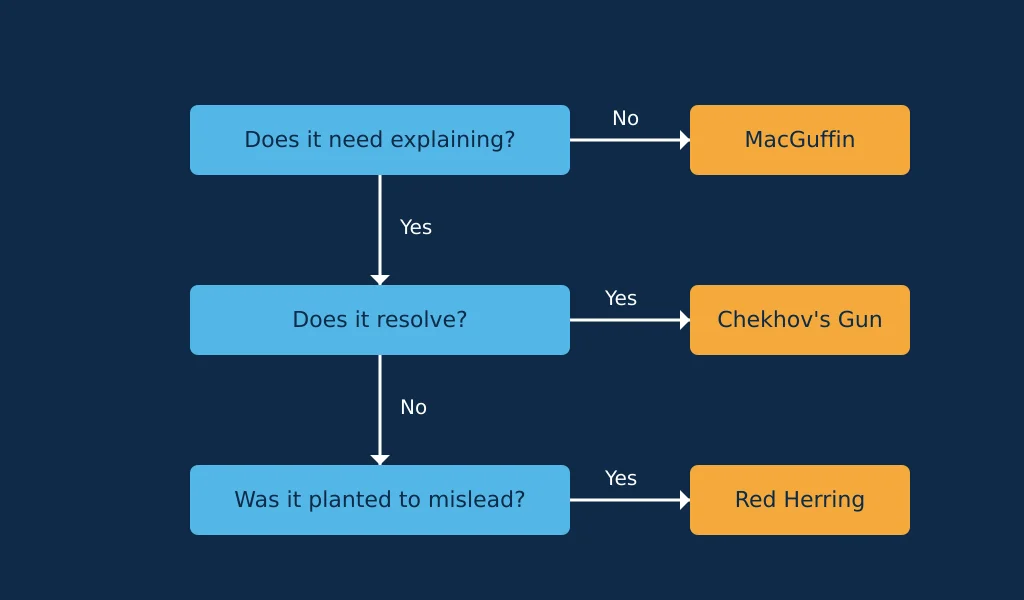
The 3-Question Test
Run any planted detail in your own draft through these three questions, in order. Each one is built from the defining test of one device: Chekhov's rule that a plant must be used, the MacGuffin's job as an unexplained engine, and the red herring's function as a deliberate false lead.
- Does it need explaining? A Chekhov's gun and a red herring both do, since your reader has to understand the payoff or see the false lead corrected. A MacGuffin doesn't.
- Does it resolve exactly as introduced? That's a Chekhov's gun. A detail that never resolves, because characters simply want it, is a MacGuffin instead.
- Was it planted to mislead? If it was, and it's exposed as false by the end, you've built a red herring, whatever else it looked like going in.
The test works cleanly in revision, once you already know what a detail is for. In a first draft you often don't, and that's fine: plant it now, decide later. Some details do double work, too. Your locked drawer could be both a MacGuffin your side characters chase and a Chekhov's gun that pays off for your protagonist, and forcing one label onto a detail like that flattens what it's actually doing.
Default to Chekhov's-gun discipline for anything you show the reader with real weight: if you can't explain why it's there, cut it or pay it off. Save the MacGuffin for the one object that exists to start the chase, not to be examined, and resist the urge to justify it on the page. Reach for a red herring only where your genre has already promised the reader some fair misdirection, mystery and thriller being the safest homes for one. Literary fiction is the venue where an unresolved false lead costs you the most.
Is Chekhov's Gun Just Foreshadowing?
No. Foreshadowing is the broad technique of hinting at what's coming, covering far more than objects: a tone shift, a line of dialogue, a change in weather. Chekhov's gun is narrower and stricter. It applies to a concrete detail shown with enough weight that your reader expects it back, and the rule insists you deliver that payoff. Every Chekhov's gun is a form of foreshadowing, but not every instance of foreshadowing carries that obligation. A lot of it is atmosphere, meant to be felt rather than resolved. If you want the fuller technique, the difference is worth reading about on its own terms.
What's the Opposite of Chekhov's Gun?
The common answer is a detail introduced with real weight and deliberately never resolved, or a red herring used to mislead rather than to pay off. Chekhov's gun promises the reader a return on their attention. Its opposite spends that attention and never gives it back, sometimes on purpose as misdirection, sometimes by accident as a loose thread a writer forgot to tie off. The useful version of that opposite is the deliberate kind: a red herring, planted with the specific job of being wrong. An unresolved detail with no such purpose isn't really an opposite. It's usually just something to catch in revision.
Before You Submit: Audit Every Planted Detail
Before you send your manuscript out, run one pass looking only at the details you gave weight to. Three checks cover most of it.
- Does every gun you show the reader eventually fire? If a locked drawer, an old photograph, or a promise made in chapter one never comes back, cut it or write the scene where it does.
- Does every MacGuffin stay unexplained? If you've spent a page justifying why the letters, the map, or the artifact works the way it does, you've probably turned your MacGuffin into a plot hole waiting to be interrogated.
- Does every red herring get resolved as false? A false lead your reader never sees corrected isn't misdirection, it's an error. A literary reader will hold it against you longer than a genre reader will.
- Does any single detail do more than one of these jobs, and have you decided that on purpose?
Once every planted detail passes, the rest of the revision pass gets easier. For the wider set these three sit inside, the full literary devices reference at 154 literary devices names the rest of the tools. If this kind of three-way sort helped, Dramatic vs. Situational vs. Verbal Irony runs the same comparison over three kinds of irony.
FAQ
Why is it called a Chekhov's gun?
It's named for Anton Chekhov, whose writing advice produced the rifle-on-the-wall formulation the device is built on. See the section above for the exact wording and where it comes from.
What is the difference between a MacGuffin and a Chekhov's Gun?
A MacGuffin drives the plot without ever needing an explanation. A Chekhov's gun is a planted detail your reader expects, and needs, to see resolved. One can stay a mystery forever; the other can't.
Is Chekhov's gun just foreshadowing?
Not quite. Foreshadowing is the umbrella technique, and Chekhov's gun is the stricter rule inside it, the version that comes with an obligation to pay off.
What is the opposite of Chekhov's Gun?
Most commonly, a red herring: a detail introduced with weight and deliberately never paid off as it appeared, or resolved instead as false. An unresolved detail with no such purpose isn't an opposite. It's just a loose thread.