What Situational Irony Actually Requires
A locksmith locked out of his own house. A lifeguard who nearly drowns on his day off. That's the shape of situational irony: an outcome that turns out opposite of what a character, or the reader, expected. Cambridge Dictionary defines the pattern as "a situation in which something which was intended to have a particular result has the opposite or a very different result." O. Henry's "The Gift of the Magi" is a familiar example: Della sells her hair to buy Jim a platinum watch fob chain that costs her twenty-one dollars, and the story's reversal turns that sacrifice against itself. Spotting a gap like that in a finished story is easy. Building one into a scene you haven't written yet takes a deliberate method.
The Three Beats: Setup, Expectation, Reversal
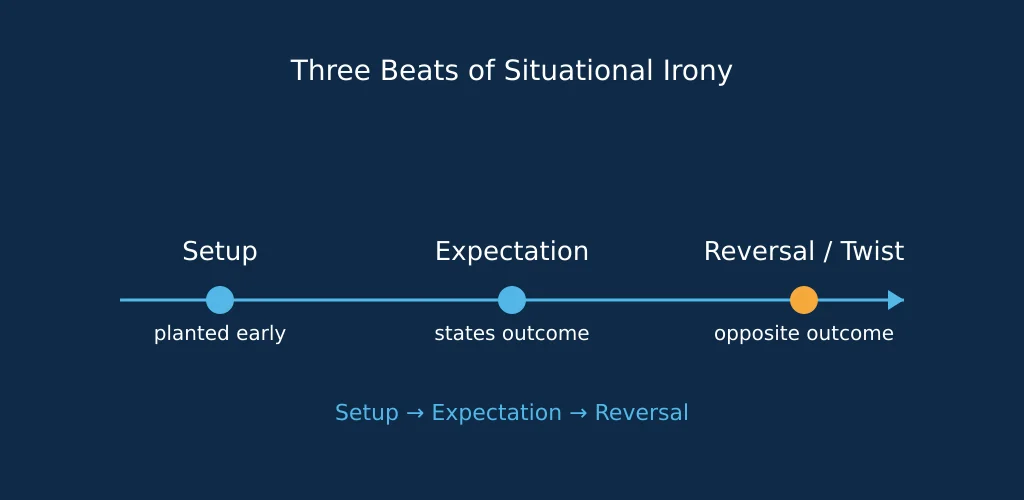
Built deliberately, situational irony runs on three beats, in order. Where each one sits in your plot decides whether the reversal reads as inevitable or as a coincidence dropped in because the ending needed one. Think of it the way you'd think about how plot mechanics fit together: each beat has a job, and skipping one breaks the machine.
The Setup Beat
The setup is the detail you plant early, before the reader has any reason to notice it. It should look incidental: a habit, a possession, a line of dialogue doing other work in the scene. It's also a form of foreshadowing, and how to plant foreshadowing without spoiling it covers that technique in detail. Nobody should clock the setup until the reversal sends them back to find it.
The Expectation Beat
Somewhere in the middle, a character or the narration states, or simply assumes, what's supposed to happen. One confident line does it, quietly contradicting the setup without anyone noticing yet. The gap between this beat and the setup is where the tension lives, right up until the reversal closes it.
The Reversal Beat
The reversal delivers the opposite outcome, using the same detail planted in the setup. This is often where a story's turning point sits, since a reversal this size tends to redirect everything after it. Need somewhere to place one? The Save the Cat Beat Sheet gives you a set of named slots to try it in.
A Worked Example: Planting the Reversal Beat by Beat
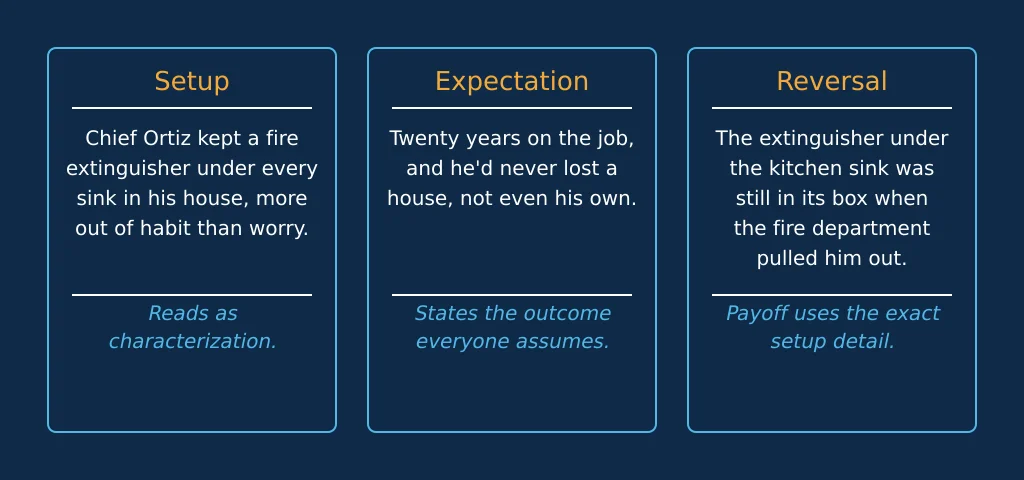
Here's a situational irony example built from scratch: a fire chief whose house catches fire. The scene runs through all three beats, one constructed sentence per beat, labelled so you can see which line does which job.
- Setup: "Chief Ortiz kept a fire extinguisher under every sink in his house, more out of habit than worry." It reads as characterization. Nothing marks it as important yet.
- Expectation: "Twenty years on the job, and he'd never lost a house." A confident line stating the outcome everyone assumes.
- Reversal: "The extinguisher under the kitchen sink was still in its box when the fire department pulled him out." The payoff uses the exact detail from the setup.
Write the reversal line first, then the expectation line, then work backward to plant the setup. Drafting setup-first tempts you to over-explain the planted detail, killing the surprise before the reversal gets to land.
Situational Irony vs. Dramatic and Verbal Irony
All three types of irony involve a gap between what's known, said, or expected and what's actually true. The difference is who's aware of that gap while it's happening. For a fuller breakdown, how situational irony differs from dramatic and verbal irony goes deeper than one table can.
| Type | Who knows the outcome | Example |
|---|---|---|
| Situational irony | Nobody, until the reversal happens | A fire chief's own house burns down |
| Dramatic irony | The reader or audience, not the character | The audience knows a trap is set; the character walks in anyway |
| Verbal irony | The speaker, who means the opposite of what's said | "Lovely weather," said in a downpour |
Pros and Cons of Building on the Three-Beat Method
The payoff is a reversal the reader can trace back to its setup. It works the same way in a domestic drama as in a thriller, and it gives you something concrete to draft: three sentences, not a vague note to foreshadow something in the margin.
The cost is an extra revision pass, since you're rereading your own draft once you already know the ending. It also risks contrivance: a setup that announces itself lets the reader see the reversal coming.
Draft Your Reversal Before You Write the Scene
Work backward from the ending you already know.
- Write the reversal line first: the sentence that delivers the opposite outcome.
- Write the expectation line second: the confident moment where a character or the narration assumes things will go the other way.
- Go back through the draft and plant the setup earlier, buried inside an ordinary action or a line of dialogue that's doing other work.
Situational Irony FAQ
What is an example of situational irony?
The fire chief from the worked example, whose extinguisher is still in its box when his kitchen goes up. Or Della, in "The Gift of the Magi," selling her hair to buy Jim a watch chain, only for the story's own reversal to undercut the gift.
What are irony 5 examples?
This phrasing usually points at the types of irony most often listed together: verbal, dramatic and situational, with cosmic and Socratic sometimes added. This page covers situational irony in depth; for examples of the others, see the full list of irony types.
What is situational irony vs irony?
Irony's the umbrella term. Situational irony is one type under it, the one where nobody, not the character and not the audience, knows the outcome will flip until the reversal actually happens.
What is an irony situation?
A situation where the outcome contradicts what was intended or expected, usually because the very effort meant to secure one result is what produces its opposite.