What Is an Epilogue? What Is a Prologue? (Quick Definitions)
You just wrote a closing chapter and it doesn't feel like a chapter. It feels like something that happens after the book is finished, and that's what an epilogue is: the chapter set after your story's main events are over. It's easy to confuse with a prologue, the chapter that comes before chapter one starts.
The Cambridge Dictionary defines an epilogue as a speech or piece of text added to the end of a play or book, often giving a short statement about what happens to the characters once the story finishes. In a novel, that usually means a chapter written from inside the story, in the story's own voice, closing something the last chapter left open.
A prologue does the opposite job at the opposite end of the book. It sits before chapter one, often outside the main timeline or point of view: a different year, a different narrator, a scene the rest of the novel can't get back to once the plot proper begins. So the core difference is timing: one happens before the story starts, the other after it ends. The epilogue in the self-publishing glossary and prologue in the glossary give you the one-line versions if you just need the terms confirmed.
One thing an epilogue isn't: an afterword. An epilogue stays inside the story, narrated by a character or the same voice that told the rest of the book. An afterword steps outside entirely, with the author talking to the reader about research, process, or a thank-you. You've written an afterword whenever your closing pages focus on yourself instead of your characters. Neither device appears among the elements of a story every manuscript needs; they're optional layers on top.
Prologue vs. Epilogue: Side by Side
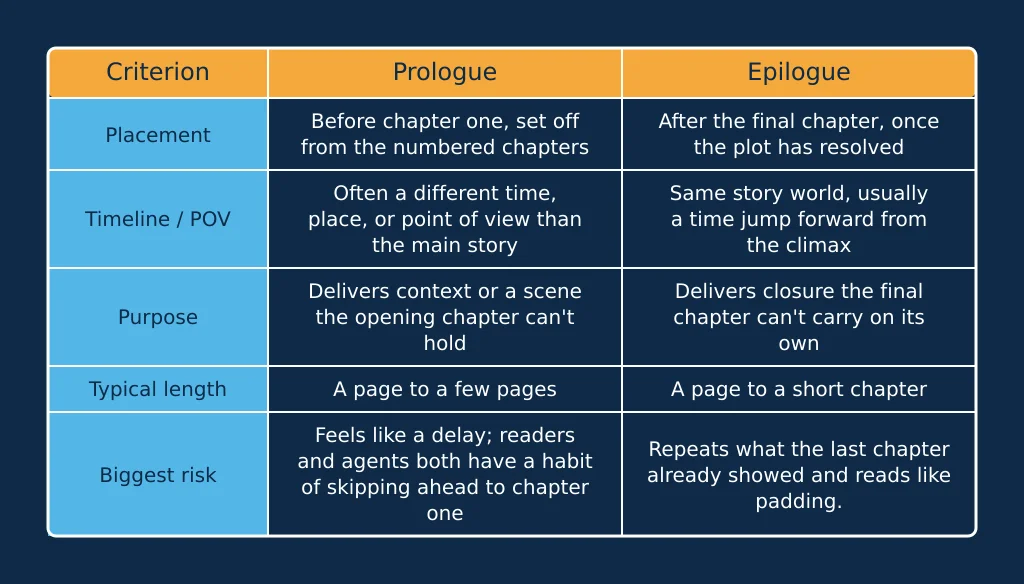
Lay the two devices next to each other and the differences come down to timing, voice, and risk. Here's the comparison in one table.
| Criterion | Prologue | Epilogue |
|---|---|---|
| Placement | Before chapter one, set apart from the numbered chapters | After the final chapter, once the plot has resolved |
| Narrator | Often a different voice or point of view than the main story uses | Same voice that told the rest of the book |
| Time relative to the main story | Before the main timeline, sometimes years earlier | After the main timeline, often a jump forward from the climax |
| What it answers for the reader | Context or a scene the opening chapter can't hold | Closure the final chapter can't carry on its own |
| Common failure mode | Feels like a delay; readers may skip ahead to chapter one | Repeats what the last chapter already showed and reads like padding |
What an Epilogue Is Actually For
An epilogue earns its place doing one of two jobs: confirming what happened to the characters once the plot's tension is gone, or closing a time jump the final chapter can't carry inside its own scene. The two examples below each do one of these jobs. An epilogue sits outside the climb through climax to resolution that Freytag's Pyramid maps, picking up after the resolution has already landed.
Confirming a character's fate
The clearest example is the epilogue of Harry Potter and the Deathly Hallows, set nineteen years later, in which Harry and Ginny, now married with three children, and Ron and Hermione, with two of their own, see the next generation off to Hogwarts. None of that fits inside the last chapter. The tension driving the plot is resolved, and the epilogue's only job is to confirm where everyone landed.
Closing a time jump the final chapter can't carry
The epilogue of Mockingjay jumps twenty years past the main events: Katniss and Peeta are married with two children, the Hunger Games have been abolished, and Katniss comforts her daughter by remembering every good thing she's ever seen someone do. That's a different kind of closure than a fate check. It's proof the world itself changed along with the people in it, and a last chapter set twenty years earlier had no way to show that.
Both epilogues do work the last chapter of their books couldn't. One closes character arcs across a generation; the other closes the story's world across two decades. If your manuscript ends at the climax and still leaves a fate unconfirmed or a future unclear, that's the gap an epilogue is for. If it's a fate, a list of adjectives to describe a character can help you name how each one has changed.
What a Prologue Is Actually For
A prologue earns its place the same way an epilogue does: it does something the surrounding chapters structurally can't. That usually means one of two things: a scene the main viewpoint character never witnesses, or a shift in tone that primes the reader before chapter one's rules take over.
Showing a scene the main POV can't reach
Say your novel is a first-person mystery, narrated entirely by the detective. The strongest opening image, though, might be the crime itself, years earlier, seen through the victim's eyes: a POV your detective narrator will never get once chapter one starts. That's a constructed example, not a real book, but it shows the shape a prologue is built for. One scene. One shift in time or point of view. Then straight into your main character's chapters. Choosing a point of view for the rest of the book is what makes this kind of gap visible in the first place.
Setting tone before chapter one begins
Shakespeare's Romeo and Juliet opens with the Chorus's Prologue, spoken at the opening of Act 1 and set apart from the numbered scenes that follow. It introduces two households alike in dignity in Verona and an ancient grudge breaking to new mutiny. The Chorus isn't a character in the plot, and the speech sets out the stakes before the audience meets anyone in scene one.
Not every opening scene clears that bar. If yours would work perfectly well as chapter one, in your main character's POV, it probably belongs there. Consider starting in medias res instead, dropping the reader straight into action without a separate chapter to set up first, or check tips for starting your story for other ways into the book that skip a prologue entirely.
Decide: Does Your Novel Need a Prologue, an Epilogue, Both, or Neither?
Run your manuscript against three yes/no questions. The first two test the jobs covered above; the third checks your genre. Answer no to the first two and you need neither.
- Does your opening scene need a different time, place, or point of view than your first chapter can reach? A yes here is a case for a prologue.
- Once the plot resolves, is there a fate left unconfirmed, or a time jump the final chapter has no room to show? A yes here is a case for an epilogue.
- Check your shelf. Series romance and thriller readers tolerate a prologue or an epilogue more readily than literary fiction readers do, so weigh what books like yours actually do before you commit.
Run the questions against the three examples on this page. The Chorus's Prologue in Romeo and Juliet passes question one: it's spoken outside the plot's own scenes, in a voice no character in the play uses. Both epilogues pass question two, on different grounds: Deathly Hallows has fates to confirm, and Mockingjay has a twenty-year jump its last chapter had no room for.
Pros and Cons of Adding Either
Here's what each device buys you, and what it costs.
| Device | Pros | Cons |
|---|---|---|
| Prologue | Delivers a scene or POV the main chapters can't hold; can open the book on tension before a slower first chapter; sets genre and tone early | Risks feeling like a delay before the real story starts; adds a POV or timeline the reader has to track before meeting the main cast; if it could be chapter one, it probably should be |
| Epilogue | Confirms a fate or closes a thread the climax had no room for; gives series readers a landing point after the plot resolves; closes a time jump cleanly | Repeats the last chapter if it isn't doing new work; can feel tacked on if it's the only chapter with a time jump; risks slowing a book that's already finished at the climax |
Write It, Then Pressure-Test It Against Your Last Chapter
Draft the prologue or epilogue the way you'd draft any other chapter: a scene, a stake, a reason to keep reading. Length follows from the job. A prologue is one scene, so it ends when that scene ends, usually shorter than a full chapter. The moment it needs more room than that, it's turned into a second story running alongside your first.
An epilogue is a single beat of closure, not a second ending, so it should run no longer than the chapters around it. If yours is running longer, that's the signal: it's doing work the final chapter should have done instead.
The check, once it's on the page, is simple. Ask whether this chapter does something the adjacent chapter can't do. If your prologue could sit inside chapter one without losing anything, cut it and start the book there. If your epilogue only restates what the last chapter already showed, cut it and let the final chapter be the ending.
This is an outlining decision as much as a drafting one, so it's worth settling before you're deep into revisions. Outlining your book covers where a prologue or epilogue fits into the fuller structure, if you haven't placed one yet. If it survives the check above, keep it. If it doesn't, you've saved a chapter a reader would've skipped anyway.
Prologue and Epilogue FAQ
What is the epilogue meaning?
An epilogue is a short chapter or passage added after a story's main events are over, told from inside the story, usually to show what happened to the characters next.
What is a prologue vs epilogue?
A prologue comes before chapter one and often shifts time, place, or point of view. It delivers context the opening chapter can't. An epilogue comes after the final chapter and delivers closure, a fate or a time jump, that the ending itself didn't cover.
Is an epilogue an ending?
Not quite. The real ending is your climax and final chapter, where the plot resolves. An epilogue comes after that, confirming or extending the resolution, the way the epilogue examples above do for their own books.
What is the opposite of a prologue?
An epilogue. A prologue stands before the first chapter and an epilogue after the last, so in a novel each is the other's counterpart: one sets the story up, the other closes it out. Outside fiction, the general opposites of a prologue are words like conclusion, ending and finale.
What is another word for "epilogue"?
There isn't an exact one-word swap for a novel's closing chapter. Reference sources position "epilogue" as the opposite of an introduction or lead-in, which is the front-vs-back distinction the comparison table above makes. "Coda" works informally too, borrowed from music for a closing passage, but it isn't a precise synonym for a novel's epilogue, and it's easy to confuse either term with afterword, which describes the author's own voice speaking directly to the reader.