What Is an Electronic Book, and Why the File Format You Choose Matters
Upload a file to KDP that isn't on its accepted list and you won't get a gentle warning. The dashboard just rejects it, with no note about which page or paragraph is wrong. An electronic book is a book saved as a digital file, displayed on a screen. That one sentence is the entire definition anyone needs.
The confusion starts right after that definition. "Electronic book" describes the content, not the container, and the container is what your e-reader, your phone or Amazon's upload page actually checks. The same manuscript can leave your computer as an EPUB, a DOCX, an old MOBI file or half a dozen other shapes, and only some of them open where you need them to. Get the extension wrong and the writing inside doesn't matter yet, because nothing has opened it.
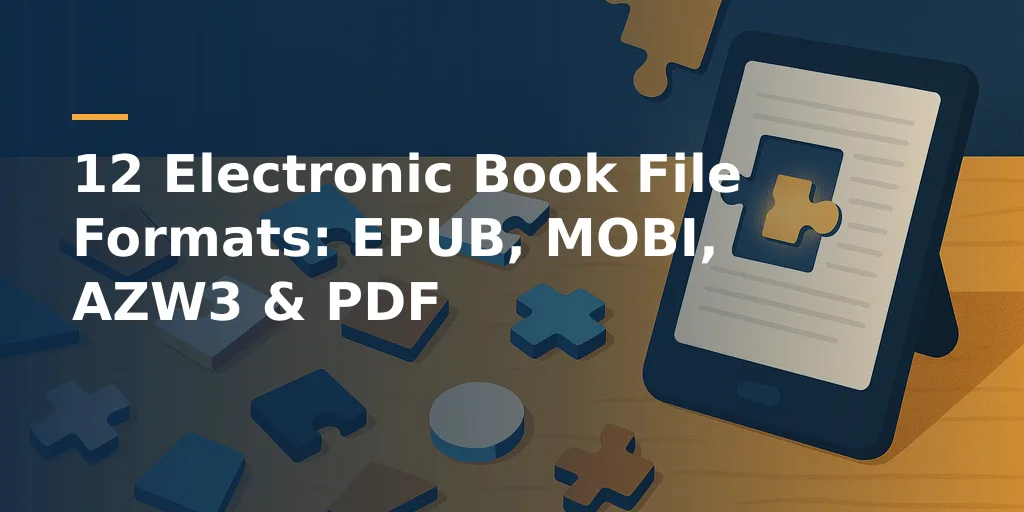
The 12 Electronic Book File Formats at a Glance
The table below covers the format landscape you're likely to run into, from the open standard behind non-Kindle reading apps to the print-ready PDF a coloring book needs. The KDP upload column follows Amazon KDP's own manuscript-format documentation directly, so a format is either listed there or it isn't. Device and app support isn't checked against each app's own published list, so those cells are marked unlisted rather than guessed. DRM stands for digital rights management, copy protection built into a file; if the term's new to you, the self-publishing glossary defines it without jargon.
| Format | Built for | Devices & apps | DRM support | KDP upload status | Still in active use |
|---|---|---|---|---|---|
| EPUB | Open ebook standard | Unlisted | Optional | Listed as an accepted upload format (ebook manuscripts) | Yes, industry standard |
| MOBI | Early Kindle/Mobipocket format | Unlisted | Yes | Not listed | Legacy files only |
| AZW | Amazon's original Kindle format | Unlisted | Yes | Not listed | Legacy |
| AZW3 | Kindle format with fixed-layout support | Unlisted | Yes | Not listed | On-device only |
| KFX | Current Kindle display format | Unlisted | Yes | Not listed | On-device only |
| Fixed-layout document format | Unlisted | Optional | Listed as an accepted upload format (print interiors) | Yes, widely used | |
| DOCX | Word processor document format | Unlisted | No | Listed as an accepted upload format (ebook manuscripts) | Yes, common submission format |
| RTF | Older cross-platform text format | Unlisted | No | Not listed | Rare today |
| FB2 | FictionBook XML ebook format | Unlisted | No | Not listed | Niche |
| DjVu | Scanned-document compression format | Unlisted | No | Not listed | Niche, mostly scanned archives |
| IBA | Apple's interactive fixed-layout format | Unlisted | Unlisted | Not listed | Little used |
| HTML | Web markup, sometimes raw ebook source | Unlisted | No | Not listed | Rarely a finished ebook file |
For KDP authors uploading an ebook manuscript, the format question doesn't need twelve options. Submit a DOCX or an EPUB, both appear on Amazon's own accepted-formats list; MOBI doesn't. If you plan to sell beyond Amazon too, keep a master EPUB in your files, because that's the format nearly every other retailer and library service will take without a fight. Reserve PDF for print interiors and heavily designed low-content books, where a fixed layout matters more than text that reflows to fit the screen.
None of that is free of cost, however. A DOCX conversion can mangle complex formatting (drop caps, footnotes, an image wrapped tight against a paragraph) in ways a hand-built EPUB won't. PDF's fixed layout looks identical on every screen, which is exactly why it reflows badly on a phone or a small e-reader and is the wrong file for a Kindle novel. And keeping an old MOBI file in your archive is harmless for opening on an old device; it just doesn't do anything for a new KDP upload today.
Drafting a story of your own? Draft scenes from your outline in Sudowrite, an AI writing tool built for fiction that keeps a story bible of your characters. Free trial, no card needed. (affiliate link)
Which File Format Does Amazon KDP Actually Want?
KDP splits every upload into two separate jobs, an ebook manuscript and a print interior, and each one has its own accepted format. Mixing them up is a common reason a first upload gets rejected. The full account walkthrough lives on the Amazon KDP hub; this part just covers the file itself.
Uploading an Ebook Manuscript
KDP's own help documentation lists EPUB, DOCX and KPF as the accepted formats for a reflowable ebook manuscript, the kind of file that reflows to fit whatever screen it lands on. KPF doesn't get its own row in the table above because it comes from a different source: Kindle Create, Amazon's free formatting tool, produces it directly. It's still a fully accepted upload for ebook manuscripts, just outside the twelve formats compared here. MOBI isn't on the accepted list. If you're not sure your file counts as one of the three, open KDP's help page and confirm before you upload, since accepted formats can vary by publishing language.
Building a Print Interior
A paperback or hardcover interior is a different upload entirely, and that's where PDF earns its place. A print-on-demand file needs to look the same on every printer's press, page numbers, margins and bleed all fixed in place, which is precisely what a PDF is built to guarantee. The print-on-demand guide walks through trim size and margins in full; if the book itself is a journal, planner or coloring interior rather than a novel, low-content books covers the category end to end.
How to Pick the Right Format for Where You're Publishing
Match the situation to the file, not the other way round. The scenarios below cover the decisions a self-publisher actually faces once the manuscript is finished.
- Publishing on KDP only: upload a DOCX or EPUB manuscript, both listed as accepted formats, and skip MOBI entirely.
- Going wide to Apple Books, Kobo or Google Play: keep a master EPUB. If you're publishing on Google Play Books specifically, it expects EPUB directly, and the same master file carries across other non-Amazon storefronts too, once you've compared distribution routes like IngramSpark vs. Amazon KDP.
- The book is a coloring, activity or journal interior: export a print-ready PDF, since low-content books are built around a fixed page rather than reflowable text.
- Archiving for future edits: save the original DOCX or EPUB, not a converted MOBI or AZW3. A converted file is a dead end for editing; the source file isn't.
- Producing an audio edition alongside the ebook: the same compatibility question comes up on the audio side, so check audiobook file formats before you export a narration file.
Before You Hit Upload: Confirm Your File Type
Run two checks before you click upload, not one. First, match your file's extension against the table above: .epub belongs in the ebook manuscript slot, .docx belongs there too, and .pdf belongs in the print interior slot. KPF isn't part of that table since it comes from Kindle Create rather than a word processor, but it's the third format KDP accepts for ebook manuscripts, so a .kpf file is fine as well. Second, don't rely on memory. Open KDP's own accepted-formats page and confirm the current list is still what you think it is; Amazon updates that page, and requirements can differ by publishing language. A file that worked for someone else's book last year isn't a guarantee for yours today. Two minutes spent checking an extension is cheaper than a rejected upload and a re-export at midnight.
Electronic Book Format Questions, Answered
Can I read an eBook for free?
Yes. Public-domain classics, library lending apps and promotional deals from retailers all offer free electronic book downloads, usually as an EPUB or a retailer-specific format tied to that app.
What is the best electronic book to buy?
There isn't one universal answer. It depends on the device you already own: a Kindle owner is tied to Amazon's own formats, while an EPUB-based library works across almost every other e-reader and app.
What is the best electronic book for beginners?
For someone reading digitally for the first time, an EPUB opened in a phone or tablet app costs nothing extra and needs no dedicated hardware. For someone publishing a first title, the safest format is whichever one your platform lists as accepted, which for KDP means EPUB or DOCX.
Where can I buy an electronic book?
Amazon, Apple Books, Kobo and Google Play all sell electronic books directly through their own apps and storefronts, each tied to its own reading app or device.
EPUB vs MOBI: which one should you use if you're not sure?
EPUB. It's the open format most non-Kindle apps and retailers expect, and it's the one KDP lists as accepted for ebook manuscripts. Keep an old MOBI file around only for backward compatibility with a device you already own, not as the file you build or submit going forward.