What Is a Theme in a Story?
The theme of a story is the central idea it argues about being human, built from what characters do rather than from anything a narrator states outright. What is the theme of a story you're planning, before you've written a single scene? It's whatever claim your plot ends up making about love, fear, power, or justice.
Cambridge Dictionary keeps its definition broad: a theme is the main subject of a talk, book, movie, etc., and in a work of literature, the same entry adds, it's the work's main idea. That's a fair starting point, but it won't tell you how to build one into a book that doesn't exist yet, which is what the rest of this page does. Theme is one of several things a finished manuscript needs (the full set is on the elements of a story page), and if plot and theme still feel tangled, what is a plot untangles the other half.
Theme vs. Topic, Main Idea, Message, and Moral
Five terms get used almost interchangeably, and that's most of the confusion. The topic is the subject matter: grief, war, a small town. The main idea is what the story is about on the surface, roughly a one-line plot summary. The theme is the story's argument about that subject, made through what happens. The message is what the author wants a reader to walk away believing, closer to intent than to the story's own argument. The moral is a lesson stated outright, like the line under a fable.
Take the logline used in the 5-step method below: a lighthouse keeper hides a secret from the mainland. The topic is secrecy. The main idea is that a man keeps something hidden until it threatens to come out. The theme is an argument about what that hiding does to him and to the people who depend on him. Flatten it into a moral and you get "honesty is always better than secrets," which is thinner than anything the story is doing. A moral announces itself. A theme has to be inferred from the plot and the ending, which is why readers trust it more.
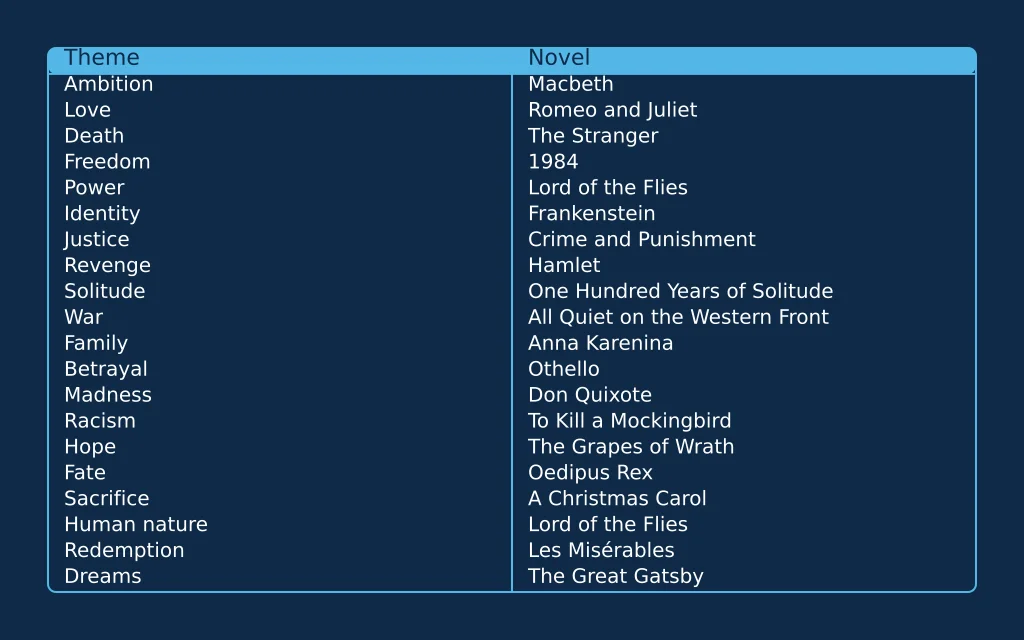
20 Themes Every Writer Should Know (With a Book That Uses Each)
Common themes in literature repeat because human problems repeat. Here are 20, each paired with one widely read book that carries it. Treat the list as a menu: your own theme sentence needs to be more specific than any label on it.
- Good vs. Evil: A clear moral battle between opposing forces drives the plot, and the reader always knows which side to root for. The Lord of the Rings by J.R.R. Tolkien never lets that line blur.
- Coming of Age: A young character loses their innocence and comes out with a harder, truer view of the world. The Harry Potter series by J.K. Rowling tracks that shift across seven books.
- Moral Courage: A character pays a real cost for doing what they believe is right while everyone around them disagrees. To Kill a Mockingbird by Harper Lee never lets its narrator look away from that cost.
- Survival: Characters fight for their own lives or someone else's, and the story tests who they become to make it through. The Hunger Games by Suzanne Collins raises those stakes book by book.
- Power and Corruption: Gaining power changes a character for the worse as ambition curdles into cruelty. Macbeth by William Shakespeare traces that fall.
- Love: A romantic bond forces two people past their first impressions and old assumptions about each other. In Pride and Prejudice by Jane Austen, that shift is the courtship.
- Betrayal: Trust between people close to each other breaks, and the story asks what's left once it does. Gone Girl by Gillian Flynn turns a marriage into that kind of wreck.
- Fear of the Unknown: Something unexplained threatens a community, and the real story is what fear does to the people living through it. Stephen King's It spreads that fear across a whole town's history.
- Obsession: A character's fixation on a person or idea takes over their choices until it costs them something real. Watchers by Dean Koontz builds its tension on it.
- Identity: A character struggles to work out who they are, apart from what everyone around them expects. The Catcher in the Rye by J.D. Salinger follows a narrator stuck in that struggle.
- Redemption: A character with a real wrong in their past works, at a cost, toward becoming someone different. Victor Hugo's Les Misérables follows one man through that change.
- Isolation: A character is cut off from other people, by choice or circumstance, and the story tracks what that does to them. In Mary Shelley's Frankenstein, both the creator and his creation are cut off.
- Justice: A wrong goes unpunished by the system meant to address it, so a character sets out to make it right. The Count of Monte Cristo by Alexandre Dumas turns that pursuit into a long reckoning.
- Man vs. Nature: A character is pitted against a natural force that doesn't care whether they win. The Old Man and the Sea by Ernest Hemingway strips the theme down to almost nothing else.
- Ambition: A character's drive for wealth, power, or admiration pulls them away from what matters. The Great Gatsby by F. Scott Fitzgerald builds its whole tragedy on that pull.
- Family and Loyalty: Blood ties and the obligations that come with them shape what a character will and won't do. East of Eden by John Steinbeck carries those obligations across generations of one family.
- Fate vs. Free Will: A character tries to outrun something that seems predetermined, and the story asks whether that's possible. Oedipus Rex by Sophocles never lets its hero escape that question, however hard he runs.
- Cost of War: Combat is shown for the toll it takes on the people fighting it. All Quiet on the Western Front by Erich Maria Remarque never looks away from that toll.
- Class and Social Status: Where a character starts in the social order shapes what's open to them, and the story tests whether that can change. Wuthering Heights by Emily Brontë builds its central relationship around that gap.
- Sacrifice: A character gives up something they value, sometimes their own life, for someone else's sake. A Tale of Two Cities by Charles Dickens ends on that kind of trade.
How to Spot the Theme in a Book You've Already Read
Sometimes you're naming a theme rather than building one: in a book you've finished, for a class, a book club, or because the ending stuck with you. Finding the theme of a story you didn't write comes down to three questions, asked in order.
The Three-Question Test
- What keeps happening? Look past individual plot points to the pattern: what characters return to, or are pushed into, again and again.
- What does the ending argue? The climax and resolution show where the story lands on that pattern, which makes the ending the theme's clearest expression.
- What would change if the theme were reversed? State the opposite claim and check whether the plot still makes sense. If it falls apart, you've found the real theme.
Worked Examples: To Kill a Mockingbird and The Hunger Games
To Kill a Mockingbird keeps returning to people choosing whether to defend someone the town has already condemned. The ending argues that the choice mattered even though it didn't save everyone it was meant to protect. Literary critic Rosemary Goring, cited on the novel's Wikipedia page, reads its central theme as the conviction that one's moral convictions are worth fighting for, even at the risk of being reviled. Reverse that claim and the courage stops mattering; nearly every major decision in the book depends on it mattering.
The Hunger Games forces its characters to choose between their own survival and loyalty to the people they love, inside a system built to punish both choices. That setup also produces the story's situational irony: the system meant to enforce obedience is what teaches Katniss to defy it. The ending argues that surviving honestly is possible, but only by refusing to play fully by the system's rules. Reverse the claim (survival requires giving up loyalty completely) and the choices driving the later books stop making sense.
Can a Story Have More Than One Theme?
Yes, and most novels do: a primary theme the whole plot bends toward, and one or two secondary themes that support or complicate it without competing for attention. In The Great Gatsby, ambition is the primary theme, with class and the myth of reinvention running underneath it.
For your own draft, pick one primary theme to build your ending and turning points around, and let anything else that surfaces stay secondary. A manuscript that argues two or three ideas with equal weight tends to land none of them.
Build Your Theme in 5 Steps (Before You Draft or While You Revise)
Where you start depends on where you are in the manuscript. If you haven't started drafting, run all five steps before chapter one, because a theme decided early shapes which scenes make the cut. If you're mid-draft or revising, skip to Step 4 and mine what's already on the page instead of forcing a theme backward onto finished chapters. The example below is invented for this article, not taken from a published book, so you can watch the method work end to end.
Step 1: Name the Question Your Story Keeps Asking
Every theme starts as a question the plot circles, not an answer you already know. Ask what dilemma your premise forces on your protagonist, again and again, in different forms.
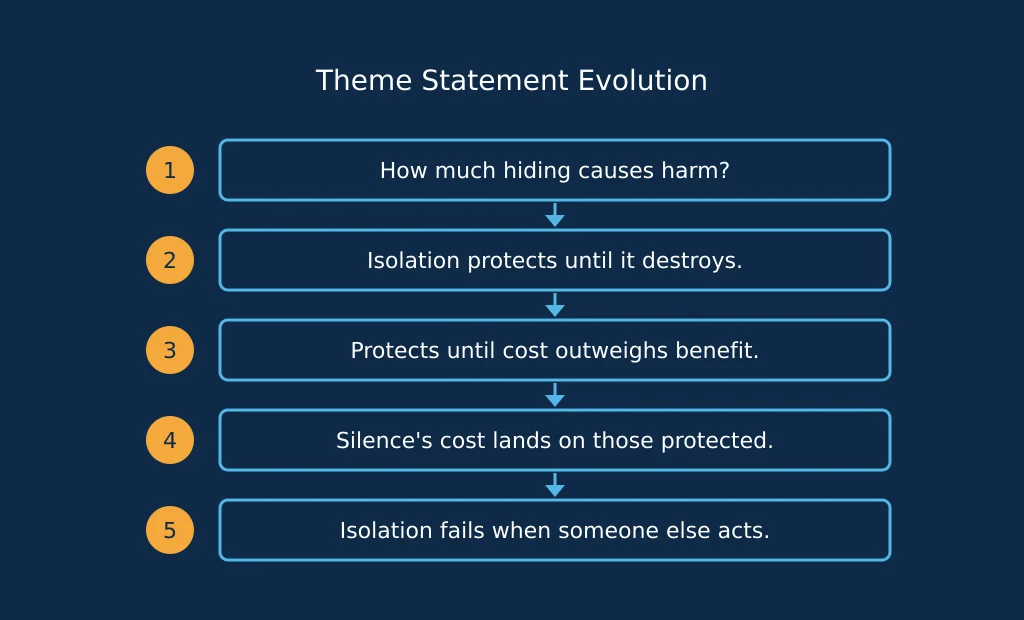
Logline: a lighthouse keeper hides a secret from the mainland. The question it raises is how much a person can hide from the people who depend on them before the hiding does the damage. That's Step 1's version: a question, nothing more specific yet.
Step 2: State It as a Sentence, Not a Single Word
A single word like "secrecy" only names the topic. A theme is a claim, so turn Step 1's question into a sentence that takes a position.
Sentence: isolation protects people right up until it starts to destroy them. It commits to an argument a reader can agree or disagree with, and that's what makes it worth building scenes around.
Step 3: Pressure-Test the Statement Against Your Ending
Your ending has to prove whatever your theme sentence claims. Gesturing at it isn't enough.
Test: at the climax, is it the secret coming out that destroys something, or the effort of keeping it? Say its exposure costs him the one relationship he was hiding it to protect. The sentence holds, and sharpens: isolation protects people only until the cost of maintaining it outweighs what it was protecting.
Step 4: Thread It Through Three Turning Points
A theme that shows up only in your opening and closing pages hasn't shaped the manuscript. Pick three turning points (roughly the first plot point, the midpoint and the crisis) and check that each tests the theme sentence from a different angle.
For the keeper: at the first turning point he chooses silence over confiding in someone he trusts. At the midpoint that silence nearly costs a life during a storm. At the crisis he finally speaks, too late to prevent the worst but in time to save what's left. Threaded through those points, the statement narrows: the cost of his silence never lands on him. It lands on the people he stayed quiet to protect. Repeated objects can carry that idea across scenes, like a locked logbook or an unlit lamp; the 155+ motifs for your novel page has a longer list to pull from.
Step 5: Cut Anything That Argues the Opposite by Accident
Read back through your draft or outline and flag any scene where a character is rewarded for the opposite of what your theme claims. Here the flag lands on the storm scene: if the keeper's silence causes a near-miss but costs nothing lasting, the theme has no teeth.
The fix is a decision: someone else on the mainland breaks the silence for him, before he's ready, and pays a price for it. That carries the theme all the way to the ending.
Final version: isolation fails the moment someone else stops waiting for the keeper to speak for himself. It's sharper than Step 4's version because it names who acts, which gives you something concrete to write toward.
The method has two tradeoffs. Deciding a theme before you draft risks scenes that feel like arguments if you enforce the statement too literally. Mining it from a finished draft, starting at Step 4, can surface an early chapter that quietly contradicts it and needs a revision pass.
Once the statement holds, symbols can carry it without stating it outright; the 110 symbols and what they mean page has options beyond the lighthouse itself. From here, move into full outlining with outline a book in 15 steps, or into beat-sheet structure: the Save the Cat beat sheet has a dedicated spot for stating your theme early in act one.
Pros and Cons of Writing With a Theme in Mind
Here's where a deliberate theme earns its keep, and where it starts working against you.
Benefits of a Deliberate Theme
- A clear theme is a filter for cutting scenes: anything that doesn't serve the argument is easier to spot.
- It gives your ending somewhere to land. A book that knows what it's arguing tends to close with more weight than one that just stops.
- It helps with blurb copy later, because you can say what the book is about in one sentence.
Drawbacks of Forcing a Theme
- Characters can end up serving the point more than the plot, and readers notice when dialogue starts sounding like a manifesto.
- Chasing a theme can crowd out what else a scene needs (tension, character voice, momentum) if it becomes the only thing you're checking for.
Write Your Theme Statement Before You Open the Next Chapter
Whether you built from Step 1 or mined from Step 4, you should now have one sentence that names your book's argument. Write it down somewhere you'll see it every time you sit down to write: your outline, your revision notes, a sticky note above your desk.
It doesn't need to survive the first draft unchanged. Themes sharpen the way the keeper's did, tested against each new scene. Written down, the sentence lets you check the next scene against the argument before you write it, which beats catching the mismatch in revision.
Theme FAQs
What is the meaning of theme?
In fiction, theme means the underlying argument a story makes about its subject, carried by what happens rather than stated as a moral at the end.
What is a theme in a story?
It's the idea the plot keeps circling back to: the claim it makes about love, fear, power, or justice through what the characters do. A reader infers it from the pattern of events, and especially from how the story ends.
What is an example of a theme?
Moral courage in To Kill a Mockingbird, ambition in The Great Gatsby, survival in The Hunger Games.
What is the significance of the theme?
Theme is what gives a finished book a reason to exist beyond its plot. It's why two novels with similar events can read completely differently, and it's often what a reader remembers after the specific scenes are gone. Without one, a manuscript still works as a sequence of events. It just doesn't add up to an argument.