What Is Love Poetry Called? The Short Answer
Search love and poetry and most results are lists of romantic poems that skip the plain fact underneath the question: "love poetry" isn't a form at all. It's a subject. The actual forms have names, and knowing them lets you say exactly what you're writing.
Seven named subgenres carry most of the weight here: the ode, the aubade, the epithalamium, the elegy, the ghazal, the sonnet and the blazon. Each comes with its own occasion and its own structural rule, and a poem built to one of these labels reads as deliberate in a way a generic "love poem" never quite does.
The 7 Named Forms of Love Poetry
What separates each of these types of love poems from the others is a specific rule that makes it that form and nothing else.
- Ode: An ode addresses someone or something directly, often invoking a god or force to act on the speaker's behalf. Sappho's "Ode to Aphrodite" is the model: the speaker calls on Aphrodite for help in the pursuit of a beloved, praying from longing rather than declaring love outright. Use an ode when the feeling is bigger than the person you're addressing.
- Aubade: An aubade is set at dawn, when two lovers have to part because morning has come. The form treats daylight as an intrusion, something pushing the couple out of the night they wanted to keep going. Pick an aubade when your poem needs a built-in deadline: sunrise, a train, a shift starting, anything that forces the parting to happen on the page.
- Epithalamium: An epithalamium is written for a real wedding, addressed to the couple or to the day itself. Use it only when an actual wedding exists in the poem's world.
- Elegy: An elegy mourns someone who's gone, often speaking to the dead as if they could still answer. Thomas Hardy wrote "The Voice" after the death of his wife Emma in 1912, part of the Poems 1912–13 that sit inside Satires of Circumstance. The love shows through what the poem misses.
- Ghazal: A ghazal is built from independent couplets unified by a repeated refrain word. Agha Shahid Ali worked to bring the ghazal's strict classical constraints into English poetry. Choose a ghazal when the feeling repeats on you and you want the poem's structure to circle back to the same word.
- Sonnet: A sonnet runs fourteen lines; that's the one rule every tradition agrees on. Rhyme scheme varies by tradition: a Petrarchan sonnet splits into an octave and a sestet, a Shakespearean one runs three quatrains and a closing couplet. Shakespeare's Sonnet 130 opens by refusing a comparison, "My mistress' eyes are nothing like the sun." Pick a sonnet when you want the compression of a single argument that turns partway through.
- Blazon: A blazon catalogues the beloved's body, feature by feature, comparing each part to something dazzling: eyes to stars, lips to coral, skin to snow. Shakespeare's Sonnet 130 is a well-known counterexample: an anti-blazon that runs through the same catalogue and denies the comparisons one by one. Use a blazon straight if you want extravagant praise; use it inverted if you want the poem to sound more honest than pretty.
Which Form Fits the Love Poem You're Writing
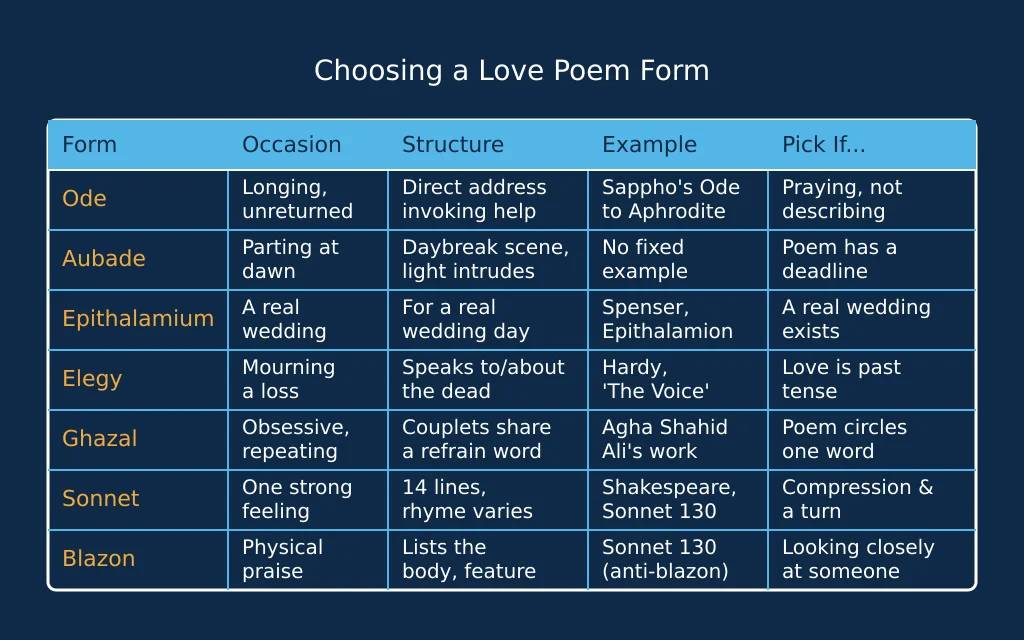
Here's how the seven forms line up. One row per form, matched to the occasion it was built for and the rule that makes it that form.
| Form | Best occasion/feeling | Defining structural rule | Example | Pick this one if… |
|---|---|---|---|---|
| Ode | Overwhelming longing, not yet returned | Direct address to a person or force, often invoking help | Sappho, "Ode to Aphrodite" | you're praying more than describing |
| Aubade | Parting at dawn | Set at daybreak, daylight treated as the intrusion | No named example: any parting forced by sunrise | your poem has a built-in deadline |
| Epithalamium | A real wedding | Written for an actual wedding day, addressed to the couple or the day | Edmund Spenser, "Epithalamion" | an actual wedding exists in the poem |
| Elegy | Mourning someone gone | Speaks to or about the dead; love shown through loss | Thomas Hardy, "The Voice" | the love is already in the past tense |
| Ghazal | An obsessive, repeating feeling | Independent couplets unified by a repeated refrain word | Agha Shahid Ali's work in English | you want the poem to circle the same word |
| Sonnet | A single strong feeling, argued through | Fourteen lines; rhyme scheme varies by tradition | Shakespeare, Sonnet 130 | you want compression and a turn partway through |
| Blazon | Physical praise, or its inversion | Catalogues the beloved's body, feature by feature | Shakespeare, Sonnet 130 (as anti-blazon) | the poem is about looking at someone closely |
Treat "pick this one if" as a starting point. For a beginner working from one strong feeling rather than a fixed occasion, the sonnet or the ode is the safer form to start with: both let you address the feeling directly without needing an event to have happened first. Occasion-locked forms such as the epithalamium, the aubade and the elegy only work once that occasion is real in the poem. Stretch an epithalamium onto a wedding that doesn't exist and it reads like a toast for a party nobody's having. The ghazal's repeating refrain is easy to attempt. Sustaining it in English without the refrain starting to feel like a gimmick is the harder part, especially once the same word has to land differently every time it comes back around. And naming the right form doesn't excuse cliché imagery inside it: the advice below on dodging stock images applies to every row above.
How to Say "I Love You" Without the Clichés Your Chosen Form Invites
Naming the form settles the structure. It doesn't settle the image problem, and every one of these seven forms drags its own built-in cliché behind it.
Every Form Has Its Own Built-In Cliché
An aubade reaches for sunrise as the enemy so often the image barely registers anymore: dawn "creeping" through curtains, the sun cast as an unwelcome guest. An epithalamium reaches for wedding-day platitudes, forever and always and till death, lines that would sit as comfortably on a cake topper as in a poem. An elegy leans on "gone but never forgotten." An ode wants a heart, a rose, moonlight. A blazon wants eyes like stars and lips like cherries before it's finished its first line, and a ghazal can force its refrain word back in just to hit the pattern, whether or not the line has earned it. None of these images are wrong. They're used up. A rose or a heart doing the emotional work in your draft is purple prose standing in for a feeling you haven't pinned down yet.
Trade the Grand Declaration for One Specific Detail
The fix repeats across every form: swap the general claim for a detail that belongs to exactly one person. "You are my sun" fits any lover in any poem ever written. "You reheat your coffee three times before you actually drink it" fits one person. The site's figurative language examples page has comparisons that aren't the stock ones, and common symbols and what they mean gives you alternatives before you reach for a rose or a heart out of habit. A poem written for one real person on one particular Tuesday beats a technically flawless sonnet about love in general.
Who Is the Famous Poet of Love, and What Form Did They Actually Write In?
"Poet of love" covers several different jobs, and each name that comes up for it is tied to a different form.
Sappho's claim rests on the "Ode to Aphrodite," a prayer for help in the pursuit of a beloved. Shakespeare earns the title through his sonnets, Sonnet 130 among them, arguing love through compression and a single turn. Thomas Hardy earns it through elegy, "The Voice" among his examples. Agha Shahid Ali is the name to reach for on the ghazal, since he worked to bring its strict classical constraints into English. The poet worth studying is whichever one wrote in the form you've chosen.
Pick the Form, Then Write One Specific Line
Go back to the table above and find the row that matches what's actually happening in your poem. If there's a wedding, write the epithalamium. If someone's already gone, write the elegy. If you've got one feeling and no event to hang it on, take the sonnet or the ode.
Once you've picked the form, write one line only your poem could contain, a real detail about a real person. If you want a shorter form to practice the same trick in, a haiku forces the same specificity into three lines, and an acrostic poem gives you a hidden-message structure to build it on. If none of these seven match what you're writing, the site's list of other poetry forms covers the rest. The form gets you started. The one true detail is what makes the reader believe it.
Love Poetry Names, Answered
What is the most beautiful love poem ever written?
There isn't one agreed answer, and any page that gives you one is picking a favourite. Sappho's "Ode to Aphrodite," Shakespeare's Sonnet 130 and Hardy's "The Voice" are three strong candidates, each for a different reason: one for its longing, one for refusing its own genre's clichés, one for grief. Pick whichever matches what you're trying to write.
What is love poetry called?
It's a subject, not a form. The named forms under it are the ode, the aubade, the epithalamium, the elegy, the ghazal, the sonnet and the blazon, and the table above matches each to its occasion.
How do I say "I love you" in poetry?
Skip the direct declaration. Give the reader one unrepeatable detail instead, a habit, an object, a specific day. "I love you" fits any poem about anyone; a detail that only fits one person does the same job with none of the cliché risk.
Who is the famous poet of love?
There's no single answer; it depends on the form. Sappho for the ode, Shakespeare for the sonnet, Hardy for the elegy, Agha Shahid Ali for the ghazal.