What Is an Acrostic Poem?
An acrostic poem hides a word, name, or short phrase in the first letters of its lines, spelled out when you read down the page instead of across it. The lines still have to work as real sentences. The hidden word sits underneath as a second layer. That double duty is what separates an acrostic poem from a poem that just happens to look tidy in a column.
A Quick Definition
Line one starts with the first letter of your target word, line two with the second, and so on until every letter has its own line. Most acrostics spell the target using a single starting letter per line. The hidden unit doesn't have to be one letter, though. Some open each line with a full syllable. Others use a whole word, especially in longer or more experimental pieces, where a single letter would get lost against that much text. Read down the page and the message appears.
Where the Word 'Acrostic' Comes From
The term comes from Greek: akro-, meaning "tip" or "end," joined with stichos, meaning "line" or "row of verse." Put together, it describes exactly what the form does, building a second meaning from the tip of each line. The device is old enough that it predates any writer you'd name in a search box today, and it appears in acrostic psalms. If you want a one-line reference definition alongside the rest of the alphabet, the Self-Publishing Glossary: A page has it filed there. And if you're weighing an acrostic against other devices worth knowing by name before you commit a page to it, the acrostic entry sits inside the site's list of 154 literary devices.
The 4 Types of Acrostic Poems
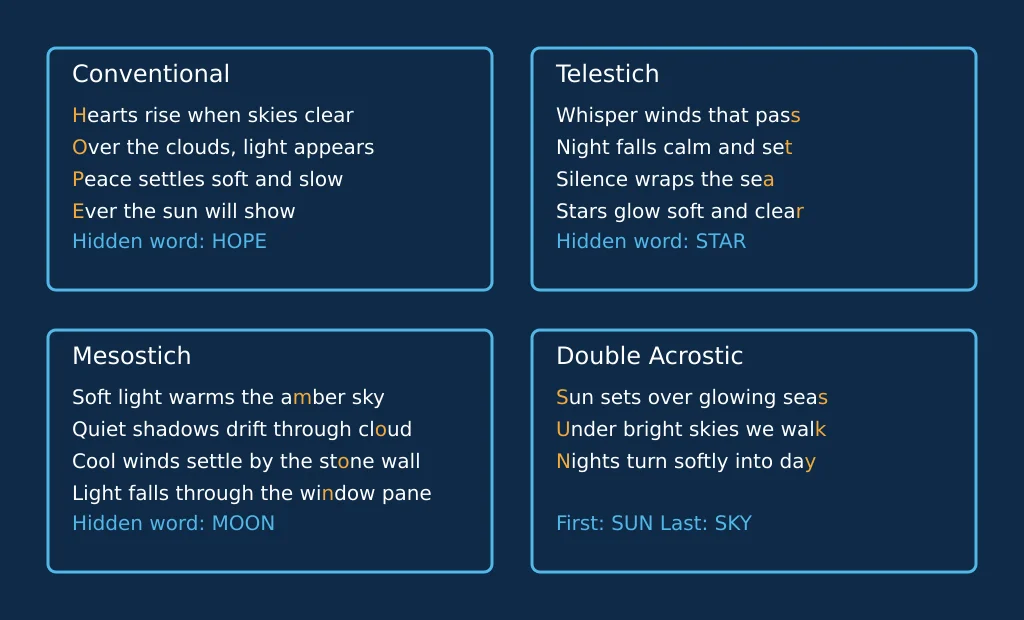
Acrostic isn't one trick. It's four, and the difference between them is where the hidden letter sits inside the line. Once you can spot all four, you'll start noticing which one fits a given project depending on how visible you want the message to be.
- Conventional (Name) Acrostic: The first letter of every line spells the word, read straight down the left margin. This is the version most readers picture by default and the one worth starting with. Say your word is HOPE: four lines, opening with H, O, P, then E.
- Telestich: The hidden word sits in the last letter of each line, running down the right-hand edge of the poem. Readers rarely check a line's last letter on a first pass, which makes it a good choice for a message meant to reward a second reading.
- Mesostich: The target letters fall somewhere inside the line, with the letter landing inside a natural word rather than opening one. It hides the trick almost completely from a casual read, though it's harder to build cleanly for exactly that reason.
- Double Acrostic: Both the first and last letters of each line spell something, either the same word twice or two different words at once. Done well, it lets a single poem carry two names or a name and a title at once, which is why it turns up in more elaborate dedications.
If none of the four fit what you're drafting, the site's list of 33 other poetry forms covers the rest of the shelf.
A Long Tradition of Hidden Names, and One You Can Build Yourself
Poets have hidden a dedicatee's name inside verse for centuries. Poets including Edgar Allan Poe and Lewis Carroll are among the names associated with the device, though reconstructing their actual texts from memory isn't something to trust on a page like this. None of that history is required to build your own acrostic. The mechanics work today exactly as they did then.
Spelling a Name in the First Letters
Say you want to dedicate a short poem to someone named Grace. Set the letters G-R-A-C-E down the left edge of the page, one per line. That's a scaffold, not a finished draft. Then write one line per letter, letting each line open with its letter:
- G: Give this page to someone worth the ink.
- R: Right from the start, she made the room feel warm.
- A: And every kindness came back doubled.
- C: Carry that memory further than the page ever will.
- E: Everything about her deserved a poem.
Cover the left edge and read only the sentences: it still works as a five-line dedication. Read down the left edge and it spells GRACE. The scaffold goes down first; the sentences are what actually decide if the poem works.
Hiding the Same Name on a Diagonal
The harder version of the same trick moves the target letter further into the line each time, so the hidden word runs diagonally instead of straight down the margin. Here's a three-line version hiding the name AMY, counted by letter position rather than by which letter starts the line:
- Amy could always find the joke in anything.
- Amazing memories always follow her.
- So young and kind, everyone says.
Ignore the spaces and count letters: the first letter of line one is A, the second letter of line two is M, and the third letter of line three is Y. Tracked on that diagonal, the lines spell AMY even though only the first line starts with its target letter. It takes longer to draft, and it's far harder for a reader to spot. That's the entire point of using it.
How to Write an Acrostic Poem in 6 Steps
The process below works for a name, a single word, or a short phrase, and it's the same one used for the Grace example above. If you want to weigh it against a different short, rule-bound form before you settle on one for your manuscript, how to write a haiku poem walks through a different set of constraints.
- Pick your word or phrase. Write it vertically down the left side of a blank page, one letter per line, before drafting anything else.
- Brainstorm freely for each letter: images, memories, facts, or phrases connected to your topic, more than you'll actually use.
- Draft one line per letter, letting each letter open the line. A word that merely contains the letter somewhere in the middle doesn't count for a conventional acrostic.
- Cover the vertical word with your hand and read only the sentences straight through. A weak acrostic falls apart here; a strong one reads like an ordinary poem that happens to carry a hidden shape.
- Cut anything that only exists to hit a letter: forced rhymes, filler adjectives, an image that doesn't connect to the rest of the poem. A line that feels bolted on usually is.
- Read the poem vertically one more time, top to bottom, to confirm the hidden word still reads clean after your edits. It's easy to break the vertical spelling while fixing a line's grammar.
Pros and Cons of Writing Acrostic Poems
An acrostic is one of the fastest poetic forms to learn and one of the easiest to get wrong in a way readers actually notice. It's worth weighing both sides before you build a whole gift book or a full poetry collection around one.
| Pros | Cons |
|---|---|
| Gives a beginning writer, or a reluctant one, an immediate structure to fill instead of a blank page. | Can force awkward or padded phrasing when a line has to open with an uncooperative letter like Q or X. |
| Works well for dedications and gifts, since the hidden name makes a poem personal without saying so directly. | Risks reading as a novelty or a puzzle rather than a poem, especially if the sentences don't hold up on their own. |
| Fits naturally into themed low-content book pages, activity spreads, and journal prompts, where a visible pattern is part of the appeal. | Gets harder to sustain over many lines without repeating the same handful of sentence openers. |
| The vertical word doubles as a built-in title or dedication, so one poem does two jobs at once. | A double acrostic or mesostich takes far longer to draft than the finished poem suggests to a reader. |
| Short and self-contained, so it's easy to test in a single sitting before committing it to a manuscript. | Loses its effect quickly if a reader has already seen several acrostics on the same page or in the same book. |
None of that means you should skip the form. It means draft the sentences first, check the vertical word second, and publish only the ones where both halves hold up on their own.
Where an Acrostic Fits: Dedications, Activity Pages, and Poetry Collections
Knowing the form is only half of it. The other half is finding a spot in an actual manuscript where a hidden word earns its place instead of feeling stapled onto the front matter, whether that's a dedication page, an activity spread, or one poem tucked inside a larger collection.
In a Dedication or Gift Poem
A dedication page is the natural home for a name-based acrostic. Readers already expect that page to be personal, so a hidden name doesn't feel gimmicky the way it might in the middle of a more serious poem. Keep it short, four to eight lines, and resist the urge to explain the trick in the text. Let a reader find it.
In a Kids' Activity Book or Themed Journal
Low-content publishers use acrostics constantly in seasonal and educational activity books, where a name or holiday word doubles as both a writing prompt and the page's visual pattern. If that's the shelf you're building toward, the site's KDP activity book templates already include interior layouts built for exactly this kind of page. Whichever spot you choose, treat the vertical word as the scaffold and the sentences as the actual test. A poem that only works read downward isn't finished yet.
Acrostic Poem FAQ
These four questions come up most often once the basic mechanics click.
What is an example of an acrostic poem?
Here's a short one built for this answer, spelling READ down a book-themed dedication: Reaching for the shelf again tonight. Every cover promises somewhere else. And the first page always forgives you for being late to it. Dog-ear it, it won't mind. Read the sentences straight through and it's a four-line note about loving books; read down the left edge and it spells READ.
What is an acrostic poem?
It's a poem where the first letter of each line, or in some variants a full syllable or a whole word, spells a target when read down the page. Whichever unit it uses, the horizontal sentences still have to hold together as an actual poem. A vertical word with no working sentences underneath it isn't a finished acrostic, it's just a list of letters.
How is Psalm 119 an acrostic poem?
It's built around the Hebrew alphabet rather than around a single name. Each section of the psalm is keyed to a successive letter, a structure generally read as a memory aid for reciting a long passage aloud, which is why it's often pointed to as one of the oldest acrostic patterns still widely read today.
What are the rules for acrostic poems?
There's one hard rule: the target letters have to appear in order, one per line, in whatever position the type calls for: first letter for a conventional acrostic, last letter for a telestich, or a letter partway into the line for a mesostich. Line length, rhyme, and subject matter are all style choices, not requirements. The one real failure mode is a line so contorted around its letter that it stops reading like a sentence at all.