No Fixed Number, But a Real Range
How many sentences are in a paragraph? There's no fixed count that holds across every kind of writing. The honest range in published prose runs from about three to eight sentences, and that band stretches or shrinks depending on what you're writing and why. An academic essay wants something closer to five. A thriller runs closer to three, sometimes one. Neither is wrong. This piece checks that range against the actual opening paragraphs of eight bestselling novels across horror, suspense, psychological thriller, literary fiction, middle-grade fantasy, YA dystopian, and commercial romance, so you can see what your genre does on the page before you start counting your own.
The Short Answer
If you need one number to write down: three to eight sentences covers most competent expository prose, the kind built to develop one idea completely before moving to the next. Fiction plays by a looser rule. Three of the eight verified opening paragraphs checked for this piece run to exactly two sentences, Harry Potter, Odd Thomas and the first paragraph of The Notebook prologue, and one runs to six, Gone Girl. That three-to-eight range shows up across composition handbooks and style guides, not from any single named authority, which is why it flexes once you leave the essay form. Use it for a report or an essay. For a novel, check what your genre's readers already expect first.
Why the Short Answer Isn't Enough for Fiction
Fiction paragraphs answer to something else entirely than the topic-support-landing shape essays and reports run on. A paragraph in a chase scene might exist to land one action beat, nothing more. A paragraph in a reflective passage might let a character sit with a memory for six sentences before the scene moves on. How you go about choosing a point of view changes the math on its own: a first-person, present-tense narrator tends toward shorter, breath-length paragraphs, while a distant third-person narrator surveying a whole town can run long. What matters for a novel is the rhythm your genre's readers already expect, and counting real books shows you that rhythm directly.
What Actually Makes a Paragraph "Finished"? Topic Sentence, Support, and Landing
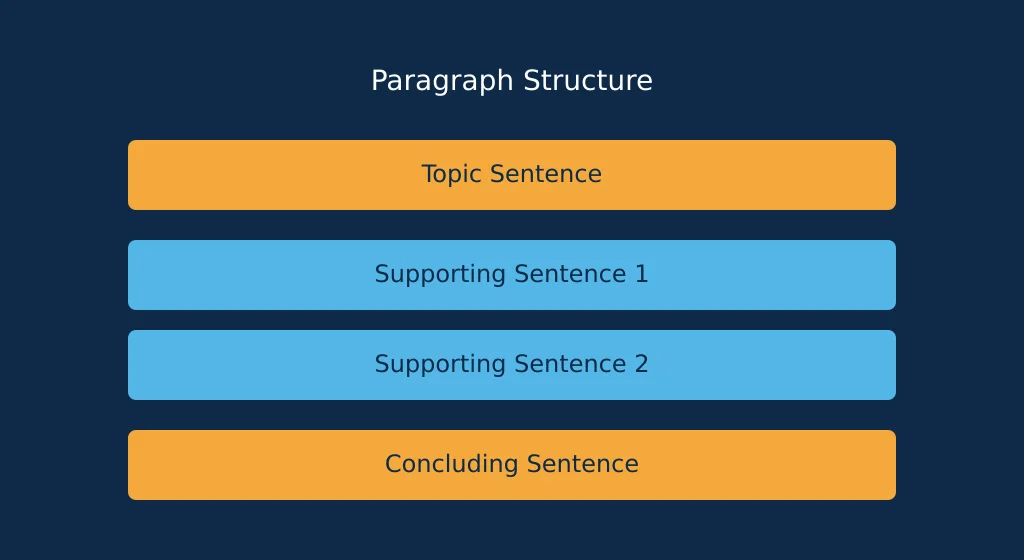
Most of the length rules floating around online come from one structural idea: a paragraph should introduce a point, develop it, and close it. That shape works well for essays and reports, and it's worth knowing even if you write fiction, because it explains why a paragraph feels "done" at all.
The Topic Sentence
The topic sentence states the paragraph's one job: the claim, the observation, the beat it exists to deliver. In an essay, it usually opens the paragraph outright. In fiction, it's usually implied. The first sentence sets a scene or an action, and everything after it serves that same moment.
The Supporting Sentences
These are the sentences that develop the opening idea: evidence and explanation in an essay, sensory detail and consequence in a story. This is where sentence count varies the most, because "enough support" is a judgment call.
The Concluding Sentence
An essay paragraph often closes by restating or transitioning: tying the point off before the next one begins. Fiction usually skips this. A narrative paragraph tends to end where the beat ends, not where a thought gets summarized, and that's one of the clearest ways published prose departs from the essay template.
Where Fiction Draws the Line Instead
If the essay model doesn't tell you where to break, something else has to. In fiction, the break usually falls at one of four seams: a new speaker takes over and the paragraph turns over with them; the scene shifts from action to reflection, or back again; time or place jumps, even by a few seconds or a few feet; or the point-of-view character's attention lands on something new. You'll see this exact seam later in Lee's four-sentence opening. Watch for these seams. Once you can name them, deciding where to break stops being a guess.
Drafting a story of your own? Draft scenes from your outline in Sudowrite, an AI writing tool built for fiction that keeps a story bible of your characters. Free trial, no card needed. (affiliate link)
Paragraph Length by Type of Writing
How long a paragraph should be depends largely on what kind of document it's sitting in. An essay, a blog post, a business report, and a novel aren't doing the same structural job, so treating them as one category is where the flat "3 to 8 sentences" answer breaks down. The table below separates them out, with genre fiction and literary fiction shown as two distinct rows, since the gap between a thriller paragraph and a literary paragraph is often wider than the gap between fiction and nonfiction generally. Each of these bands is where that general three-to-eight range lands once you split the writing types apart, and fiction is the pair of rows that breaks it in both directions, dropping to one sentence in genre fiction and climbing to nine in literary fiction.
| Writing type | Typical sentence range | Why it lands there |
|---|---|---|
| Academic essay | 4–7 sentences | Built around the topic-support-conclusion shape; a grader expects one fully developed idea per paragraph. |
| Blog/web content | 1–4 sentences | Written for scanning on a screen; short paragraphs and white space keep a reader moving down the page. |
| Business report | 3–6 sentences | Needs to be skimmable by a reader looking for one specific figure or decision, not reading start to finish. |
| Genre fiction (thriller, horror, YA) | 1–5 sentences | Built for pace; short paragraphs and one-line paragraphs push the eye forward through action and dialogue. |
| Literary fiction | 3–9 sentences | Prioritizes interiority and description over pace, so paragraphs are given more room to build an image or a thought. |
Trouble starts when a manuscript borrows the wrong row, and it's a mistake that's easy to make when you're leaning on an AI drafting tool like Sudowrite to speed up a first pass. An essay-length paragraph, four to seven sentences building one idea in full, dropped into the middle of a chase scene stops the chase to finish a thought nobody's trying to have at speed. The reader wanted three sentences and a jump to the next beat; instead they got a fully argued point sitting where a gunshot should be. It happens in the other direction too. A blog-length paragraph of one or two sentences dropped into literary fiction reads thin, more like a series of captions than a scene with room to breathe.
Hybrid genres make the choice less obvious. A cozy mystery sits somewhere between genre fiction's pace and literary fiction's interiority, so which row applies? Check the scene, not the whole book. A cozy mystery's kitchen-table conversation can run closer to the literary fiction row, three to nine sentences, because the point of that scene is the relationship, not the case. The same book's confrontation scene, the one where the killer finally gets named, probably wants genre fiction's shorter, faster paragraphs instead. Very few manuscripts sit in one row cover to cover. Most competent books move between rows scene by scene, matching the paragraph to what that particular page is doing.
We Counted the Opening Paragraphs of 8 Bestselling Novels: Here's What We Found
Here's how sentences-per-paragraph in fiction actually looks when you check real books. Each row gives the sentence count of that novel's true opening paragraph, checked against the published text. The Notebook's prologue runs three short paragraphs before the story proper starts, so all three are logged instead of just the first.
| Novel | Author | Genre | Sentences in opening paragraph |
|---|---|---|---|
| It | Stephen King | Horror | 5 |
| Watchers | Dean Koontz | Suspense/thriller | 3 |
| Odd Thomas | Dean Koontz | Paranormal suspense | 2 |
| Gone Girl | Gillian Flynn | Psychological thriller / domestic suspense | 6 |
| To Kill a Mockingbird | Harper Lee | Literary/Southern fiction | 4 |
| Harry Potter and the Sorcerer's Stone | J.K. Rowling | Middle-grade fantasy | 2 |
| The Hunger Games | Suzanne Collins | YA dystopian | 5 |
| The Notebook | Nicholas Sparks | Commercial romance | 2 / 6 / 9 (prologue, paragraphs 1–3) |
The longest true opening paragraph among the eight belongs to Gone Girl, six sentences building toward an unsettling head fixation and a quiet dose of pathos, examined in full below. Three of the eight open on exactly two sentences: Odd Thomas, Harry Potter, and the first paragraph of The Notebook's prologue. That prologue then goes further than anything else in the sample once it reaches its third paragraph, opening on the question "My life?" and running to nine sentences on its own. Here's what's driving the rest of the field.
- Koontz opens Watchers in third-person past tense: on his thirty-sixth birthday, Travis Cornell rises at five, dresses in hiking boots, jeans, and a blue-plaid shirt, and drives his pickup from Santa Barbara into rural Santiago Canyon. Three plain, sequential sentences, no detour.
- Odd Thomas opens across four short paragraphs before the first scene even starts. Paragraph one gives the name and explains why you shouldn't care; paragraph two runs through a string of celebrity denials; paragraph three is a single sentence, dropped in on its own for punctuation.
- Rowling's opening runs exactly two sentences: the Dursleys are perfectly normal, thank you very much, and they're the last people you'd expect to be involved in anything strange. Paragraph two opens with one flat sentence naming Mr. Dursley's job, director of a drill firm called Grunnings.
- Collins opens in first person, present tense, on the cold side of the bed where Prim should be. Katniss reaches for her sister, guesses at a bad dream, and answers herself in three words on the page: "Of course, she did." The paragraph closes on "This is the day of the reaping."
- Sparks opens the prologue on two questions only, who he is and how the story will end. The second paragraph spends six sentences on a foggy window, layers of clothing, and a space heater against eighty years of cold, before the third opens on "My life?" and runs nine sentences long.
Three Paragraphs Worth Reading Twice: King, Flynn, and Lee Up Close
Numbers in a table only go so far. Two of these opening paragraphs are quoted here in full, so you can see what the counts above look like on the page. King's is walked through element by element instead, since reproducing that excerpt isn't necessary to make the same point.
- Stephen King's It: Five Sentences to Build Dread:
King's real opening paragraph runs five sentences. Together they place a paper boat riding a rain-swollen gutter down Witcham Street, a dark traffic light with no power reaching it, a week of steady rain, Derry's electricity still out, and the year: 1957. Nothing happens yet. The paragraph exists to set a street, a storm, and a year before the story asks anything of the reader.
That's a patient way to open a horror novel, and it works because dread here comes from atmosphere, not event, worth remembering if you're writing a horror story of your own.
- Gillian Flynn's Gone Girl: Six Sentences, One Fixation:
The real opening paragraph runs six sentences. "When I think of my wife, I always think of her head." "The shape of it, to begin with." "The very first time I saw her, it was the back of her head I saw..." "Like a shiny, hard corn kernel or a riverbed fossil." "She had what the Victorians would call a finely shaped head." "You could imagine the skull quite easily."
Nick names his obsession outright, then breaks off into a fragment that works like a stage direction: the shape of it. A memory follows, the first thing he ever noticed about her, before two comparisons turn the head into an object worth studying, a corn kernel, a riverbed fossil, something closer to an antique than a person. The paragraph lands cold. "You could imagine the skull quite easily" isn't a sentence a besotted husband says about someone he loves. Something's wrong underneath it.
Nick opens on his wife as a person and closes the same six sentences on her as an object he could hold in two hands and turn over. That's the register a psychological thriller narrator can use to sound reasonable while quietly telling the reader something is off.
- Harper Lee's To Kill a Mockingbird: Four Sentences, a Whole Childhood:
When he was nearly thirteen, my brother Jem got his arm badly broken at the elbow. When it healed, and Jem's fears of never being able to play football were assuaged, he was seldom self-conscious about his injury. His left arm was somewhat shorter than his right; when he stood or walked, the back of his hand was at right angles to his body, his thumb parallel to his thigh. He couldn't have cared less, so long as he could pass and punt.
This four-sentence paragraph follows the topic-support-landing shape almost exactly, compressed into one beat of backstory. It opens with the injury itself, Jem's arm broken at the elbow before he was even thirteen, then folds a whole stretch of later childhood into a single clause about football. The third sentence slows down: the angle of the hand at rest, the thumb parallel to the thigh, more exact than anything else here. Then the paragraph turns, once, from Jem's injury as an event to Jem's attitude toward it, the same action-to-reflection seam named earlier in this piece. It's why four sentences can carry an entire childhood's worth of accepting a permanent injury.
How to Use These Benchmarks in Your Own Draft
Paragraph length in a novel isn't something to fix in isolation. It only means something next to your genre and your scene. Here's how to apply what's counted above to the manuscript you're already working on.
- Find your genre's row in the writing-type table above and treat its range as your starting point. Writing YA dystopian? The Hunger Games opens on five sentences of first-person, present-tense scene-setting before the plot moves; a paragraph that ran fifteen sentences at that point would ask the reader to wait too long for Katniss to notice her sister is missing.
- Count your last finished chapter by hand. Every paragraph, one number each. Count narrative paragraphs only; log dialogue-only lines in a separate tally, since they don't behave like prose paragraphs, then compare your numbers to the benchmark before judging anything.
- Action or dialogue-heavy scenes running long: cut at the nearest of the four seams above. A twelve-sentence paragraph in a fight scene, split right after the first punch lands instead of describing the whole exchange in one block, reads twice as fast without losing anything the reader needed.
- Reflection, memory, or exposition earns more room. The Notebook's prologue climbs to nine sentences in a single paragraph once Sparks settles into memory. A flashback in your own draft can run that long too, provided the paragraph is still doing one job and doesn't drift from the memory itself into unrelated backstory halfway through.
- Read the chapter aloud and trust your breath over the count. Running out of air mid-paragraph in a chase scene, or feeling rushed past a moment that should land, both mean the pacing is fighting the sentence count. Adjust the sentence count until the read matches the scene.
The same logic extends past narration. If a scene is heavy on speech, the paragraph question often folds into a separate one: formatting dialogue correctly usually solves the pacing problem before sentence-counting does. This kind of paragraph discipline compounds fast in a tight word count too, and it's a big part of what makes structuring a short story feel deliberate.
Sentence-Counting: Benefits and Drawbacks
Turning paragraph length into something you can count changes how you revise. It also comes with real limits.
Benefits of Counting Sentences
- It gives you a checkable pacing target. A vague feeling that something "feels long" becomes a number you can act on: if a paragraph runs to twelve sentences and you can't summarize its one job in a breath, it's doing two jobs and needs to split.
- It catches paragraphs that have quietly drifted off-topic. A paragraph that opens on your character's fear of thunder and closes on a family's mortgage payments hasn't found a natural ending; it's changed subject without telling you.
- It makes genre mismatches visible fast. A horror manuscript stacked with nine-sentence paragraphs reads sluggish next to Collins's five-sentence, present-tense opening, and now you can point at exactly why.
Drawbacks of Counting Sentences
- Followed too rigidly, it flattens voice. A rule insisting every sentence in a paragraph run about the same length would sand away exactly the kind of variation that gives an opening paragraph its shape.
- It ignores dialogue and white space entirely. A page of back-and-forth speech can run twenty one-sentence "paragraphs" and read perfectly.
- It can encourage cutting sentences that were doing real work: description that builds atmosphere, or a beat that lets a reader breathe, just to hit a number pulled from a different genre's benchmark.
The same caution applies to length in the other direction. A paragraph you've let run long to sound literary can tip into purple prose if the extra sentences decorate the scene without doing much else for it. How you handle active vs. passive voice changes how long a paragraph feels, even when the sentence count stays the same.
Pick Your Paragraph Benchmark Before You Draft the Next Chapter
Pick one row from the writing-type table now, before you open the next chapter: whichever genre sits closest to yours. Write the number down somewhere you'll actually see it while drafting, a sticky note on the monitor, a comment pinned at the top of the document, wherever you'll look on a bad writing day. Then leave it alone. Don't count sentences mid-scene; save that for revision once the draft is down, and let the chapter come out at whatever pace it wants while you're actually writing it.
When you do sit down to check, work chapter by chapter rather than skimming the whole manuscript at once. Open the most recently finished chapter first, since that's the one still fresh enough to judge honestly. Count every paragraph's sentences the way this piece counted King's and Lee's, dialogue set aside in its own tally, action scenes weighed separately from reflection scenes. If your numbers sit close to your genre's range, leave the chapter alone. If a run of paragraphs comes in heavy against a fast scene, or clipped against a slow one, mark the page and move on to the next chapter; fix the flagged pages in one pass once you've read the whole manuscript with the benchmark in mind. Revisit the count again a draft or two later. Pacing that felt right on a first pass often reveals itself only after you've cut scenes and the rhythm around it has shifted.
Frequently Asked Questions About Paragraph Length
A few quick answers to the versions of this question people search most often.
Is a paragraph 5 or 6 sentences?
It can be. Five to six sentences sits comfortably inside the typical range for essays and literary fiction alike, and Gone Girl's real opening paragraph lands right in that band at six. But the range holds mainly for academic and literary writing. Genre fiction runs looser, typically one to five sentences per paragraph: Harry Potter and Odd Thomas both open on two flat, and a single long sentence can carry an entire paragraph on its own in horror or thriller pacing.
Is 4 sentences 1 paragraph?
Yes, and it's one of the most common lengths in both fiction and nonfiction. Four sentences is enough room to state something, add one supporting detail, and land on a consequence, without stretching into a full scene change. If you keep landing on four sentences when you count your own draft, you're very likely already following a topic-support-landing shape without having named it.
Is 3 lines a paragraph?
A paragraph is defined by its content and its break point, not by how it happens to wrap on a page. Line count shifts with font size, margin width, and device, so three lines might be one long sentence or four short ones. Count sentences instead. Line count won't tell you anything reliable.
How long is a short paragraph?
In fiction, short usually means one to three sentences, common in action beats, dialogue exchanges, and horror or thriller pacing. Odd Thomas, Harry Potter, and the first paragraph of The Notebook's prologue all land on two sentences, and Watchers opens on three, right at the top of that range. In academic or business writing, short starts around three sentences and still counts as complete if it develops one clear point.