What Is a Fictional Character?
A fictional character is an invented person, creature, or entity who acts inside a story someone built on purpose: a novel, a screenplay, a comic panel, or the draft sitting open on your screen right now. They don't hold a passport or a birth certificate anywhere outside the pages that contain them, no matter how real they feel by chapter three. The test is simple: did a writer assemble this figure to serve a made-up narrative, or is this a record of someone who actually lived and did these things?
The word covers a lot of ground. A fictional character can be human, animal, alien, a talking teapot, or a city itself if the story gives it a voice. What they share is origin, not shape: every one of them was built, piece by piece, by a person deciding what this figure wants, fears, and does next. That's the fictional character definition this page works from: an invented figure existing only inside the story built around them. Working out the type of fictional character your scene needs — including where a morally complicated lead sits on the antihero spectrum — comes before you draft a single line of dialogue for them.
Fictional vs. Real-Life-Based Characters
Writers borrow from real life constantly, and that's where the definition gets tested. A character loosely modeled on a grandparent, a former boss, or a public figure stays fictional the moment you invent dialogue they never said, give them a motive you made up, or drop them into events that never happened. Memoir and biography work differently: the author describes an actual person's documented life and stays bound to what happened.
So the line isn't inspiration. Plenty of fictional characters started as someone the writer knew. The line is control: once you're deciding what the character does next instead of researching what they actually did, the character on the page belongs to the story now.
Types of Fictional Characters at a Glance
Before you build a character from nothing, it helps to know the type of fictional character your story actually needs. These pairs aren't mutually exclusive — a character can be a round, dynamic protagonist all at once — but each pair answers a different question about the job that character does on the page.
| Type | Quick Definition | Example | Full Guide |
|---|---|---|---|
| Protagonist / Antagonist | Who the story follows versus who blocks them | Harry Potter and Voldemort | protagonist vs. antagonist |
| Round / Flat | Multi-dimensional versus built around one trait (terms from E.M. Forster's Aspects of the Novel) | Atticus Finch versus Mrs. Hudson from the Holmes stories | round vs. flat characters |
| Dynamic / Static | Changes by the end versus stays the same | Hermione Granger versus Sherlock Holmes | dynamic vs. static characters |
| Major / Minor (Side) | Drives scenes throughout versus appears briefly | Harry Potter versus a background prefect mentioned once | side or minor character |
| Archetype / Stock | A recognizable pattern with depth versus a functional placeholder | Albus Dumbledore as a mentor archetype versus an unnamed henchman | 20 literary archetypes |
| Recurring / One-off | Returns across the story versus appears once and exits | Hermione Granger versus a single-scene informant | — |
| Foil / Confidant | Contrasts with the protagonist to sharpen them versus someone the protagonist confides in | Draco Malfoy versus Ron Weasley | — |
| Narrator / Non-narrator | Tells the story directly to the reader versus never speaks to the reader at all | Dr. Watson versus Sherlock Holmes | — |
Eight pairs, one question each. Once you know which type of fictional character your scene is missing, the build framework below shows you how to actually make one.
4 Fictional Characters That Show These Types in Action
Four fictional character examples, each tagged with the type it illustrates best, turn the table above into something concrete before the build framework starts. Each one comes from a named, published work, and each entry points to something the character actually does on the page rather than just a label.
- Sherlock Holmes: the detective at the center of Arthur Conan Doyle's Sherlock Holmes stories: a flat, static archetype built on one dominant trait, deductive brilliance, that never shifts across the books. He solves every case purely through observation and reasoning, and that consistency is exactly what proves a flat character can anchor an entire series.
- Lady Macbeth: Shakespeare's antagonist in Macbeth: round because she urges her husband toward the murder and then has to steel herself against her own remorse afterward. That's ambition and conscience working in the same character at once.
- Hermione Granger: J.K. Rowling's character across the Harry Potter series: dynamic because she starts the story as Hogwarts's most rule-bound top student and, by the end, is breaking rules herself to fight alongside Harry. The arc runs on changing priorities, not a changed personality.
- Atticus Finch: a major character in Harper Lee's To Kill a Mockingbird (Scout is the novel's protagonist and narrator). Atticus reads as round because the book shows him as both the lawyer who takes the risk of defending Tom Robinson in court and the father who then has to explain that decision to his own children. Two different pressures pulling on the same person, not one moral mouthpiece.
How to Build a Fictional Character in 7 Steps
Here's how to build a fictional character from nothing, run start to finish on one invented example: Mara Voss. She isn't pulled from any published book. She exists only in this article, built live so you can see exactly what each step produces.
Step 1: Give Them a Want and a Wound
Every character needs an external want, the goal driving them through the plot, and a wound, the past injury shaping how they chase it — and how that want collides with that wound is usually where a story's theme takes shape. The want gives the plot something to move toward. The wound explains why the character chases it the wrong way.
Mara Voss's want: lead architect at the firm that passed her over twice. Her wound: her mother left the family to chase a promotion of her own, so ambition and abandonment got tangled together in Mara's head before she turned thirteen.
Step 2: Decide Their Role in the Plot
This step decides the type of fictional character you're actually writing: protagonist, antagonist, mentor, or foil. Settle the job before you get attached to who they are as a person. The role tells you which scenes they need to appear in and what the plot requires from them.
Mara's the protagonist of a workplace thriller. She's the one making the decision the whole plot turns on: whether to expose a structural flaw in the firm's biggest project before the ribbon-cutting.
Step 3: Choose a Flaw That Creates Conflict
A flaw isn't decoration. It has to actively work against what the character wants, so the story doesn't need an outside villain to generate friction. Stuck picking one from scratch? The site's list of 177+ character flaws is built for exactly this step.
Mara's flaw: she can't delegate, because asking for help feels like admitting the promotion was never deserved. That flaw drives her toward the top job and isolates her from the one colleague who could have warned her about the flaw in the blueprints.
Step 4: Build a Distinct Voice
Give the character a speech habit a reader could recognize with the name blacked out. A verbal tic, a refusal to answer directly, a specific vocabulary: anything that makes their dialogue theirs alone.
Mara answers emotional questions with facts instead of feelings. Ask if she's scared and she'll tell you the bridge held for eleven years before anyone re-checked the load calculations.
Step 5: Add One Physical or Behavioral Tell
Give the character a single, specific tell. Readers remember one clear gesture far better than a paragraph of physical description, and it doubles as shorthand for dialogue tags instead of naming an emotion outright. For more options than one worked example can show, browse the site's 405 character mannerisms.
Mara straightens things: files, cutlery, picture frames, whenever a conversation edges toward her mother. It's a small, visible habit that does the emotional work a paragraph of narration would otherwise carry.
Step 6: Plant a Backstory Pressure Point
This is the one unresolved event from the character's past that the plot will eventually press on. It doesn't need a flashback chapter. It just needs to exist, waiting.
Mara's pressure point: her mother left the week Mara turned twelve, and it's never been discussed since. Her own daughter turns twelve halfway through the book, and the date arrives whether Mara's ready or not.
Step 7: Define the Arc
Decide whether this character changes by the last page or stays fixed while the story moves around them. That choice determines whether you're writing a dynamic or a static character, and it should follow from everything the first six steps already built.
Mara ends the book dynamic. She gets the promotion, but only after the blueprint decision forces her to admit the want was never really about the title. It was the wound talking the whole time.
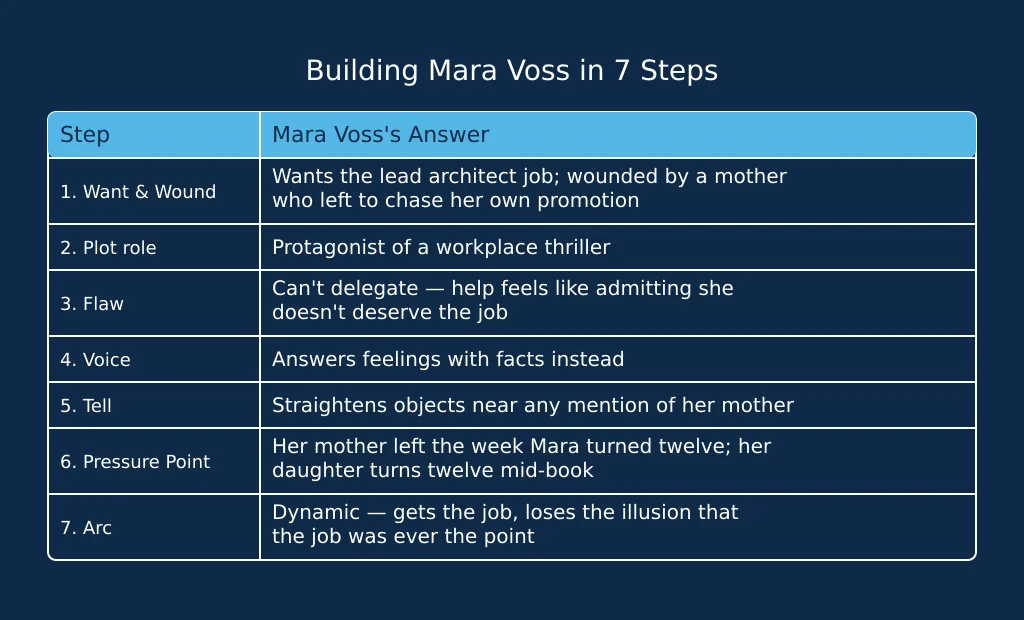
Run the same seven questions against your own character. Here's what the finished set looks like when it's Mara's:
| Step | Mara Voss's Answer |
|---|---|
| 1. Want and wound | Wants the lead architect job; wounded by a mother who left to chase her own promotion |
| 2. Plot role | Protagonist of a workplace thriller |
| 3. Flaw | Can't delegate — help feels like admitting she doesn't deserve the job |
| 4. Voice | Answers feelings with facts instead |
| 5. Tell | Straightens objects near any mention of her mother |
| 6. Backstory pressure point | Her mother left the week Mara turned twelve; her daughter turns twelve mid-book |
| 7. Arc | Dynamic — gets the job, loses the illusion that the job was ever the point |
Top-Down vs. Bottom-Up: Two Ways to Build a Character
You can run those seven steps in two directions. Before you decide which type of fictional character to build, choose whether you're working top-down or bottom-up. Top-down starts from the role and works inward. Bottom-up starts from the psychology and lets the role show up later.
Top-Down (Archetype-First)
Start at step 2. Decide the role the plot needs filled, mentor, antagonist, comic relief, then pick an archetype that fits and work backward through want, wound, flaw, and voice until the character matches it.
- Fast: you can have a functional character in scene one without waiting for them to reveal themselves.
- Reliable for genre fiction, where the plot's machinery needs every role staffed on schedule.
- Risk: the character can read as bolted onto the plot if you never circle back to steps 1 and 3 once the draft slows down.
Bottom-Up (Discovery-First)
Start at step 1. Sit with the want and the wound until they feel specific, then draft scenes and let the plot role emerge from what the character actually does under pressure.
- Slower to produce a usable character, since the plot function isn't decided up front.
- Produces real interiority, well suited to literary and character-driven fiction where the internal shift is the plot.
- Risk: a rich, believable person with no clear job in the story, which shows up as scenes that go nowhere.
Which One Should You Use?
The two approaches trade off along the same three lines:
| Criteria | Top-Down | Bottom-Up |
|---|---|---|
| Speed | Fast | Slower |
| Best fit | Plot-driven, genre manuscripts | Character-driven, literary manuscripts |
| Main risk | Depth never gets added back in | Plot function never gets pinned down |
Writers drafting a plot-driven or genre manuscript should build top-down: starting from role and archetype gets the character functioning correctly in scene one. Writers drafting a character-driven or literary manuscript should build bottom-up, starting from want and wound and letting the plot role emerge later, because forcing an archetype onto an interior-heavy story tends to read as bolted-on. The full breakdown of that distinction lives in the site's guide to plot-driven vs. character-driven stories.
Turn the 7 Steps Into Your Character's First Scene
You've got seven answers now. The next move is putting them on the page. Write your character's first appearance and let the want and wound decide what they're doing when the reader meets them, not a stage direction that just describes the room.
Let the flaw cause one small piece of friction in that first scene, even if the real conflict is chapters away. Drop the voice tic into the very first line of dialogue. Show the physical tell once. Keep the backstory pressure point buried and unmentioned, waiting for the moment later in the book when it can't stay buried anymore.
If the character survives that first scene and still doesn't have a name that fits, try the site's character name generator. It's faster than scrolling a baby-names site for twenty minutes.
Fictional Character FAQ
What is the most popular fictional character?
Rankings differ depending on what's being measured, but the same handful of names come up again and again: Sherlock Holmes, Harry Potter, and Mickey Mouse sit near the top of nearly every version of the list. This page isn't going to add another ranking. Use the types above to work out which one your own character is closest to, then build them properly with the seven steps.
What does fictional character mean?
It means a person, creature, or entity invented by a writer to act inside a made-up story. Real people who show up in memoirs or biographies don't qualify.
What is a fictional character example?
Atticus Finch, Hermione Granger, Sherlock Holmes, and Lady Macbeth are all fictional character examples: each one exists only inside the novel or play that created them. Mara Voss, the character built step by step earlier in this piece, counts too, invented for this article as a worked example.
Who is a cool fictional character?
Lady Macbeth is a strong pick. She's round, ambitious, and willing to push past her own conscience, which is exactly what keeps a reader guessing about what she'll do next. Use the seven-step framework above to build that same kind of pull into your own character.