What Is an Antihero? (One Term, Many Shades)
Your protagonist breaks rules a straightforward hero wouldn't. The useful question is where exactly on the antihero scale they sit. An antihero (also spelled anti-hero or anti hero) covers everything from a coward who finds one moment of nerve to a manipulator you keep rooting for anyway, and that range is the problem. Treating "antihero" as a single label tells you almost nothing about which techniques your draft actually needs.
The Cambridge Dictionary defines an antihero as the central character in a book, play or movie who lacks a hero's traditional qualities, such as courage, and is admired instead for what society generally reads as a weakness in their character. Wikipedia's entry adds the other half of the picture: the antihero typically comes from a lower social class than the traditional hero and stands outside it, sometimes as a criminal. Put the two together and you get a working rule. An antihero keeps the protagonist's job, driving the plot and holding your sympathy, while giving up the hero's traditional virtue and social standing.
That's still one label doing the work of seventeen different characters. An antihero is one position within the wider set of character archetypes, and the rest of this piece breaks that one position down into a spectrum you can actually place your protagonist on.
Antihero vs. Villain vs. Anti-Villain
Before you pick a type from the spectrum, you need the two boundary lines that keep "antihero" from sliding into a different word altogether. Three criteria do the sorting: what the character wants, how sympathetic the story makes that want, and what methods they're willing to use to get it.
Antihero vs. Villain
An antihero isn't simply a villain. The role keeps the protagonist's job while borrowing a villain's methods. A villain's goal typically opposes the protagonist's, and the story is built so the reader wants that goal stopped. An antihero's goal, however messy the methods, usually lines up with something the reader wants to see happen, or at least something the story treats as worth pursuing. A villain wields harm as a tool without much internal cost. An antihero pays for it, in guilt, in relationships, in what the choice makes them into.
Antihero vs. Anti-Villain
The two terms get confused because both sit in the moral middle, but they sit on opposite sides of the story's structure. An antihero is the protagonist, the character whose choices drive the plot and whose head you're mostly in. An anti-villain is the opposing force: an antagonist given a sympathetic goal or an understandable backstory, but still functionally in the way of the protagonist. If you're unsure which one you've written, check whose story it is. For the underlying roles both terms modify, protagonist vs. antagonist covers the plain mechanics.
The Antihero Spectrum: 17 Types, From Reluctant Hero to Sympathetic Villain
A list of four or five broad categories, arranged loosely from most sympathetic to least, leaves wide gaps, such as the space between a coldly practical operator and someone genuinely unscrupulous. It also doesn't tell you how to write any of them. The seventeen bands below fill that territory, each paired with one technique you can apply on the page, running from the type closest to a traditional hero through to the type closest to a villain. Two bands, 14 and 17, cross a line worth flagging now: they occupy the antagonist's slot in the story rather than the protagonist's, which is exactly the distinction the anti-villain section above draws. Most of the seventeen are driven more by internal conflict than by external stakes (see internal vs. external conflict), and all of them need a character underneath who's round rather than flat, built as a full person.
1. Reluctant Hero
Acts heroically only when forced into it, and avoids the call for as long as the plot allows. Motivated by self-preservation or loyalty to one specific person. Technique: trigger action with a threat to someone they love, not an abstract stake, and let them resist out loud for at least one full scene.
2. Classic Anti-Hero
Lacks the courage, confidence or idealism of a traditional hero: cowardly, cynical, self-interested, but still nominally fighting for the right side. Their arc proves competence. Technique: let early failures be genuine failures, not near-misses dressed up as humility, so there's somewhere real for the arc to go.
3. Tragic Anti-Hero
Driven by a defining flaw (ambition, pride, vengeance) that grants power and guarantees a fall. Shakespeare's Macbeth is the model: ambition pushes him toward regicide, and once he holds the crown that same ambition curdles into tyranny while Lady Macbeth unravels beside him. Technique: make the flaw responsible for the character's best moment and their worst one, just pointed in different directions.
4. Byronic Hero
Brooding, intelligent, contemptuous of social convention, self-destructive, and carrying a wound they won't name. Technique: withhold the wound's specifics for several chapters and let behavior, isolation, and cruelty toward people who get close do the work.
5. Knight in Sour Armor
Cynical on the surface, does the right thing anyway, and complains the entire way through. Technique: give them a running verbal tic of sarcasm or complaint that never once actually stops the good deed. The gap between the words and the action becomes the character's signature.
6. Loveable Rogue
Charming, self-serving, breaks rules for personal gain, redeemed mostly by charisma and by loyalty to a small circle of people. Technique: earn the charm on the page with wit and generosity toward that circle. Don't let narration simply assert the charisma.
7. Pragmatic Anti-Hero
Makes cold, results-first calls, trading a smaller harm for the outcome they're after, whether that's saving the many or one person they're responsible for. Uncomfortable, but not villainous. Technique: show the calculation happening in real time, not summarized after the fact, so the reader weighs it alongside the character.
8. Anti-Hero With a Code
Operates by a strict personal code that overrides ordinary morality and ordinary attachment, with the code deciding the actions. Stephen King's Roland Deschain fits the type: a gunslinger from a knightly order descended from Arthur Eld, bound to a quest that regularly outweighs the people around him. Technique: state the code explicitly early, then test it against something the reader wants him to break it for.
9. Unscrupulous Anti-Hero
No fixed code. Uses whatever method works, and keeps protagonist status only because their goal, or their targets, make them the least-bad option in the story's world. Technique: give them one clear line that would cost you the reader if it were crossed, and never let them cross it.
10. Nominal Hero
Technically the hero by plot role (chosen one, detective, commanding officer) but built almost entirely from selfish or petty traits with no real virtue underneath. Technique: let the plot's stakes force heroic-shaped action even while the interior narration stays selfish, so the gap between role and character does the moral work.
11. Redeemed Antagonist
Begins the story as an obstacle or antagonist, then a late revelation recasts earlier actions as sacrifice. In Harry Potter and the Deathly Hallows, Harry views Snape's memories and learns that Snape loved Harry's mother Lily, pleaded with Dumbledore to protect the Potters, and spent years afterward working as a double agent against Voldemort. This type only works with a character who's dynamic rather than static, since the redemption has to be earned across the story. Technique: plant the revealing detail early, visible but misreadable on a first pass.
12. Unreliable Anti-Hero
The reader can't fully trust the account they're getting, because the character is actively curating it. Gillian Flynn's Amy Dunne in Gone Girl demonstrates the type from the setup alone: she stages her own disappearance, engineered specifically to get her husband arrested for her murder. Technique: give the character two distinct registers, the version they're performing and the version leaking through, and widen the gap as the story goes.
13. Well-Intentioned Extremist
The goal is genuinely good. The method usually isn't. Willing to damage a system, or hurt individuals, to reach an outcome they believe justifies it. Technique: make the underlying goal something the reader would want too, so the discomfort sits with the method.
14. Antagonistic Anti-Hero
Functions as an obstacle to the actual protagonist for much of the book, but runs on the same antihero logic: understandable motive, harmful method. Technique: give them a subplot with its own stakes, so they read as a character with a story of their own.
15. Amoral Anti-Hero
Doesn't operate on a moral framework at all, and pursues self-interest without the guilt or the code the earlier types carry. Technique: avoid narrating guilt you don't intend to pay off. Let consequences land externally.
16. Picaresque Anti-Hero
An episodic survivor who moves through a corrupt or absurd world using trickery and adaptability. Technique: structure their chapters as loosely connected episodes. The type's appeal is accumulation.
17. Sympathetic Villain
Functionally a villain: their goal opposes the protagonist's, and the story treats them as the antagonist. What keeps them on this spectrum is a comprehensible, even sympathetic interior. Technique: give them one scene alone, with no one else present to judge them, where the reader sees the actual cost of their choices.
Which Type Is Your Protagonist? A 3-Question Placement Test
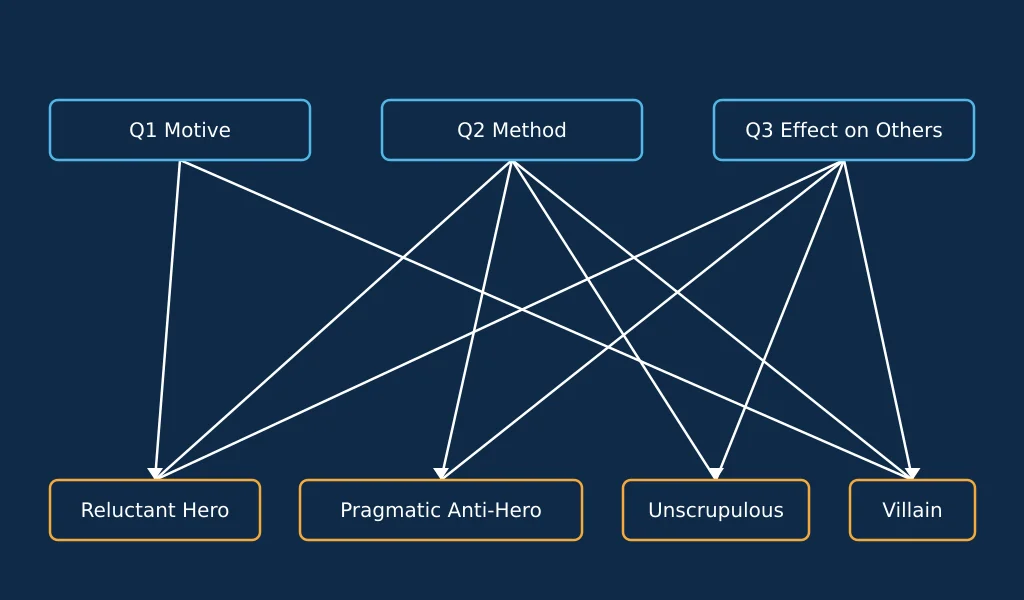
The seventeen bands above are ordered by three criteria: motive, method and effect on others. Turn those criteria into questions and you get a test you can run on your own protagonist.
Step 1: Motive
What does the character actually want, and would the reader want that outcome too, at least in broad strokes? A shared motive (protect someone, survive, right a specific wrong) pulls a character toward the heroic end. A purely self-serving one (power, wealth, revenge with no larger justification) pulls toward the villain end.
Step 2: Method
How do they pursue that want? Reluctantly and within some ethical limit. Coldly and by calculation. Indifferent to who gets hurt. Actively cruel. Each answer shifts the character one or two bands further from the reluctant hero end.
Step 3: Effect on Others
What actually happens to the people around them because of the character's choices? None. Minor and reversible. Serious but incidental. Deliberate and repeated. This question does more sorting than the first two combined, because motive and method can both look sympathetic right up until you check the damage.
Worked Example: Placing a Constructed Protagonist
Say your protagonist is a smuggler named Rin. She's moving stolen weapons to pay off a debt keeping her sister in indentured labor. Cornered mid-job by a guard who recognizes her, she kills him to avoid capture.
Run that through the test. Motive: protective, sympathetic, a want most readers share, which alone would place her near the top of the spectrum. Method: illegal, and lethal once cornered, which drags her down several bands on its own. Effect on others: one death, but of an armed combatant actively trying to capture her, not a bystander, which keeps the damage from tipping her all the way to unscrupulous.
Combined, Rin lands as a Pragmatic Anti-Hero: sympathetic want, cold method under pressure, contained damage. That's the type telling you her scenes need the calculation shown clearly as it happens, in line with the technique attached to that band above.
Notice what did the actual placing: the worst thing she does on the page. Run that single act through all three questions before you reach for the antihero label at all. The resulting type, not the umbrella word, is what tells you whether her arc needs redemption pacing, an unreliable narrator, or a sympathy anchor planted early enough to survive that scene.
Two tradeoffs come with this test. It assumes one defining act, so a protagonist who shifts across a series (a redemption arc, a corruption arc) will land at a different type in book three than in book one, and you'll need to re-run the test at each major turn. It also doesn't resolve genre pressure: a grimdark version of Rin and a cozy-mystery version of Rin can land at the exact same type here and still need very different pacing, because the test measures moral position, and tone is a separate decision.
Lock In Your Type, Then Pressure-Test It in Your Next Scene
Once you've named your protagonist's band on the spectrum, don't leave it as a note on a character sheet. Pick the next big scene where their morality gets tested (the next heist, confrontation or betrayal) and check that the technique attached to their type actually shows up in it: the calculation on the page for a Pragmatic Anti-Hero, the withheld wound for a Byronic Hero, the private scene alone for a Sympathetic Villain.
If the flaw powering that scene is still vague, pin it down first. A list like 177+ character flaws is faster than guessing, and a character questionnaire is useful once the type is settled and you need the backstory that got them there.
Benefits of writing to a fixed spectrum position
A few outcomes follow directly from committing to a band.
- Readers can predict the shape of a choice even when they can't predict its content, which is what makes a morally grey character feel deliberate.
- A specific type points to a specific technique: redemption pacing for one band, unreliable narration for another.
- Calibrating sympathy gets easier once you know how much damage the type can survive before the reader disengages.
Drawbacks of writing to a fixed spectrum position
Two costs come with that commitment.
- Real characters drift. A protagonist can straddle two bands for an entire draft before settling, and forcing an early label can flatten that movement.
- Tone, pacing and genre stay outside it, as the grimdark and cozy versions of Rin showed.
Antihero FAQ
What does anti-hero mean?
An anti-hero is a story's protagonist who lacks a hero's traditional virtues (courage, honesty, selflessness) and holds the reader's investment through some other quality instead: competence, wit, or a want the reader shares even when the methods aren't admirable.
Is an anti-hero just a villain?
No. The quickest test is whose story it is and who pays for the harm: an antihero drives the plot and carries the cost of their methods, while a villain stands in the protagonist's way. Bands 14 and 17 are the honest edge case, where an antihero-shaped character ends up sitting in the antagonist's seat.
Is Batman a hero or antihero?
Depends on the version. By the spectrum's own criteria, most takes on the character land closer to an Anti-Hero With a Code than a traditional hero. His methods (fear, surveillance, force) sit well outside a straightforward hero's toolkit, but a personal rule governs how far he'll take them, which is exactly what defines that band.
Is Taylor Swift an antihero?
Taylor Swift is a real person, so she falls outside the fiction-craft sense this article uses. Still, a pop song titled "Anti-Hero" says something about how far the term has traveled from literary criticism into everyday speech.