What Is Third Person Point of View?
If a beta reader circled a page and wrote "whose head are we in here?", you've already met the problem this article solves. Third person point of view narrates a story using he, she, or they, rather than I (first person) or you (second person). The narrator stands outside every character, describing what happens to them instead of speaking as them.
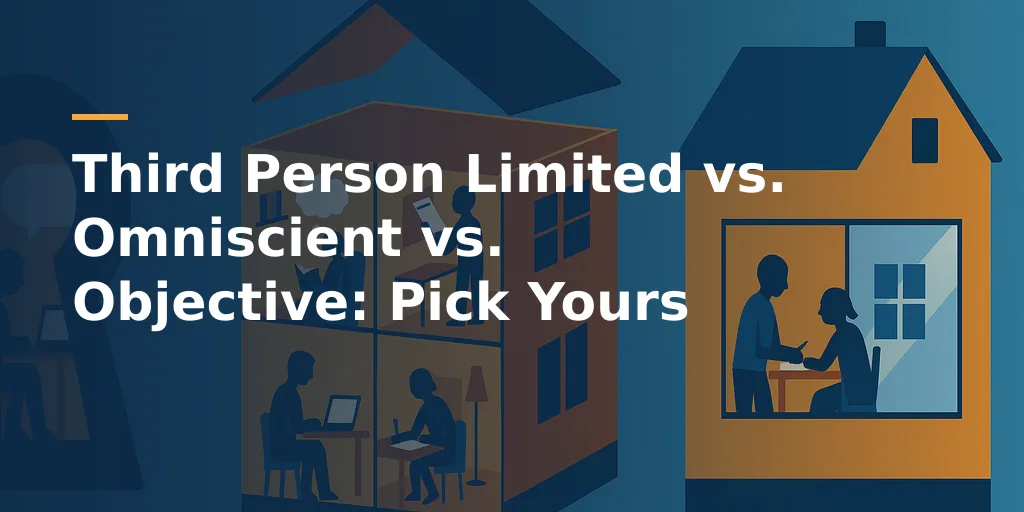
That much is one line. What trips writers up is that third person point of view isn't one setting but three. Third person limited follows one character's knowledge and feelings at a time. Third person omniscient knows more than any single character in the story. Third person objective reports only what a camera could catch, no thoughts at all. That choice is yours as the author, and it decides whether narration reads clean or reads confused, far more than the pronoun itself does.
For the fuller map of first, second, and third person together, point of view in writing covers the whole set. If you just need the bare-bones definition, the point of view (glossary) entry has the one-line version. This piece stays narrow: which of the three third-person subtypes fits the book you're drafting.
Third Person Limited
Third person limited ties the narration to one character's knowledge, thoughts, and feelings at a time, usually for an entire scene or chapter before any shift. You can describe what that character sees, remembers, and worries about. Everyone else in the scene stays readable only through their words, faces, and actions, the same way they'd be readable to the POV character standing in the room.
What Limited Narration Lets You Do
Because the narrator's knowledge is capped at one mind, limited gives readers the closest thing to first person's intimacy without the I. You can withhold a fact simply because your POV character doesn't know it yet, which is a built-in engine for suspense. Switch POV characters between scenes or chapters, and the reader follows along cleanly, because the shift is marked by a break, not buried mid-paragraph. That's why limited makes a safe default for a first novel: deep interior access, low technical risk.
Limited in a Published Novel
The Harry Potter series is narrated from a third person limited point of view, following the main character's knowledge and feelings scene by scene, with only a handful of exceptions such as the opening chapters of a few books. Readers learn what Harry learns, when he learns it. That's the whole mechanism at work: the plot's information and the main character's information arrive together.
Third Person Omniscient
Third person omniscient hands the narrator more knowledge than any single character has. Cambridge Dictionary's plain definition of the word gets at it directly: omniscient means "having or seeming to have unlimited knowledge," with the dictionary's own example being "God is omniscient." Apply that to a narrator, and you get someone who can dip into any character's mind, comment on events no character has witnessed, and tell the reader things the cast never learns.
What the Omniscient Narrator Knows
An omniscient narrator can move between minds within a single scene, step back to summarize what a whole town believes, or address the reader directly with an opinion. That range makes third person omniscient a natural fit for handling exposition: the narrator can simply state backstory, without routing it through one character's convenient memory. Some older novels use this voice to comment on the community the story is set in, weighing in on characters the way a neighbor might. Modern omniscient tends to be quieter about it, but the underlying trick (wider knowledge than any one character) hasn't changed.
Deliberate Omniscient vs. Accidental Head-Jumping
Here's the difference in miniature, both lines built to show the mechanism rather than quoted from anywhere. Deliberate omniscient: "Maria was certain the deal was done. Across town, her partner already knew it wasn't." The narrator owns both minds openly and tells you so. Accidental head-jumping: "Maria smiled, sure of the deal. He frowned, already knowing he'd lost it." Same two facts, but nothing signals the swap. A reader can't tell whether they're still in Maria's head or have been quietly moved into his. Omniscient is a chosen point of view. Head-jumping is a mistake made inside limited, where the rule was one mind per scene and the narration broke it without saying so.
Third Person Objective
Third person objective narrates only what's observable: action, dialogue, setting, nothing else. No character's thoughts, memories, or feelings get stated outright. The narrator behaves like a camera in the room, or like stage directions in a script, recording what a bystander could see and hear and leaving interpretation to the reader.
The Camera-Eye Rule
The test is simple. If a sentence names what a character thinks, wants, or feels without them saying it aloud or showing it physically, it isn't objective anymore. "She was furious" breaks the rule. "She set the cup down hard enough to crack the saucer" keeps it. The reader learns a character's inner state only through what they do and say.
Objective in a Published Story
Wikipedia's glossary of narratology cites Ernest Hemingway's short story "Hills Like White Elephants" as a working example of this: an external point of view, in which the narrative is defined only by the characters' words and actions within a particular setting, with feelings, knowledge, and perceptions left off the page. Whatever a reader infers about what the two people in that story want has to come from what they say to each other and what they do.
You can build the same effect from scratch. Two people sit across a table. One turns a glass in slow circles. The other checks a phone twice in ten seconds and puts it face down. Neither line of dialogue mentions nerves. The reader supplies the tension anyway, because objective narration is built to make them do exactly that.
Third Person Limited vs. Omniscient vs. Objective at a Glance
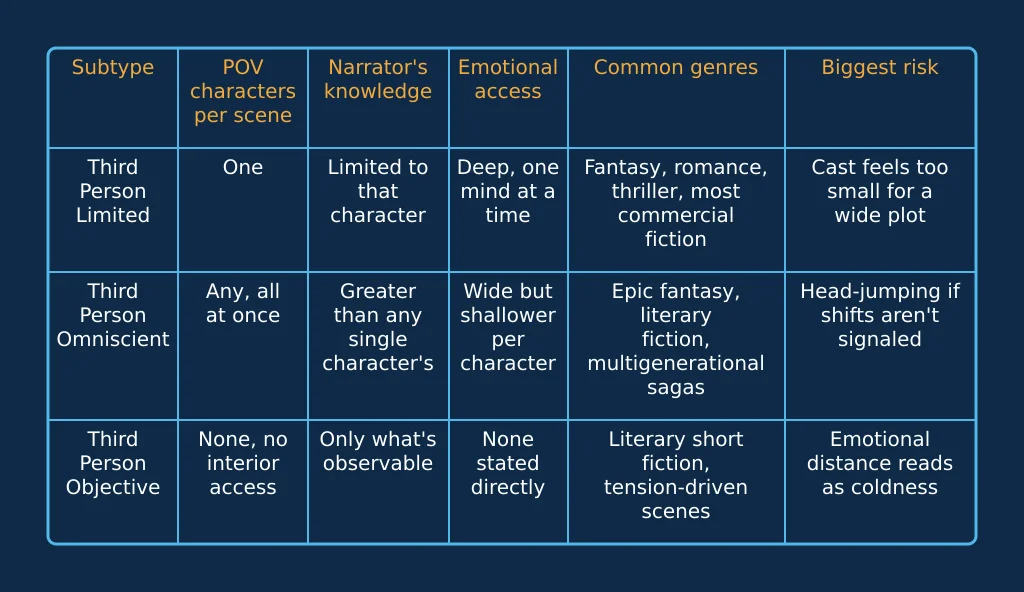
Once the three subtypes are defined separately, the differences are easiest to see side by side. This table lines them up on the criteria that decide which one fits a manuscript.
| Subtype | POV characters per scene | Narrator's knowledge | Emotional access | Common genres | Biggest risk |
|---|---|---|---|---|---|
| Third Person Limited | One | Limited to that character | Deep, one mind at a time | Fantasy, romance, thriller, most commercial fiction | Cast feels too small for a wide plot |
| Third Person Omniscient | Any, all at once | Greater than any single character's | Wide but shallower per character | Epic fantasy, literary fiction, multigenerational sagas | Head-jumping if shifts aren't signaled |
| Third Person Objective | None, no interior access | Only what's observable | None stated directly | Literary short fiction, tension-driven scenes | Emotional distance reads as coldness |
Which One Should You Actually Write? A 3-Question Decision Checklist
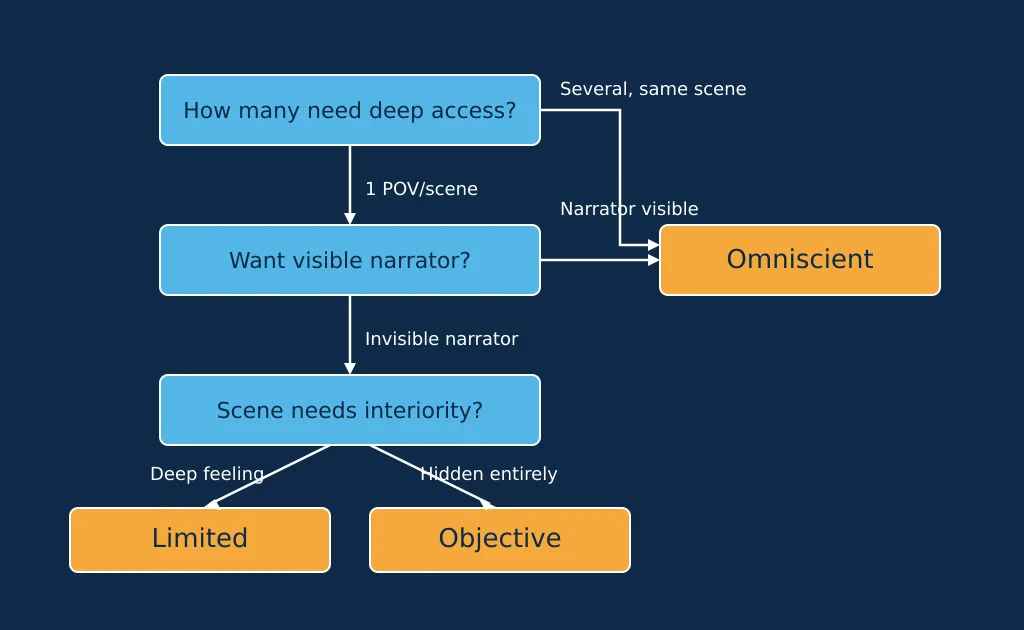
Run your own manuscript through these three questions in order. Each one points toward a subtype, and by the third question you'll likely already know which way you're leaning.
Question 1: How many characters need deep access?
Count only the characters whose thoughts and feelings the plot depends on. A long cast list doesn't need deep access for everyone in it. If only your main character's inner life drives the story, Limited is a clear fit, and it stays a fit even with several POV characters as long as they get separate scenes. A cast where several characters' inner lives matter inside the same scenes points toward Omniscient instead. This is also where deciding which characters deserve a POV matters: giving deep access to a character who's really there to serve the plot dilutes focus without adding anything the reader needs.
Question 2: How much narrator personality do you want?
Some books want a narrator readers can hear: opinions, wit, direct commentary on the story as it unfolds. If that's the voice you're after, Third Person Omniscient is built for it, since the narrator's visible personality is part of the reading experience by design. If you want the narration to feel invisible, letting the character's own voice carry the page, Limited and Objective both keep the narrator out of the way. The difference between those two comes down to Question 3.
Question 3: How much interiority does each scene need?
If a scene's whole point is what a character feels while it happens, Limited gives direct access to write that feeling on the page. When a scene needs wide context, with several characters' situations laid out in one pass, Omniscient can pull back to give it. And when the tension lives in what's said and done, with the reader kept outside everyone's head, that's what Objective is for. It should be a deliberate choice, not a scene whose interior life just hasn't been developed yet.
The verdict
Most first-time third-person writers land best on Limited, one POV character per scene. It gives the deepest reader connection for the least technical risk, and it stays forgiving of a first draft's other problems in a way the other two subtypes aren't. Reserve Omniscient for stories where a wide cast and a narrator's voice are part of the book's appeal, and save Objective for short, tension-driven scenes where withheld interiority is the effect you want.
Each choice carries a cost. Limited trades scope for closeness: readers only know what one character per scene knows, so a wider plot needs scene or chapter breaks to move the camera. Omniscient is the hardest of the three to sustain without lapsing into head-jumping, and authorial intrusion today reads as a deliberate stylistic choice, so it has to stay consistent or it looks like a mistake. Objective sacrifices emotional intimacy almost entirely, which makes it a poor fit for character-driven genres like romance, where readers are there specifically for interior life. Not sure which category your book falls into? Plot-driven vs. character-driven stories is worth checking before you commit: Omniscient tends to suit the plot-driven end, Limited the character-driven end.
Pros and Cons of Each Third-Person Type
The checklist above tells you where to start. These are the tradeoffs worth knowing before you commit a full draft to one subtype.
- Third Person Limited: Pros: easy to keep consistent, and natural for suspense, since the reader knows only what the POV character knows. Cons: information outside that one character's awareness has to wait until someone in the scene learns it.
- Third Person Omniscient: Pros: room for a distinct narrator voice, the ability to summarize events no single character witnessed, useful for large casts and long timelines. Cons: a narrator's visible opinions can feel dated unless they're handled with intent.
- Third Person Objective: Pros: forces action and dialogue to carry the whole scene, well suited to short, sharp moments. Cons: hard to sustain across a full novel without the distance turning cold.
Run Your Opening Scene Through the Checklist
Before you draft another chapter, take the scene you've already written and run it through the three questions above. Count how many characters' thoughts it shows. Check whether the narrator's voice is doing commentary you didn't plan for. Notice whether the scene works because of what a character feels, or because of what they do and say.
If the answers point to a different subtype than the one you're writing in, better to find that out now. Discovering on page two hundred that your story wants Omniscient means a substantial revision pass: every existing scene has to be checked for information the new subtype wouldn't have let you show yet.
Third Person Point of View: Frequently Asked Questions
What are 3rd person point of view examples?
Any story narrated with he, she, or they instead of I. The Harry Potter series is third person limited, and Hemingway's "Hills Like White Elephants" is objective, both covered above. Third person limited follows one character's thoughts per scene, third person omniscient moves between multiple characters' minds and can comment on events none of them witnessed, and third person objective reports only actions and dialogue with no stated thoughts at all.
What are 1st, 2nd, and 3rd person examples?
First person narrates from inside a character, using I, as if the protagonist were telling the story directly. Second person addresses the reader as you, putting them inside the action. Third person narrates from outside, using he, she, or they, and splits further into the limited, omniscient, and objective subtypes covered above.
What is 3rd person omniscient vs. 3rd person?
Omniscient is one of third person's three subtypes, not a separate point of view. "Third person" on its own just means narration using he, she, or they. Omniscient specifies how much that narrator knows: more than any single character, with access to multiple minds and to events no one character witnessed. Limited and objective are the other two subtypes under the same third person umbrella.
Is there a 4th person view?
Not as a standard choice in fiction craft: first, second, and third person cover how a novel or short story is narrated. The term does turn up in linguistics for grammatical distinctions in some languages, but that's a different subject from choosing a narrator for your book.