What Does Exposition Mean, Exactly?
Exposition is the background information a story feeds you about its setting, characters, or history: where you are, who these people are, what happened before page one. Every narrative needs some. The word does double duty, though, and that's what trips writers up mid-draft. One sense is a stage, a labeled stretch of story structure that comes before anything else happens. The other is a technique, something a writer does in scattered moments across three hundred pages, long after that opening stage has ended.
The Other Exposition: Trade Shows, Expository Essays, and "Exposé"
Search the word and you'll turn up three unrelated meanings before you reach fiction craft. A trade exposition is a fair, a business expo where companies show off products. Nothing to do with a story. Expository writing is a nonfiction category taught in composition classes, essays and articles that explain a subject, closer cousin to a manual than to a novel. Plenty of searches land here looking for "exposé," a journalistic term for a report that exposes a secret or a scandal. Same root, close enough in sound to trip up a search bar. It reveals wrongdoing; exposition orients a reader inside a plot.
None of those three belong to fiction craft. The rest of this piece sticks to the sense a novelist means, and the FAQ below settles which sense applies where a reader is likely still confused.
The Story-Structure Stage vs. the Storytelling Technique
Separating the two senses solves most of the confusion on its own. One is a named position in a specific map of story structure. The other travels with the narrative from the first page to the last, whichever map you're using, or none at all.
Exposition as a Stage (Freytag's Pyramid)
German playwright Gustav Freytag mapped five-act tragedy into five stages and called the first one, plainly, Exposition. It sits before the rising action, the point where the audience meets the setting and the main players before an inciting incident pushes the plot forward. Exposition is a fixed slot at the very start, the same way rising action, climax, falling action, and resolution are fixed slots after it. Nothing else in the pyramid shares the label.
Exposition as a Technique (Any Narrative Structure)
Drop Freytag's terminology and the technique still exists. A writer working from Save the Cat, the Snowflake Method, or no named structure at all still has to tell the reader where they are and who they're with. That job doesn't end when the opening stage does. A backstory reveal in chapter fourteen is exposition. A single line about a character's job, dropped into a chase scene, is exposition too, and it often lands hardest when it's delivered as a quick simile rather than a flat statement.
Backstory is the biggest single category this technique has to carry: a character's job, a family rift, why the war started. None of it needs to land in one place. Background lands when it arrives attached to something already happening on the page; stack up several unattached facts in the same paragraph and none of them lands at all.
Present-scene context and backstory aren't the same thing, either, and mixing them up is where a lot of drafts stall. A description of the room a character is standing in is present-scene context. Backstory is something that already happened before page one. The technique sense of exposition covers both, but the test for how much to include differs: present-scene detail earns its place by grounding the reader right now, backstory earns its place by explaining why the current moment matters, often surfacing the story's theme along the way.
Where 'Exposition' Sits in Five Story Structures
Freytag's Pyramid is the only structure here that literally uses the word "exposition" for its opening stage. Reach for the Hero's Journey, Save the Cat, the Story Spine, or the Fichtean Curve instead, and you won't find the label, though the job of orienting the reader still has to happen somewhere. Here's what each one calls it and where it falls.
| Structure | What It Calls the Opening Stage | Where It Falls in the Sequence |
|---|---|---|
| Freytag's Pyramid | Exposition | First of five stages, before the rising action begins |
| Hero's Journey | Ordinary World | Before the Call to Adventure, the story's first named beat |
| Save the Cat | Opening Image and Set-Up | Snyder's published beat sheet places these in roughly the first ten pages |
| Story Spine | "Once upon a time..." | The opening line of the spine, before "and every day..." |
| Fichtean Curve | No separate stage | Opens already inside rising action, with no dedicated setup beat |
That last row matters more than it looks. Outlining with the Fichtean Curve means there's no missing exposition stage to go hunting for. There isn't one by design. The structure trades a settling-in period for momentum, and background gets folded into moments that are already moving forward. That's closer to the technique sense of exposition than the stage sense, worth knowing before you assume every structure owes you a slow opening.
The Four Ways Writers Actually Deliver Exposition — With Examples From Four Novels
Once you know which sense applies to the page you're stuck on, the next question is practical: how do you actually get the information onto the page? Here are four exposition examples to check your own draft against, one per technique, each paired with a novel that uses it well.
- Direct Exposition: The narrator or a character states the background plainly, no dressing up. To Kill a Mockingbird opens this way: Scout's narration lays out Maycomb's history, its slow pace, and the Finch family's standing across a few unhurried pages before the plot moves at all. Direct exposition works when a reader needs orienting fast and the facts don't need any mystery around them. Push it past a page or two before anything happens, and you've crossed into an info dump, which the next section covers.
- Indirect Exposition: Background surfaces through detail and inference rather than a flat statement. Gone Girl keeps Nick Dunne evasive about his affair on the morning his wife disappears, conveyed through what he notices, what he avoids, and what he leaves unsaid. Amy's diary later states the marriage's collapse outright, in entries that read like an early warning; readers only learn afterward that the diary is fabricated, planted evidence built to convict Nick. Take it too far and a reader loses track of what actually happened offstage. Indirect exposition suits a story built on atmosphere or suspicion, where the reader is meant to do some of the assembling.
- Exposition Through Dialogue: One character tells another something the reader also needs. Hagrid's talk with Harry in Harry Potter and the Philosopher's Stone delivers Voldemort's history, the wizarding world's rules, and Harry's own past inside a conversation that still feels like two people talking. The tell is a line like "As you know, Bob." Cut it, and give the character a private reason to say the thing, so it matters to the listener as much as it matters to the reader.
- Exposition Through Action: Background comes out through what characters do, not through what anyone says. The Hunger Games shows the poverty and the rules of District 12 through the reaping and through Katniss hunting illegally in the woods. Action-based exposition keeps a story moving while it informs. The risk is a fight scene over-choreographed just to smuggle in world-building.
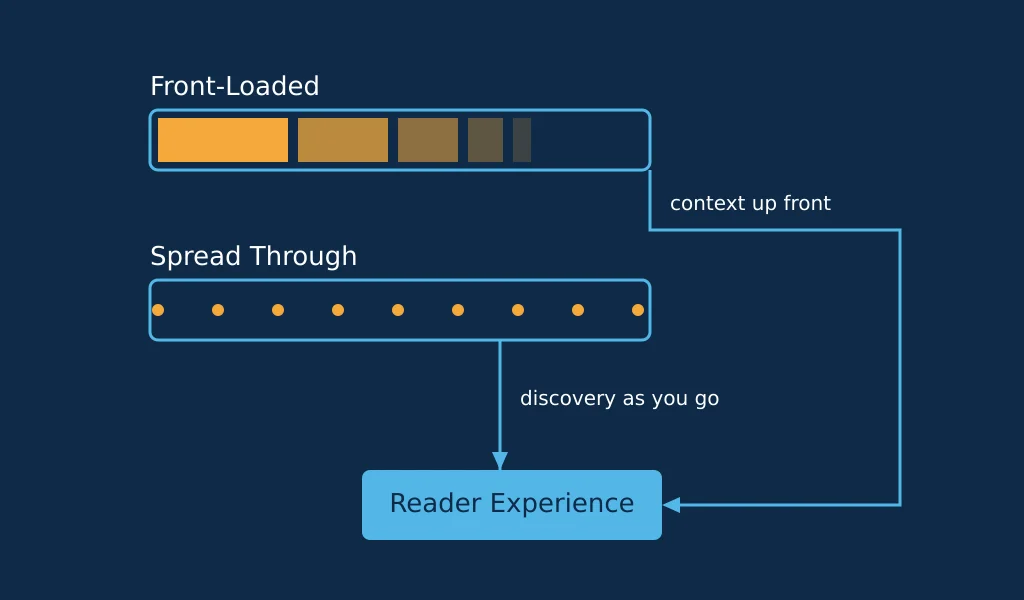
Front-Loaded Exposition vs. Exposition Spread Through the Book
Every writer eventually has to choose one of two defaults: put the necessary background in a dedicated opening stretch, Freytag's sense of exposition, or let it surface as technique, spread thin across the whole draft. Genre, pacing goals, and how much world-building your book needs all push the decision one way or the other.
A Dedicated Opening Stage: Benefits and Drawbacks
- Benefit: the reader is oriented before they have anything urgent to track. This matters most in secondary-world fantasy, where invented terms and languages need defining upfront the way The Lord of the Rings front-loads Middle-earth's history before Frodo ever leaves the Shire.
- Benefit: it's easier to write cleanly too, since the writer isn't juggling plot momentum and background delivery in the same sentence.
- Drawback: a reader previewing your Amazon Look Inside sample often wants a hook before they'll sit through setup, and that free preview is the only page many strangers read before deciding to buy.
- Drawback: a long opening stage is exactly where an info dump forms, particularly in a debut manuscript where the writer over-explains out of nerves.
Spreading It Across the Draft: Benefits and Drawbacks
- Benefit: momentum from page one. This is the Fichtean Curve's whole approach.
- Benefit: it forces discipline, too. A writer has to decide, moment by moment, what the reader genuinely needs right now.
- Drawback: a reader can lose the thread if too little context arrives too late, especially in a longer or multi-POV book.
- Drawback: it demands careful tracking of what's already been revealed. Repeating the same background twice reads as padding.
The Info Dump: Exposition's Only Real Danger
An info dump is what happens when one of the four techniques above runs unchecked, too much information landing too fast, with nothing else happening around it. It isn't a fifth technique. It's a failure mode any of the other four can slide into.
Diagnosing a dump in revision is mostly a deletion test. Read the passage and ask what a reader would lose if you deleted it outright, keeping only the sentence that started it. If nothing about the immediate page breaks, you've found the dump.
Most dumps are a character's whole history compressed into one paragraph before the plot needs any of it, prior events unloaded well ahead of when they matter. Spread across many pages instead, the same material rarely reads as a dump at all. If you're breaking a paragraph down to fit inside dialogue or action, check how much of that history the moment can actually carry before it starts feeling stapled on.
Redistributing a dump is mechanical work once you've found it. Split the cut paragraph into two or three lines, then place them where they belong: one inside dialogue a character would plausibly say, another inside a beat of action where the detail changes what that character does. The last line can go to internal thought, if your point of view allows it. Three separate deliveries. They rarely read as a dump the way one paragraph does.
There's a cost to withholding the same information too long, too, and it's the one writers worry about less. A reader missing a key fact for too many pages will invent one, lose track of why a moment matters, or stop trusting that the details will ever arrive. An info dump commits everything at once. Silence for too long waits past the point a reader still cares.
Length is a rough guide only. A single paragraph of setup rarely reads as a dump. A full page of it, dropped in before anything happens, usually does. The real test is whether the reader is being told something they could already feel from what's around it.
Decide Which Job Your Exposition Is Doing Right Now
Go back to the page you're stuck on and ask which sense of the word applies. If it's the opening chapter, check what your structure actually calls that stage, using the table above, and stop assuming Freytag's terms apply if you're building from a different structure. If it's chapter fourteen and a character just recalled something from their past, you're in the technique sense, and the real question is which of the four delivery methods fits the moment you're currently drafting.
A quick pass through your draft turns this into something checkable. Mark every spot where you're handing the reader information, then ask whether a character could be shown wanting something in that same beat instead, and note which of the four techniques did the work. Three direct-exposition passages in a row mean it's time to swap one for dialogue or action. Nothing but indirect exposition for a whole chapter, on the other hand, is a sign to check that a reader without your knowledge of the plot could still follow what's happening. The pass is chapter-by-chapter marking work, not a rewrite.
Frequently Asked Questions About Exposition
The questions below come up most often in search, and they split the same way this piece does: some settle the story-structure stage, others settle the plain-English meaning or its non-fiction lookalikes.
What is the exposition in a story?
It's the background information a story gives you about its world, its characters, and what happened before the action starts. In Freytag's Pyramid it's also the name of the first stage specifically, the stretch before the rising action begins.
What is the meaning of exposition?
Background information, delivered on purpose. That's the whole meaning in a fiction context: setting, character history, prior events, anything the reader needs before the plot can make sense to them.
What are examples of exposition?
Scout's narration describing Maycomb at the start of To Kill a Mockingbird. Hagrid explaining Voldemort to Harry over tea in a hut on a rock. Katniss hunting illegally in the woods outside District 12, which tells you almost everything about the district's rules without a single line of explanation. Each one hands over background information through a different technique, but all three count as exposition.
What is the synonym of exposition?
Depends which exposition you mean. For the craft term this piece covers, the closest synonyms are background, setup, or orientation. Outside fiction, exposition can also mean an exhibition or trade show, or expository writing, the explanatory nonfiction style. A novelist means something else entirely.