What Is IngramSpark?
You've already got a book listed on Amazon KDP, and somewhere along the way someone mentioned that IngramSpark gets a paperback into actual bookstores. Before you hand over the setup fee, you want to know what it buys, and whether it does something KDP can't.
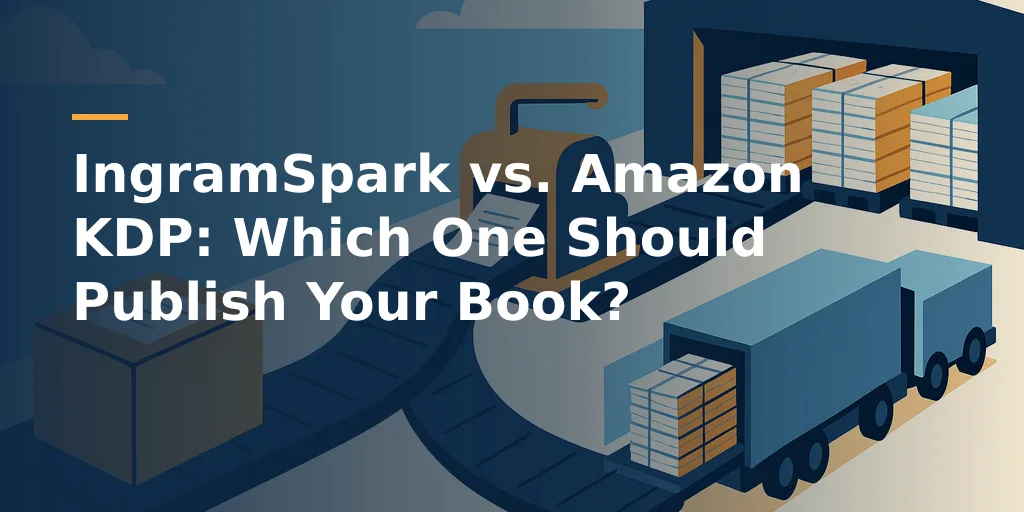
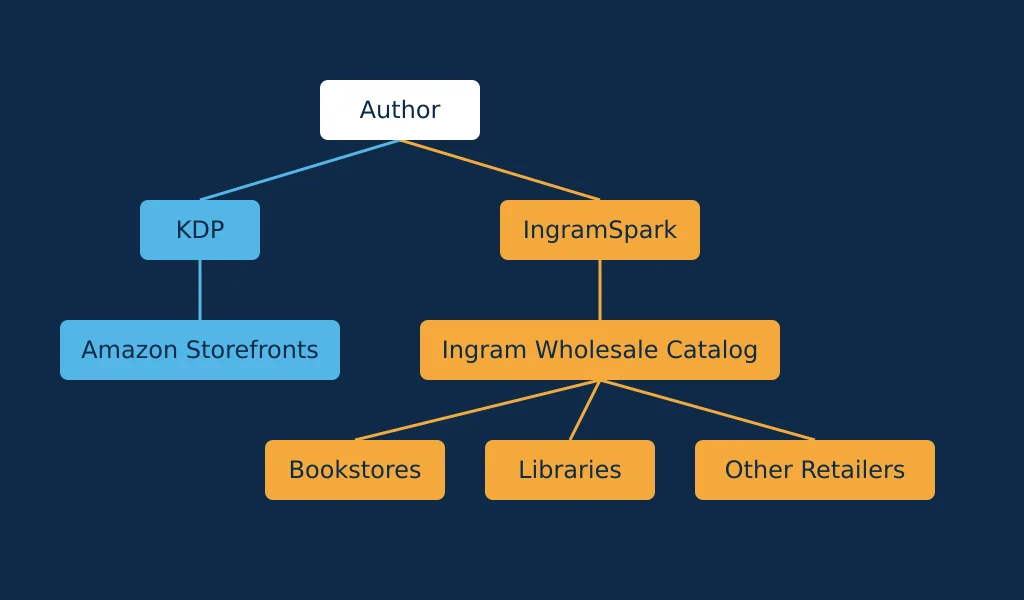
IngramSpark is a print-on-demand and ebook distribution service owned by Ingram Content Group, one of the largest book distributors in the world. It prints paperbacks and hardcovers one copy at a time, the same print-on-demand mechanic Amazon KDP uses, and it distributes ebooks to major retailers too. The difference sits in how each platform sells. KDP lists your book on Amazon and pays you when a shopper buys it there. IngramSpark works as a wholesale distributor instead, making your book available, at a discount you set, to the bookstores, libraries and other retailers that buy from Ingram's catalog.
KDP has its own version of wholesale reach, called Expanded Distribution, and it's worth naming here because it's the source of most of the confusion. Expanded Distribution can place your paperback into some of the same wholesale channels IngramSpark reaches, but Amazon sets the discount and return policy on those terms rather than you. That's the real difference between the two platforms: who sets the terms.
Setting up a book follows a similar shape on each platform, though the fields differ once you look closely. On KDP, you create a free account, click "+ Kindle eBook" or "+ Paperback," and work through three tabs: book details (title, series, your book blurb, keywords, BISAC categories), content (your manuscript and cover files), and pricing (list price, royalty option, territories). Submit for review, then wait for approval.
Account creation on IngramSpark is free too, but publishing costs money the moment you submit a book. You enter similar book details, add an ISBN of your own since IngramSpark asks for one on the record, upload separate interior and cover PDFs — just one of the several electronic book file formats you'll need to keep straight across platforms — choose trim, paper color and binding, and fix your wholesale discount and returnable status before paying the setup fee.
IngramSpark vs. KDP at a Glance
The table below lays out IngramSpark vs. KDP row by row. Some rows favor KDP's simplicity, some favor IngramSpark's reach, and the rest come down to how much control you want over pricing and print.
| Dimension | Amazon KDP | IngramSpark |
|---|---|---|
| Setup fee | None | $49 per book |
| Revision fee | No listed charge for file updates | $25 per revision |
| Ebook royalty | 70% of list price within a set price band, 35% outside it | 85% of net revenue, regardless of retailer |
| Paperback royalty formula | List price minus KDP's printing cost, times your royalty rate | List price minus your chosen wholesale discount minus printing cost |
| Printing cost basis | Set by KDP, based on trim, page count and paper | Based on trim, page count, paper and binding you choose at setup |
| Exclusivity / enrollment | Optional; KDP Select locks the ebook to Amazon | No exclusivity requirement on any format |
| Distribution reach | Amazon storefronts worldwide; wholesale channels via Expanded Distribution on fixed, non-returnable terms | Wholesale catalog reaching bookstores, libraries and other retailers, including Amazon, on terms you set |
| Wholesale discount & returns | Fixed by Amazon | Chosen by you |
| ISBN | Free assigned ISBN available | You supply your own |
| Trim, binding & page count | Fixed list of trims and formats; page range tied to trim and paper | Wider trim, paper and binding menu; page range also shifts with binding choice |
That fee row is the core of the IngramSpark cost question. KDP charges nothing to publish, and IngramSpark charges to get a title live at all. Proofread the full interior before you submit it the first time, since each additional revision adds another charge on top. Turnaround time is comparable on both platforms once a file's approved, since print-on-demand means neither one keeps you waiting on a print run, though actual delivery time still depends on where the order's shipping.
Royalties Compared: Run Your Numbers Through Both Calculators
Percentages alone won't tell you which platform pays more on your book. The two royalty models are built differently.
On KDP, your paperback royalty is your list price minus KDP's own printing cost, multiplied by your royalty rate. Print cost depends on trim size, page count and paper choice, so it shifts with your book's spec. Ebook pay works on a tiered structure. KDP pays 70% of list price within a set price band, and 35% outside it.
On IngramSpark, the paperback royalty is your list price minus the wholesale discount you chose minus IngramSpark's printing cost, so raising the discount lowers what you keep. Ebook pay is simpler and flat. IngramSpark pays authors 85% of the net revenue it receives from each ebook sale, regardless of retailer, meaning the same rate applies across Apple Books, Kobo, and everywhere else it distributes.
Where the Two Calculators Ask You Different Questions
Both platforms give you a free calculator, and both start with the same three fields: trim size, page count and list price. Pick a price using pricing your book if you haven't settled on one yet, since it changes which royalty tier you land in for both ebook and paperback.
KDP's calculator stops there and shows the royalty once its own fixed printing cost comes out. IngramSpark's calculator adds two fields KDP never asks for: the wholesale discount rate, and whether the title is returnable. Raise the discount and the paperback royalty drops, because a bigger cut goes to whoever's buying at wholesale. Switch the binding to something other than a standard paperback, and the printing cost baked into the number moves too. Run the same trim, page count and price through the KDP royalty calculator and through IngramSpark's version, side by side, trying a couple of different discount rates on the IngramSpark side. Whichever number comes out higher for your specific book is the one that matters; the headline percentage on either platform tells you nothing on its own.
How Printing Works on Each Platform
Both platforms print books one copy at a time, so there's no warehouse, no upfront print run, and no unsold stock sitting on a pallet. Where they differ is the range of physical books each one lets you make.
KDP Print's File and Trim Rules
KDP Print works from a fixed menu. You choose from its list of approved trim sizes, format your interior and cover to its bleed and margin specs, and the platform enforces a minimum and maximum page count tied to your trim and paper choice. That narrower menu buys something back: one file spec and one set of rules to check before you upload.
IngramSpark's Wider Print Options
IngramSpark's trim, paper and binding menu is wider than KDP's, covering formats such as children's books and art books that fall outside KDP's fixed list. That extra range matters most for projects needing a trim size or binding style KDP doesn't offer, less so for a standard 6x9 paperback.
Where Each Platform Gets Your Book Sold
Setup fees and formulas matter less than the plain question of who can buy your book, and from where.
Amazon KDP's Reach
Amazon KDP lists your book on Amazon's own storefronts, across every region Amazon operates in. If Amazon search is where most of your sales already come from, that reach alone may cover what you need. Expanded Distribution can push your paperback into some wholesale channels too, but Amazon fixes the discount and return terms on those listings. A store evaluating a title under those terms sees a fixed discount and a non-returnable flag, with nothing to negotiate, which is usually why it orders through Ingram instead.
IngramSpark's Wholesale Network
Ingram's catalog is what bookstores, libraries, and school and academic buyers order from directly. Independent bookstores and chains place orders through Ingram the same way they'd order from a traditional publisher's distributor, checking the discount and return terms attached to a title before committing shelf space. Library wholesalers work the same catalog to fill standing orders and consortium buys. Publish through IngramSpark, and your book's record sits inside that catalog with whatever discount and return status you chose, so a buyer can evaluate it like any other wholesale title.
An IngramSpark title is available to Barnes & Noble and independent stores through the Ingram wholesale network. That's one visible example of a much longer list of accounts buying from the same catalog.
The traffic runs the other way too. Publishing through IngramSpark doesn't cut you off from Amazon. A book published via IngramSpark can also appear as a buyable listing on Amazon, since IngramSpark distributes to Amazon among tens of thousands of other retailers. Because that distribution runs through the same record, the paperback can sit in the wholesale catalog and on Amazon's site at once.
Control Trade-Offs: Pricing, Returns, and Discounts
The wholesale model asks you to decide how much of a discount to give a bookstore and whether you'll take unsold copies back, a decision KDP never asks you to make.
What KDP Locks In
KDP fixes its own distribution terms. You choose your list price, but the wholesale discount and returns policy aren't yours to decide. Expanded Distribution can carry your paperback into wholesale channels, but it applies Amazon's fixed discount and non-returnable terms there too, the same terms as a direct listing.
What IngramSpark Lets You Choose
On IngramSpark, you set the wholesale discount rate a bookstore or library pays, and you decide whether your title is returnable or non-returnable. A higher discount paired with returns allowed matches the terms stores already expect from other publishers, which can make a bookstore more willing to order. A lower discount or a non-returnable listing protects your margin, though it may look less familiar to a wholesale buyer. Returnability just means unsold stock can come back to you later, and it's your call either way.
The Upside and Downside of Publishing With IngramSpark
None of this makes IngramSpark a straight upgrade over KDP. It solves one specific problem, wholesale access, and it comes with real costs attached.
What IngramSpark Gives You
- Puts your book inside Ingram's wholesale catalog, the same one bookstores and libraries use to place orders.
- Pays a flat 85% of net ebook revenue no matter which retailer makes the sale, simplifying tracking across multiple stores.
What It Costs You
- A per-book setup fee and a revision fee, on top of costs KDP doesn't charge at all.
- An ISBN you have to supply yourself, where KDP will assign one free if you don't already own one.
- A second dashboard and a second set of file specs to manage alongside KDP.
KDP Select Exclusivity Only Locks Your Ebook, Not Your Print Book
KDP Select's exclusivity clause binds the digital edition only. It has no reach into your paperback or hardcover rights, and confusing the two is what stops a lot of otherwise straightforward setups.
What KDP Select Exclusivity Covers
KDP Select is Amazon's enrollment program for ebooks. Enroll a title, and you agree to sell that ebook exclusively through Amazon for the enrollment term, in exchange for perks like Kindle Unlimited page reads and promotional pricing tools. The clause applies to the digital edition. Full stop.
What It Doesn't Touch
Your paperback or hardcover isn't part of that agreement. You can enroll a book's ebook in KDP Select and publish the same book's paperback through IngramSpark at the same time, with no conflict between the two. The enrollment terms allow exactly this combination: Kindle Unlimited income on the ebook side, bookstore and library reach on the print side.
Which Platform Fits Your Publishing Situation?
Five situations cover most readers landing on this page. Find yours, then act on the recommendation attached to it.
- Low-content or journal publisher. You publish planners, coloring books or activity books, and Amazon search traffic already drives nearly all of your sales. A journal or coloring book rarely gets ordered onto a bookstore shelf, so a wholesale catalog doesn't add much here. KDP alone covers this case, with no per-book fee, no ISBN to source, and a business that depends on volume more than shelf placement. If your catalog eventually needs wholesale reach too, the broader low-content books guide covers what changes once volume shifts that math.
- First-time novelist pricing a single paperback. You've written one book, and there's no bookstore relationship or event on the calendar yet. Stick with Amazon KDP to start. One book doesn't need a wholesale account serviced, and the setup fee buys a distribution channel you don't have the audience to use yet. Has a bookstore actually requested stock, or are you just hoping one might? Add IngramSpark once a real request or event shows up.
- Author with bookstore or library ambitions. A local shop said they'd carry your book if it were available through their usual ordering system, or you're pitching a library consortium. Choose IngramSpark. Expanded Distribution can technically reach the same shelf, but only on Amazon's fixed discount and non-returnable terms, and a store expecting to negotiate won't accept those. IngramSpark lets you set terms a wholesale buyer recognizes. A single interested store, a library consortium, or a standing order is reason enough to open the account.
- Author selling direct at events. You need copies for a table at a fair or a signing, and you already have a KDP account with no bookstore relationships to service. Order through KDP only. The extra setup step buys nothing for twenty copies at a table, and Amazon KDP author copies covers this need without a second account. If the event turns into a standing bulk order beyond what author copies handle, that's when IngramSpark's wholesale ordering starts to make sense.
- Author enrolled in KDP Select. Your ebook is already enrolled for Kindle Unlimited income, and you want print reach beyond Amazon too. Keep the ebook in KDP Select, and publish the paperback through IngramSpark. Check your current enrollment term in your KDP dashboard before changing anything, since the exclusivity clause never touches print, so this combination costs nothing extra on the ebook side.
Is IngramSpark Legitimate, and Is It Worth the Extra Setup Cost?
Most people searching for an IngramSpark review want an answer to two separate questions: is it legitimate, and is it worth the extra setup cost. IngramSpark is legitimate. Whether it's worth the extra setup cost depends entirely on the scenario above.
Who's Behind It
IngramSpark is owned and operated by Ingram Content Group, a distributor that's been moving books between publishers and retailers for decades, long before self-publishing existed as a category. It isn't a vanity press, and it doesn't ask for payment beyond its published setup and revision fees. It doesn't take rights to your book either; you keep full ownership and set your own price, same as on KDP. A company that asks you to pay for editing, marketing, or "acceptance" as a condition of publishing is running a different model than either KDP or IngramSpark.
When the Setup Fee Pays for Itself
The fee buys entry into a catalog stores and libraries use. If your business depends on shelf placement, the fee is a small line item next to what a single store order is worth. If Amazon is your only market, that same money doesn't return anything, so it's better spent elsewhere. Check which goal describes your book before you create the account.
Pick Your Platform Before You Upload a File
The decision comes down to one question: does anyone besides Amazon need to be able to order this book? Answer that first, then set up accordingly.
- Selling only through Amazon, low-content or otherwise. Create a KDP account and stop there.
- One paperback, no bookstore requests yet. Start with KDP, and revisit IngramSpark once demand shows up.
- Bookstore, library, or wide-retail goals. Create an IngramSpark account for the print edition.
- Events and direct sales with no wholesale ambition. A KDP account is enough; add IngramSpark only once you need a bulk order beyond an author-copy purchase.
- Ebook enrolled in KDP Select, print reach wanted beyond Amazon. Set up both, KDP for the ebook and IngramSpark for the print edition.
Frequently Asked Questions
How much does it cost to publish with IngramSpark?
IngramSpark charges $49 to set up a title and $25 for each revision. KDP charges neither fee, which is the core cost difference between the two platforms.
Does Barnes and Noble buy from IngramSpark?
An IngramSpark title is available to Barnes & Noble and independent stores through the Ingram wholesale network.
Is IngramSpark a legitimate company?
It is. Ingram Content Group, its owner, has been distributing books for decades, and IngramSpark charges published setup and revision fees only, with no payment required for acceptance or promotion. You keep full rights and pricing control over your book throughout.
Does IngramSpark put books on Amazon?
It can. IngramSpark distributes to tens of thousands of retailers, Amazon included, so a book published through IngramSpark can end up as a buyable Amazon listing alongside its bookstore and library availability. A KDP-only listing can reach wholesale channels too, through Expanded Distribution, but on terms Amazon fixes rather than terms the author sets.