Your book is already live on KDP, you've opened an ACX tab, and the first screen is asking about audio rights before you've even reached a title page. ACX audiobooks are how a KDP author extends a self-publishing catalog into audio, turning an existing Kindle ebook or print listing into a recording sold on Audible and Amazon, without booking a studio or hiring a narrator through an agency. This walkthrough covers the account setup, the royalty models, the exclusivity trade-off, and what happens after you submit — nine steps in total, from account creation to the moment your audiobook is ready to publish.
What Is ACX and How Does It Turn Your KDP Book Into an Audiobook?
ACX stands for Audiobook Creation Exchange. Audible launched it in 2011 as a service where rights holders — authors, publishers, estates — hire producers directly, instead of booking a professional studio themselves; the self-service structure has stayed the same since: submit a book, choose a payment model, find a producer. ACX calls the hired party a producer: often a narrator working solo, sometimes a narrator paired with an audio engineer who edits the files before delivery. ACX doesn't record anything itself; it's the layer where you post a book, someone auditions for it, and the finished recording goes up for sale once Audible approves it. A book published through Amazon KDP — as a Kindle ebook, a paperback, or both — is what makes you eligible to submit here.
ACX, Audible, and Amazon: How the Three Fit Together
Audible runs ACX, and Amazon owns Audible, so the three sit in a straight line: Amazon owns the retailer, the retailer owns the recording marketplace, and your book sits underneath both once you list it. ACX asks you to confirm you hold the audio rights to a specific book, a narrower question than the one KDP asked when you first published. Once approved, the recording goes up for sale on Audible.com and on Amazon, so one submission reaches both storefronts.
Before You Start: What You Need to Be Eligible for ACX
ACX won't let you post a book until you clear a short set of gates. Check these before you create an account, so you're not filling out screens for a book that isn't ready to publish.
- You must own or control the audio rights to the book. If you signed a contract with a publisher or a collaborator, check what it says about audio rights before assuming the answer is yes.
- ACX restricts eligible rights holders to legal residents of a short list of countries — currently the United States, the UK, Canada, and Ireland — with a local taxpayer ID and a bank account in one of those countries. If you're an author outside that list, you can still license the audio rights to someone who qualifies, but you can't hold the ACX account directly.
- You need a finished, publishable manuscript or a book already live on KDP. Auditions run against a real excerpt of the text, not a description of it.
- ACX runs a tax interview similar to the one required for KDP royalties, collecting your tax residency and identification details before any payment can go out.
If you haven't published on Amazon yet, sort that out first — creating an Amazon KDP account comes before ACX, since ACX asks you to attach a book that exists somewhere in Amazon's publishing system. Creating an ACX account is itself a free service; whatever cost there is comes later, in the royalty split or the fee you negotiate with a producer.
Step-by-Step: Setting Up Your ACX Account and Submitting Your Book
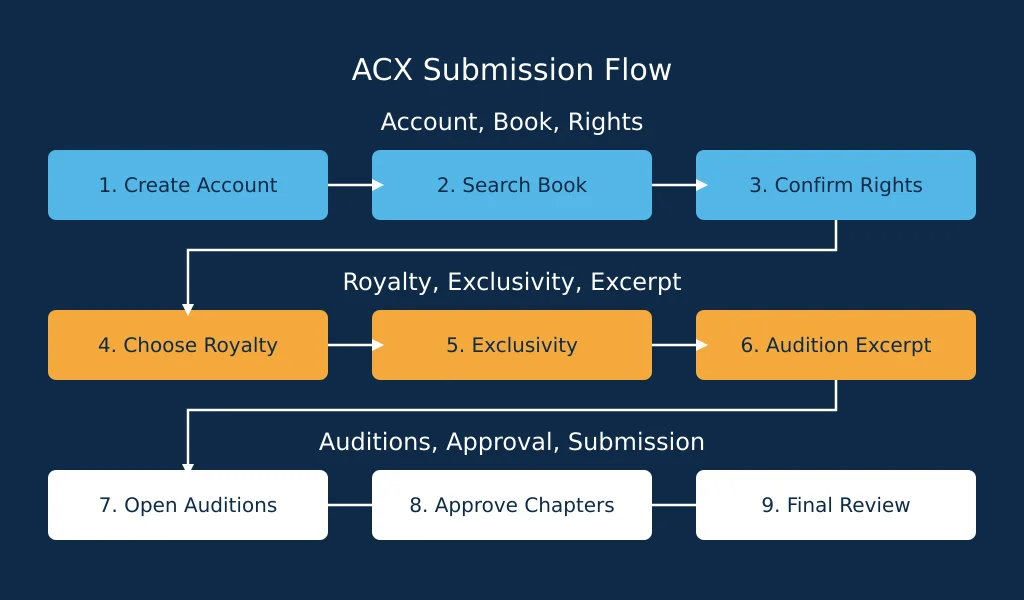
Here's how ACX walks you from account creation through final submission, in the order the process asks for them. Nine decisions, grouped into three stages. ACX updates its rates and deadlines occasionally, so double-check any dollar figure or date against the screen in front of you before you commit to it.
Steps 1–3: Account, Book, and Rights Confirmation
The first three steps are mostly paperwork. The book-search step checks your existing Amazon listing for matching details; the account and rights steps ask you to confirm information rather than pulling anything in automatically.
- Create or sign in to your ACX account using your Amazon login — the same credentials you use for KDP.
- Search for your book by title or ISBN first; ACX pre-fills what it can find from your Amazon listing — typically the title, author name, and cover art — and you add a genre and an audio-specific description written for Audible's audience. If the search comes up empty, add the details manually.
- Confirm you hold the audio rights on the rights confirmation screen. The screen only asks you to declare that you hold the rights; ACX does not ask for documents. If your book has a co-author, or was written under a prior publishing contract or ghostwriting arrangement, settle audio rights in writing before you tick the box — untangling a dispute after a producer has already recorded chapters costs far more than checking it now.
Steps 4–6: Royalty Model, Exclusivity, and Your Audition Script
Steps four through six set the payment model, the distribution choice, and the audition excerpt — the core decisions that shape how the book earns and where it can sell.
- Choose your royalty model: Royalty Share, Royalty Share Plus, or Pay for Production. Set this while the book is still in draft, and treat it as fixed once a producer accepts an offer — the agreement ACX generates is built around whichever model you picked.
- Choose Exclusive or Non-Exclusive distribution. Royalty Share and Royalty Share Plus are both available on exclusive books only — choosing Non-Exclusive limits you to Pay for Production instead. Exclusive distribution isn't a permanent lock — see the distribution section below for how conversion and termination actually work.
- Upload an audition excerpt: a passage from the book, long enough for a narrator to read for several minutes. The book won't open for auditions until this excerpt is posted, so treat it as the last thing you settle before step seven.
Before writing that excerpt, settle whether you're producing an abridged vs. unabridged audiobook. Most fiction and memoir on ACX ships unabridged; an abridged edition needs to be labeled as such during submission.
Steps 7–9: Auditions, Approval, and Final Submission
This is where the earlier choices stop being editable — auditions turn into a hired producer, and a folder of approved files turns into a live audiobook.
- Open the book to ACX's audition pool for public submissions, or search by name to invite a specific narrator directly.
- Review the auditions you receive, then send an offer to the producer you choose. ACX generates an agreement covering the agreed rate and delivery deadlines, and both sides confirm it before recording begins.
- Approve each finished chapter as your producer uploads it, or request a revision if something's off. Listen closely before you click approve, and treat an approved chapter as final rather than assuming you can reopen it later. Once every chapter shows approved, the final submission step unlocks and the audiobook moves into ACX's review queue for approval by Audible, Amazon, and Apple Books.
Royalty Share vs. Royalty Share Plus vs. Pay for Production: Which Payment Model Should You Choose?
Step four asks you to pick a payment model — the ACX royalty share options (Royalty Share and Royalty Share Plus) or Pay for Production — and the choice sets the shape of every future royalty statement. ACX shows current rates and terms on the screen where you accept a model, and it's worth reading that screen closely, since the numbers shown there are the ones that actually apply to your book.
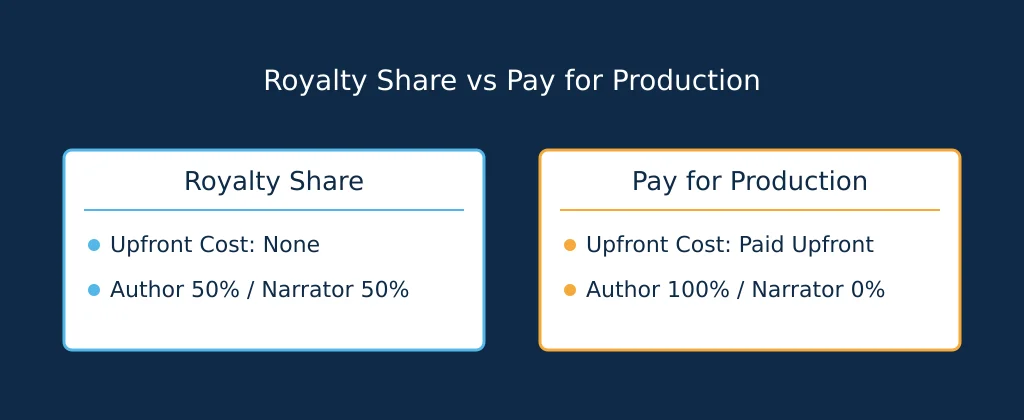
A producer works for a cut of the audiobook's ongoing royalty instead of a flat fee under Royalty Share, so you and the producer are both paid only once the book sells. From May 26, 2026, ACX pays a 50% royalty on an exclusive book that's newly claimed or uploaded, split 50/50 between author and producer — 25% each — and a 30% royalty on non-exclusive books. Royalty Share isn't offered on non-exclusive distribution at all — going wide means paying upfront instead. Royalty Share is the only one of the three models that requires no cash before recording starts. If a book of yours is still enrolled under ACX's older 40% exclusive / 25% non-exclusive terms, you'll need to make an enrollment decision before December 31, 2026, or the audiobook comes down from Audible.
Royalty Share Plus pairs the same royalty split as Royalty Share with a reduced upfront per-finished-hour payment to the producer, so you pay less upfront than a full PFH fee would cost but still owe some cash before the book earns anything. It suits an author with some budget who can't cover a full PFH fee outright but wants to shrink that upfront cost.
Pay for Production works the other way again: you're paying for the narration outright, before a single copy sells, priced per finished hour and usually shortened to PFH — the total fee is the negotiated rate multiplied by the finished hours of audio the book runs. PFH rates are set per producer, so a producer with a longer catalog and stronger reviews will quote higher than someone auditioning for a first book. Treat any figure you're given as that producer's own rate, and ask for a finished-hours estimate against your manuscript before agreeing to a price. In return, your author royalty stays at the full rate — 50% exclusive or 30% non-exclusive — since the producer was already paid upfront instead of waiting on sales.
| Model | Upfront Cost to You | Royalty Split | Exclusivity Requirement | Best For |
|---|---|---|---|---|
| Royalty Share | None — no cash outlay to record | 50% royalty on exclusive books from May 26, 2026, split 50/50 between author and producer — 25% each | Exclusive distribution only; not offered non-exclusive | Authors with steady KDP sales but no budget to pay upfront |
| Royalty Share Plus | A reduced PFH fee, lower than a full Pay for Production rate | Same royalty split as Royalty Share, paired with the reduced upfront PFH payment | Exclusive distribution only | Authors with some budget who want to lower the upfront cost without paying a full PFH rate |
| Pay for Production, Exclusive | A negotiated PFH rate, paid before recording begins | Full 50% exclusive royalty stays with the author | Optional — you can choose exclusive and still keep the full rate | Authors with a budget who want a higher long-term royalty |
| Pay for Production, Non-exclusive | Same negotiated PFH rate | Full 30% non-exclusive royalty stays with the author | None — free to distribute anywhere | Authors with a following outside Amazon or plans to sell audio direct |
Run the ebook and print numbers you have through the KDP royalty calculator before deciding how much upfront cash you're willing to spend — Pay for Production and Royalty Share Plus both mean spending real money regardless of how the audiobook eventually sells.
Exclusive vs. Wide Distribution: What Locking In With ACX Costs You
The exclusivity checkbox in step five works the same trade-off as the exclusivity decision behind KDP Select — you give up reach in exchange for perks tied to Amazon's ecosystem. The lock-in isn't indefinite: since February 2021, a DIY or Pay-for-Production book on sale for 90 days or more can convert from exclusive to non-exclusive, and any rights holder can request termination after that same 90-day mark. The one exception is Royalty Share: a Royalty Share book cannot switch to non-exclusive at all, and ending its distribution after the 90 days still needs the producer's consent.
Going non-exclusive doesn't remove ACX from the picture: an exclusive book sells on Audible, Amazon, and Apple Books — listed as iTunes in older ACX documentation — all through ACX. Non-exclusive distribution keeps those same three outlets through ACX and adds the right to distribute the audiobook elsewhere yourself, through a separate distributor service that can link it to stores like Kobo. ACX doesn't reach those additional stores directly, so a non-exclusive book without a separate distributor service sells in exactly the same three places an exclusive one does.
Whispersync for Voice, the feature that bundles a Kindle ebook with its audiobook so a reader can switch between reading and listening, is available on exclusive and non-exclusive books alike. Eligibility depends on the recording: an unabridged audiobook that closely matches the Kindle edition's text, generally around a 97% match, qualifies either way.
| Distribution Type | Where It Can Sell | Royalty Impact | Lock-in Period | Whispersync Eligibility |
|---|---|---|---|---|
| Exclusive | Audible, Amazon, and Apple Books, through ACX | Unlocks Royalty Share and Royalty Share Plus, plus the 50% exclusive royalty rate under Pay for Production | 90 days minimum, then a one-time switch or exit on request; Royalty Share adds the producer's consent | Eligible either way, subject to an unabridged recording that closely matches the Kindle text |
| Non-exclusive (Wide) | Still sells on Audible, Amazon, and Apple Books through ACX; other retailers like Kobo are added yourself through a separate distributor service | 30% royalty instead of the exclusive rate, in exchange for the right to distribute elsewhere | Same 90-day minimum applies to the ACX agreement itself; non-exclusive additionally lets you add or drop other retailers through your own distributor service at any time | Eligible either way, subject to an unabridged recording that closely matches the Kindle text |
Finding and Auditioning Narrators Without Losing Your Royalty Split
The steps above cover posting a book and picking a producer from the pool of auditions it draws. What they don't cover is how to judge what comes back, how to keep more of your royalty once someone accepts the offer, or how you'll actually get review or promo copies of the finished audiobook into listeners' hands — for ebooks, tools like BookFunnel handle that delivery problem.
- Write an audition excerpt that's genuinely representative: a page of dialogue, a page of plain narration, and a passage that carries the book's tone. A sample should show the voice across the whole book, so avoid submitting only the opening chapter.
- Post the excerpt publicly for open auditions, or, if you already know someone's work from another audiobook, invite them directly instead. A direct invite keeps the book private and can move faster than an open call.
- When auditions come in, listen for pacing and character differentiation before recording polish. A demo recorded at home with the right voice for your protagonist beats a studio-clean read that misses the character entirely.
- For books paid upfront, the PFH rate is negotiable, and a direct invite to a producer you already trust often gets a lower rate than an open call, while keeping the full author royalty under Pay for Production. Royalty Share and Royalty Share Plus, by contrast, commit you to a split for the life of the book, so weigh the options before anyone signs on.
After You Submit: What the Audible Review Checks and When You Get Paid
Once every chapter is approved on your end, the finished audiobook still goes through ACX's review process, checked against Audible and Amazon's technical and content standards, before it appears for sale. ACX doesn't publish one fixed number for how long that review takes — check the estimate shown on your title's dashboard once you submit, since it varies with review volume. If you've gone wide, each additional retailer you add through your own distributor service runs its own technical review before listing you too.
The review checks audio quality and file structure — noise levels, silence padding, and chapters that match your table of contents. It confirms the files meet Audible's delivery specs — the producer's performance choices are outside its scope.
If a book comes back rejected, treat it as a partial fix rather than a restart: address what's flagged and resubmit those files for another pass. A rejection on a handful of chapters doesn't mean re-recording the whole audiobook.
Before that review starts, confirm your producer delivered files in the audiobook file formats Audible actually requires, since files that don't meet Audible's technical requirements get sent back for correction. Once the audiobook is live, Audible pays royalties monthly on a net-30 basis: a statement and a payment — direct deposit, or a check if you're a US rights holder — go out each calendar month, starting with the first full month the book is on sale. Reports break earnings down by retailer, worth comparing against your KDP report for the same title once you have a few statements to look at.
What the Audible Return Policy Means for Your Royalties
Audible handles returns through its own customer service system, and a return processed after you've been paid for that sale is typically deducted from a later royalty statement rather than billed to you directly. For a book selling steadily, occasional returns show up as a small negative line on a future statement, not something to dispute unless the pattern looks unusual for your book or its customer base.
Is ACX Worth It? Weighing the Pros and Cons for KDP Authors
There's no single answer to whether ACX is worth it, because the three payment models and two distribution choices produce genuinely different situations for different authors. What stays consistent is the specific trade-off you're making at each screen.
| Pros | Cons |
|---|---|
| Royalty Share and Royalty Share Plus get an audiobook made with little to no upfront cost to the author | Royalty Share means giving up half the royalty to the producer, for as long as the book stays under that model |
| Access to professional narrators through auditions, without hiring a studio | No exit before the 90-day mark, and a Royalty Share deal ties any later exit to the producer's agreement |
| One submission reaches Audible, Amazon, and Apple Books at once | Going wide rules out Royalty Share and Royalty Share Plus, so a non-exclusive book always means paying a producer upfront |
| Whispersync for Voice can bundle your audiobook with its Kindle edition on either distribution choice, once the unabridged recording closely matches the Kindle text | Reviewing every chapter as it's delivered falls on the author — ACX's own review checks technical delivery, not editorial quality or performance, so no one else is judging whether the reading is any good; customer returns under Audible's return policy can also claw back a paid royalty on a later statement |
Your Next Step: From KDP Listing to Live Audiobook
Open ACX and start with account creation using your Amazon login. Before you do, have these ready so you're not stopping mid-screen to go find them:
- Confirmation of who owns the audio rights to your book
- Your tax residency details, the same ones on file with KDP
- An excerpt from the book long enough for a narrator to read for several minutes, formatted as your audition script
- A decision, made before you start, among Royalty Share, Royalty Share Plus, and Pay for Production, since the screen won't let you leave it unanswered once you reach it
With those four things sorted, the first screen you'll hit after logging in is the book search — type in your title or ISBN and ACX pulls in what it can from your KDP listing before you fill in the rest.
ACX Audiobooks: Frequently Asked Questions
Short answers to the questions that come up before the first submission.
Can you actually make money from ACX?
Yes, but how much depends on your book's existing audience and which royalty model you picked. Royalty Share and Royalty Share Plus only pay in full once the audiobook sells, so a book with a small KDP readership produces a small trickle of audio royalty at first. Pay for Production asks you to spend money before you know if it earns back. None of the three models guarantees a return before you list the book — the honest way to know is to submit, watch a statement or two, and judge from there.
Can I get paid to read books for Audible?
Yes — that's the producer side of ACX. Instead of submitting your own book, you create a profile on that side of the site, upload a sample reel, and audition for books other authors have posted. You're paid a PFH fee, a royalty share, or a blend of both under Royalty Share Plus, depending on which model the rights holder chose for that book.
What is the difference between ACX and Audible?
Audible is the retail platform where customers buy and stream audiobooks. ACX is the marketplace behind it — the place where authors and producers create the audiobooks that later go up for sale on Audible. Nothing sells directly through ACX itself; you submit and record there, and the finished file appears for sale on Audible and Amazon afterward.
How much can you make as a narrator on ACX?
There's no set rate. If you're paid per finished hour, the PFH figure is negotiated for each book individually — it's whatever you quote for the job. The rate you can command tends to track your own record: more finished audiobooks and stronger listener reviews let you quote higher, while a producer building a first credit typically prices lower to win the audition. If you take Royalty Share instead, you split that book's 50% exclusive royalty with the author — 25% each — so your income rises and falls with sales, with no fixed rate. Royalty Share Plus pairs that same split with a smaller upfront PFH payment; the ongoing royalty share itself stays the same as plain Royalty Share. A book that sells well pays out over time, and one that doesn't sell pays little no matter how strong the narration is.