The proof copy of your book is open on the desk. On the left-hand page a list reads red, white and blue; on the facing page another reads red, white, and blue — same chapter, same afternoon of drafting, two different punctuations. The mark that differs is the serial comma, better known as the Oxford comma, and no one outside your own imprint is going to make the call for you.
The serial comma is the comma placed before and, or, or nor in a list of three or more items. The mark is optional in the strict sense: no grammar of English requires it, and dropping it is not an error. It is a house-style choice, and as a self-publisher you are the house. What follows is the decision itself, mapped to what you are actually publishing, a way to fix a manuscript that currently does both, and a short block you can save so your editor, your proofreader, and book three all match book one.
Oxford Comma, Serial Comma, Harvard Comma: One Mark, Three Names
Before the decision, thirty seconds of vocabulary — because the mark you are deciding on travels under three names, and an editing brief can use any of them at you.
What the Oxford Comma Actually Is
The whole definition fits in a sentence pair. Without it: The box held a compass, a knife and a coil of rope. With it: The box held a compass, a knife, and a coil of rope. The disputed mark is the one before and. It only ever appears in a list of three or more items, and it applies equally to lists joined by or (tea, coffee, or juice) and by nor.
Oxford comma, serial comma, and Harvard comma are three names for that single mark. The first two are the names you will see most often in style guides and editing briefs; the third turns up mainly in American academic contexts. Nothing changes between them, so if an editor writes "serial comma throughout" and you were expecting the word "Oxford", you have been given the same instruction.
Why Nobody Can Tell You It Is Wrong
English grammar does not settle this. Both versions of that sentence about the box are complete, correct, and comprehensible. What differs is convention: some publishers, guides, and traditions include the comma always, some include it only when the sentence needs it, and none of them can appeal to an authority above their own guide. Anyone who tells you that omitting the serial comma is a mistake is describing a preference, and anyone who tells you the comma is clutter is doing the same thing from the other side.
That means the only genuine requirement is consistency inside one book, and ideally across everything with your name on it. A reader will not notice the presence or absence of a comma. A reviewer, a copy editor, or an attentive beta reader will notice the moment your manuscript does both on facing pages.
The Problem You Really Have: You Are the House Style
A magazine writer never has this problem. The masthead hands them a style guide and the copy desk enforces it. Self-publishing removes that layer entirely: no imprint style guide exists for your books until you write one. So the useful question is not "which side is right" but "what is my default, and where is it written down?" If you arrived here from the term itself and want the neighbouring vocabulary, the index of self-publishing terms starting with O covers the surrounding jargon. Otherwise, pick your row in the next table and you can stop reading after it.
Make the Call in Five Minutes: The Oxford Comma in Fiction, Nonfiction, and Everything Else You Publish
This is the decision itself: your format on the left, a sensible default beside it. The notes after the table cover the books that refuse to sit in one row.
How to Read the Table
Find the row that matches what you are publishing. The "Serial comma default" column is the setting to adopt unless you have a reason not to; the "Why" column is that reason spelled out so you can overrule it knowingly. These are defaults, not requirements. A novelist who prefers the cleaner look of no serial comma and applies it consistently has made a perfectly defensible choice.
| Book type | Style guide it follows by default | Serial comma default | Why | Watch out for |
|---|---|---|---|---|
| Literary and genre fiction | The Chicago Manual of Style | Use it | Chicago recommends the serial comma, and US trade fiction is edited to Chicago, so American readers have been reading it for years without noticing | Lists inside dialogue, where a character's rhythm may argue against it |
| General nonfiction, how-to and self-help | Chicago | Use it | Instructional lists are long and often contain their own ands; the comma keeps the items separate | Bulleted lists — decide separately whether bullets take end punctuation at all |
| Academic or citation-heavy nonfiction | APA or MLA | Use it | Both APA and MLA call for the serial comma, so the choice is made for you by the guide your citations already follow | Quoted matter, which keeps the original author's punctuation |
| Book press releases and media copy | AP Stylebook | Skip it in simple lists | Journalists write and edit to AP, which omits the comma in a straightforward series; matching that makes your copy easier to lift | AP keeps the comma when an item contains its own conjunction or the series is complex |
| Children's picture books and early readers | Chicago | Use it | Lists are short and read aloud; the comma marks the pause an adult reader will make anyway | Very short lines where a comma crowds the illustration; recast rather than mix styles |
| Poetry collections | None — the poem decides | Not applicable | Line rhythm, breath, and white space govern punctuation in verse; a blanket rule can flatten a line | Front matter, contents, and author bio should still follow one consistent style |
| Low-content books: prompt lines, planner headers, journal pages | Your own template style | Use it, then lock the template | Prompts are reused across dozens of interiors; one decision baked into the template removes the question forever | A mixed set of interiors bought or built at different times |
| Titles aimed mainly at UK readers | New Hart's Rules or a house choice | Either, applied consistently | British practice is split: Oxford's own manual favours the comma while several UK newspapers use it only for clarity | Readers noticing inconsistency, not the choice itself |
| Amazon book description and back-cover blurb | Match the book | Same as the interior | The blurb is the first prose a buyer reads; a mismatch reads as carelessness before they open the sample | Character limits, where one comma occasionally matters |
| Lists spoken inside dialogue | Voice | Not applicable — judge line by line | Speech is punctuated to show pace and breath, so a breathless character may run items together on purpose | Doing it deliberately in some lines and accidentally in others |
When Your Book Sits in Two Rows at Once
Most books do. A novel has dialogue in it; a how-to book gets a launch announcement; a UK-set thriller sells mostly to American readers. Resolve it this way: the interior of the book takes one default, top to bottom, and the exceptions are named exceptions rather than a second style. Dialogue is the common one, and it is worth deciding alongside the rest of your speech punctuation — the mechanics live in the guide to how to format dialogue. Marketing material sits outside the book and can follow its own convention: a book press release written to journalism style will not clash with a Chicago-styled novel, because no reader sees both at once.
Where Dropping the Serial Comma Actually Costs You
The comma is optional; ambiguity is not. These are the sentences where the choice stops being cosmetic and starts changing what the reader believes happened.
Three Oxford Comma Examples That Change the Meaning
The defaults in the fiction and nonfiction rows lean toward using the comma because of lists like these. Each pair is the same words with one mark added.
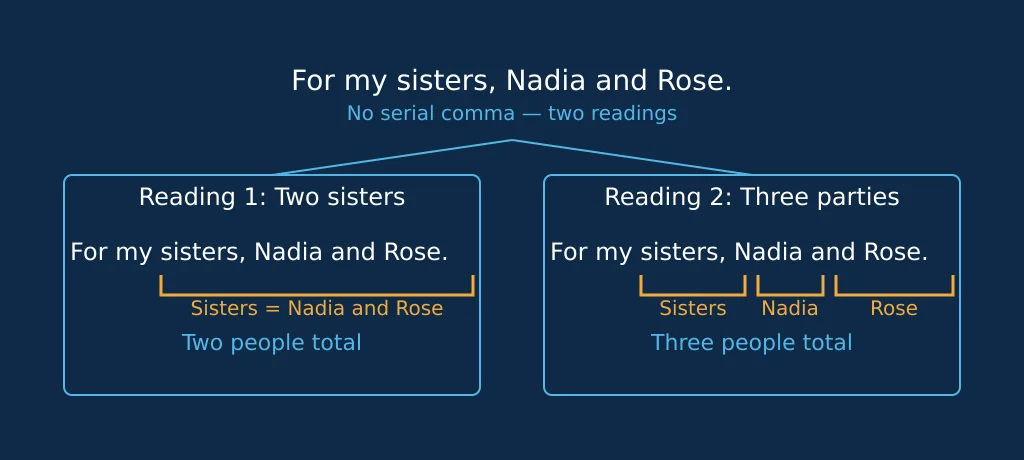
- Dedication line, without: For my sisters, Nadia and Rose. This can be read as two sisters who are named, or as three parties: the sisters, plus Nadia, plus Rose. With the comma — For my sisters, Nadia, and Rose — the three-party reading is the one the page delivers.
- Grouped items, without: The cook, the gardener and the driver and the maid were questioned. Who was questioned together? With the comma — The cook, the gardener, and the driver and the maid — the driver and the maid are plainly one pair.
- Compound item, without: Breakfast is cereal, bacon and eggs and toast. With the comma — cereal, bacon and eggs, and toast — the plate stops rearranging itself.
Notice that the first example is a dedication. Front matter is set once, read by everyone who opens the sample, and almost never re-read by the author after the first proof. It is exactly where an ambiguous list survives to print.
When the Oxford Comma Creates the Confusion
The comma is not a one-way clarity device. Consider: Thanks to my editor, Sarah Kline, and my agent. A reader can take "Sarah Kline" as the editor's name in apposition, which leaves two people thanked instead of three. Adding the comma caused that reading, and removing it does not fix it either. Two fixes work, and neither is a comma. Reorder so the name falls last, where nothing can be read as standing in apposition to it: Thanks to my editor, my agent, and Sarah Kline. Or repeat the preposition in front of every item, which blocks the appositive reading while keeping all three parties: Thanks to my editor, to Sarah Kline, and to my agent.
The Comma That Went to Court
In 2026 the US Court of Appeals for the First Circuit decided a Maine overtime dispute, O'Connor v. Oakhurst Dairy, in which delivery drivers argued they were owed overtime pay. The state law listed activities exempt from overtime, and because the list carried no serial comma it was unclear whether "packing for shipment or distribution" described one activity or two. The court held the wording ambiguous and read it in the drivers' favour; the case was settled afterwards, and Maine later rewrote the provision using semicolons rather than adding a comma.
Take the rewrite, not the ruling, as your lesson. Here is the rule of thumb worth pinning above the desk: if a list is ambiguous either way, the comma is not the problem — rewrite the list. Reorder the items, break it into two sentences, or separate the items with semicolons.
What the Style Guides Say (and Which One Is Yours)
No guide settles this for you, but knowing where each one stands tells you what your editor was trained on and what the books shelved next to yours already do.
The Guides That Ask For It
These are the guides you would plausibly adopt as your own house style for a book interior.
| Style guide | Position on the serial comma | Who follows it | Relevance to a self-published book |
|---|---|---|---|
| The Chicago Manual of Style | Recommends it in a series of three or more items | US trade book publishers, most freelance book editors | The practical default for a novel or a general nonfiction title; ask for "Chicago" and a copy editor knows what you mean |
| APA Publication Manual | Requires it | Psychology and social-science writing | Relevant if your nonfiction carries APA-style citations |
| MLA Handbook | Recommends it | Humanities and literary scholarship | Relevant for academic or literary-criticism titles using MLA citations |
| Oxford Style Manual / New Hart's Rules | Favours it as Oxford house practice | Oxford University Press and editors trained on its rules | The natural pick if you are producing a UK-market book and want a British guide that still uses the comma |
The Guides That Skip It, and When They Don't
Newspaper style is where omission comes from, and the reason is space: column inches were finite and a mark saved was a mark saved. Neither of these guides bans the comma outright, which is why both are awkward to hand to a proofreader as a blanket instruction.
| Style guide | Position on the serial comma | Who follows it | Relevance to a self-published book |
|---|---|---|---|
| AP Stylebook | Omits it in a simple series, but keeps it where an element contains a conjunction or the series is otherwise complex | News desks, PR writers, most journalists | Adopt only for media copy and press releases, not for the book itself |
| The Guardian style guide | Uses it only where a sentence needs it for clarity | Guardian journalists and writers who like the "only when necessary" approach | Workable, but harder to hand to an editor because every list becomes a judgement call |
AP is the guide most often cited for skipping the comma, so it is worth being precise about what it says: the Stylebook allows and expects the comma where a list would otherwise mislead. Anyone who tells you AP forbids the serial comma is compressing the guidance.
British vs. American Practice
The name comes from Oxford University Press, whose in-house rules for compositors — the Hart's Rules tradition, printed for staff in the early twentieth century and still alive as New Hart's Rules — prescribed the comma; the term "Oxford comma" attached itself to the practice later. "Harvard comma" is the American twin, and the name is usually linked to Harvard University Press. The tidy irony is that the mark named for a British university press is used far more consistently in American publishing than in British newspapers. For a self-published trade book in either market, The Chicago Manual of Style is the practical default because it is the guide your freelance editors already own, which does not make the other guides wrong for the work they were written for.
Pros and Cons of Using the Oxford Comma
Both columns here are real, which is why the argument never ends. Weigh them against the kind of prose you actually write, not in the abstract.
Benefits of Using It
- It is one decision applied everywhere, which is easier to hold across 90,000 words than "only when needed".
- Fewer ambiguous lists reach print, especially in front matter and long instructional series.
- It matches the Chicago-edited books your readers already buy, so your pages look like the shelf they sit on.
- It is trivially easy to instruct: two words in an editing brief and a proofreader can enforce it without asking you a single question.
Drawbacks of Using It
- It costs a character in places where characters are tight: a subtitle, a headline, an ad, a planner header set in large type.
- It looks wrong to readers raised on newspaper style, particularly in the UK.
- In a short, simple list of three plain nouns, it does no work at all.
- It can create the appositive misreading shown above, which the omitted comma would not have produced.
What the Argument Is Really About
The argument is loud because the stakes are low and the positions are cheap to hold. One side values clarity and predictability; the other values economy and a cleaner line. Neither can appeal to a higher authority, because English has no governing body and the style guides disagree with each other in print. That is why the debate never resolves and why it does not need to resolve for you to finish your book. Pick the row from the table, apply it everywhere, and the question stops being interesting.
Auditing a Mixed Manuscript in One Pass
A manuscript that currently does both gets fixed in one sitting with a search function and the four steps below — no full read-through required.
Step 1: Decide Before You Search
Write your choice at the top of the manuscript file before you open a search box. Auditing while still deciding produces a manuscript that is half-converted and a memory that insists it is finished. Decide, note the date, then start.
Step 2: Find Every Serial List
Search for and with a leading and a trailing space, then repeat for or and nor . The spaces matter: they keep and from matching inside band, island, and understand. Word's Find box and the navigation pane will accept the spaces and show you the number of matches; Google Docs' Find and Replace does the same; Scrivener's project search runs the query across every document in the binder at once, which is what you want for a manuscript split into scene files. Grammar checkers such as Grammarly and ProWritingAid also carry a serial-comma preference in their settings — set it to match your decision before you accept a single suggestion, or the tool will spend the afternoon arguing with you.
What you are doing is stepping through hits and judging each one. Do not run a blind find-and-replace on and . It will insert commas into two-item lists, into compound predicates, into company names, and into every quoted sentence in the book, and undoing that is a bigger job than the audit was.
Step 3: Judge the Exceptions, Don't Batch Them
Leave these alone as you pass through:
- Company, firm, and brand names that contain their own punctuation, which are spelled the way their owners spell them.
- Quoted matter of any kind, which keeps the original punctuation even when it contradicts your style.
- Titles of published works, for the same reason.
- Lists of two items, which never take the comma under either style.
- Lists already separated by semicolons, which are a different structure and not your problem today.
- Dialogue lines where you punctuated for breath on purpose — flag them, note why, and move on.
Step 4: The Places Writers Forget
The interior gets audited because the interior is what the search box is pointed at. These do not:
- Dedication and epigraph
- Acknowledgements, which are nothing but lists
- Copyright page and disclaimer
- Chapter subtitles, running heads, and part titles
- Image captions, tables, and any figure text
- Back matter: also-by page, author bio, newsletter call to action
- The KDP book description, subtitle, and series description, which live outside your manuscript file entirely
Work chapter by chapter rather than in one sitting, and keep a running log of every exception you leave in place. A full-length novel is an afternoon's work at this pace, and the log is what stops you re-litigating the same three sentences at proof stage.
Write It Down: The Style Sheet Entry That Keeps Book Three Matching Book One
A decision only holds if it is written where your future self and your proofreader will look. That place is a style sheet, and the entry takes a minute.
The Block to Copy
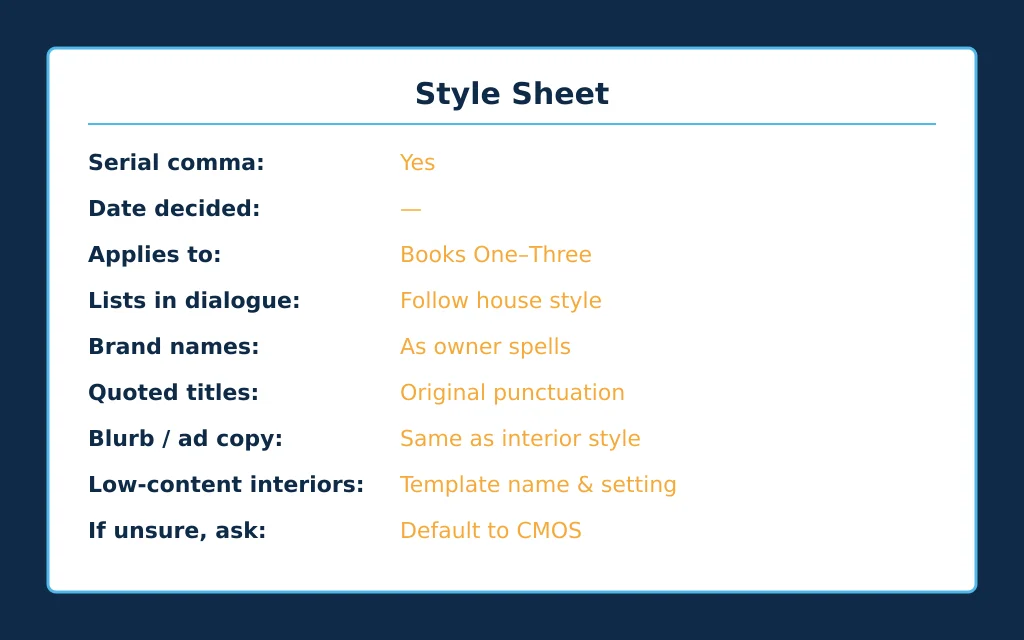
Copy this, fill in the answers, and it becomes the record that survives drafts, software changes, and hired help:
- Serial comma: yes / no
- Date decided:
- Applies to: (list the titles and the series)
- Lists inside dialogue: follow house style / punctuate for voice, case by case
- Company, firm, and brand names: keep as the owner spells them, never normalised
- Quoted matter and published titles: keep original punctuation
- Blurb, ad copy, and press material: same as interior / journalism style
- Low-content interiors and prompt lines: (template name and setting)
- If unsure, ask: (your name and email, or "default to The Chicago Manual of Style")
Where to Keep It
Three copies beat one. Put the block on a front page of the working manuscript file, above the title, deleted only at final formatting. Put a second copy in your series bible next to character names and place spellings. Put a third in the shared document or folder the editor works in, so it is visible without anyone asking. Scrivener users can pin it as a project note where it stays on screen while you draft. This is also the natural home for your other once-and-for-all mechanics: the footnote vs. endnote choice for a nonfiction title, your spelling variant, your dash style, and any standing preference about active vs. passive voice you want an editor to respect rather than override.
How to Hand It to an Editor or Proofreader
One line in the brief does it: "House style is Chicago, serial comma throughout, exceptions listed in the attached style sheet — please query anything the sheet does not cover rather than changing it." Without that line, a copy editor applies their own default, and you will pay to have it applied and then pay again to have it reversed. It matters which stage you are at, too, because the two roles do different jobs with your sheet — the breakdown in copy editing vs. proofreading shows which one enforces a comma decision and which one only catches what slipped through.
The series argument is the strongest one for writing any of this down. A single book that mixes both styles looks like a typo. A series where books one and two use the serial comma and book three does not looks like a different author, and it is the kind of thing a reviewer names in a sentence you cannot edit.
Your Next Three Moves With the Serial Comma
- Find your row in the decision table and take its default. If your book sits in two rows, the interior gets one style and the exceptions get named, not multiplied.
- Run the four-step audit on the manuscript: search and , or and nor with the spaces, judge each hit, log the exceptions, then sweep the dedication, acknowledgements, captions, back matter, and your KDP description.
- Fill in the style sheet block, date it, store it in the manuscript file and the series bible, and paste the one-line instruction into your next editing brief.
Once those three are done, the serial comma is a setting on your imprint rather than a question you answer again at every draft.
Frequently Asked Questions About the Oxford Comma
Short answers to what self-publishers actually type into the search box.
Is a serial comma the same as an Oxford comma?
Yes. Serial comma, Oxford comma, and Harvard comma are three names for the same mark: the comma before and, or, or nor in a list of three or more items. If an editor's brief says one and your notes say another, you are still describing one decision.
What is the controversy with the Oxford comma?
It is a clash between clarity and economy with no authority able to settle it. Book publishers generally use the comma because it prevents ambiguous lists; newspapers generally omit it in simple series because it costs space. The style guides disagree in print, English has no governing body, and both versions are correct — so the argument continues without ever resolving.
Are serial commas grammatically correct?
Yes. Including the serial comma is grammatically correct, and so is leaving it out. Neither choice is an error in itself; the only genuine fault is switching between them inside one book. Where a list does change meaning, as with the dedication line above, the reliable fix is to rewrite the list rather than to argue about the mark.
Is it grammatically correct to use an Oxford comma?
It is. The Chicago Manual of Style, APA, and MLA all call for it, and no widely used guide treats it as a mistake. AP omits it in simple series, which is a house preference rather than a ruling on correctness.
Does Amazon KDP care whether I use the Oxford comma?
No. KDP has no punctuation requirement of any kind. No book is rejected, delayed, or reviewed over comma style, and there is no setting in your account that touches it. The consistency matters to readers and reviewers, not to the platform.
Should my ebook and paperback use the same comma style?
Yes, and the simplest way to guarantee it is to produce both formats from one corrected source file rather than editing them separately. Readers who buy the ebook and later the paperback are the same readers, and a change between editions reads as sloppiness rather than as a design decision.
Do I need the Oxford comma in my book description and subtitle?
You do not need it, but matching your interior is the better habit — the description is often the first prose a buyer reads. The one place to relax is a subtitle or ad line pushed against a character limit, where dropping a comma is preferable to dropping a word.
Do journal prompts and planner pages in a low-content book need it?
Prompt lines and planner headers are lists too, so the same choice applies and the same inconsistency shows. The efficient move with low content books is to fix the style inside your interior templates once, since those prompts get reused across dozens of titles and correcting them later means correcting every book in the set.