What Is a Mythical Creature, and Why Story Role Beats Alphabetical Order
Mythical creatures are beings pulled from myth, legend, or oral tradition that don't exist in the natural world: a dragon, a kelpie, a phoenix, a nine-tailed fox. Search for the term and you get an A-to-Z of trivia, sphinx, kraken, kelpie, centaur, in no particular order. What you need mid-draft is a gatekeeper for chapter nine, not a glossary, so this list sorts 140 of them by the job they do in a story rather than by name.
What makes a being "mythical" rather than simply invented is the tradition attached to it: someone told this story as though it mattered, and the creature still carries that culture's fears or values wherever it turns up next.
What Makes a Creature "Mythical"
Three things separate a legendary being from a monster you simply invent for chapter twelve. It has an origin outside your manuscript, a named mythology or tradition it comes from. It has a job that recurs across the stories that feature it, guarding, deceiving, or foretelling doom. And it usually breaks the rules of ordinary biology in one specific, patterned way rather than a random one: wings on a horse, a human torso on a horse's body, a woman's face on a bird.
Why Sort by Story Role Instead of A-Z or Origin
Most creature lists sort by where a being came from or by what letter its name starts with. That's fine if you already know you want a Japanese fox spirit. It's less useful if what you actually know is that chapter three needs something to warn your protagonist before a funeral. This list sorts the other way: not where a creature is from, but what it does when it shows up in a draft. Once you're thinking in character archetypes for your human cast, sorting creatures by function instead of geography is the same move applied one level down.
The 7 Story Roles a Mythical Creature Can Fill
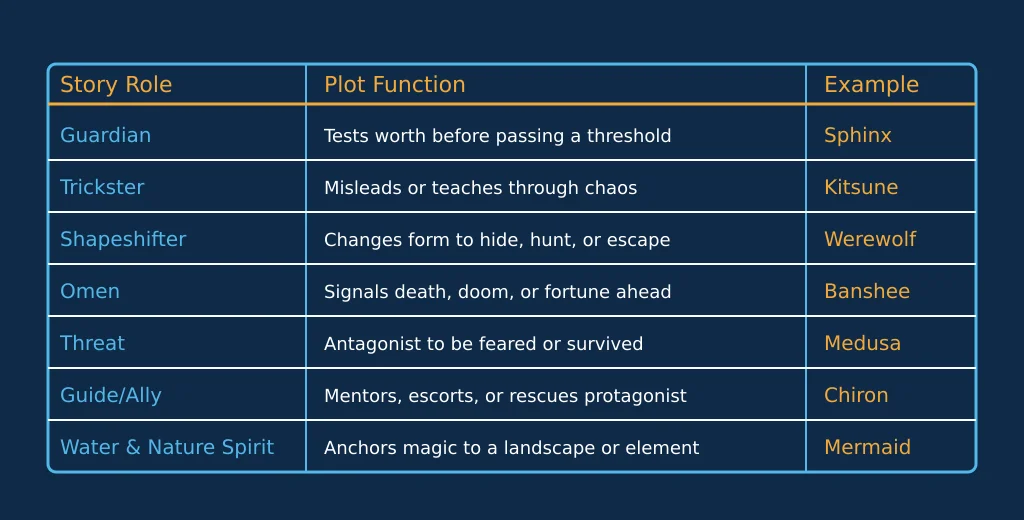
Seven jobs cover almost everything a creature like this does in a manuscript. Skim the table, find the row that matches the gap in your outline, then jump straight to that section below.
| Story Role | What It Does in the Plot | Classic Example |
|---|---|---|
| Guardian | Blocks or tests a threshold, forcing the hero to prove worth before passing | Sphinx |
| Trickster | Misleads, bargains, or teaches through chaos instead of open combat | Kitsune |
| Shapeshifter | Changes form to hide, hunt, seduce, or escape recognition | Werewolf |
| Omen | Signals death, doom, or fortune before the plot event lands | Banshee |
| Threat | Serves as the antagonist to be fought, feared, or survived | Gorgon (Medusa) |
| Guide/Ally | Mentors, escorts, or rescues the protagonist | Centaur (Chiron) |
| Water & Nature Spirit | Anchors magic to a specific landscape or element | Mermaid |
Drafting a story of your own? Draft scenes from your outline in Sudowrite, an AI writing tool built for fiction that keeps a story bible of your characters. Free trial, no card needed. (affiliate link)
Guardians: Creatures That Protect, Watch, or Test the Threshold
A locked door, a sacred grove, a riddle that has to be answered correctly: guardians exist to test whether your hero has earned the right to pass. The check matters more than the fight, which is what separates this role from a straight Threat.
- Gnome: a small earth-dweller from Germanic and alchemical tradition, watching over buried treasure and garden plots. Place one at the edge of a hoard your hero shouldn't touch yet; it won't fight, but it remembers.
- Sphinx: Egyptian in origin, later folded into Greek myth as a riddle-posing guardian who kills anyone who answers wrong. Build a whole scene around one unanswerable question and let the stakes be literal.
- Cerberus: three heads, one gate. The hound at the entrance to the Greek underworld lets spirits in but never lets them back out, which makes it the model for any passage in your plot that should only run one direction.
- Fu Dog (Shishi): Chinese temple guardians carved in pairs to flank an entrance. A statue that turns out to be alive, mid-scene, is a cheap and reliable reveal for a threshold your hero didn't know was watched.
- Naga: serpent guardians from Hindu and wider Southeast Asian tradition, coiled around treasure or sacred water. They test intent, not strength, so let a conversation decide the outcome and save the blade for later.
- Griffin: part lion, part eagle, guarding hoards of gold in both Persian and Greek sources. Drop one on a mountain pass your hero has to cross, and let theft, not trespass, be what wakes it.
- Komainu: Japanese shrine-guardian lion-dogs, carved in mirrored pairs like the fu dog. Good for a shrine scene that needs a sudden, unexplained animation right when the building seems empty.
- Dvergar (Dwarves): Norse smiths and mountain-dwellers who guard the treasures and forges they build. They rarely hand anything over without a bargain first, which forces a trade scene where a straight gift would have been easier.
- Yali: a lion-elephant hybrid carved into South Indian temple entrances, meant to ward off anyone approaching with bad intent. Have it react to a character's motive, not their strength, and you've built a test for a villain in disguise.
- Alicanto: a bird from Chilean and Atacama tradition said to guard veins of gold and silver, leading greedy prospectors into the dark. It punishes greed specifically, not curiosity, which makes it useful in a treasure-hunt subplot with more than one motive in the room.
- Bunyip: an Aboriginal Australian being tied to waterholes and swamps, blamed for keeping people away from certain stretches of water. Let it stay unseen. One path in your setting becomes the path nobody in-world will take.
- Draug: a Norse barrow-wight guarding its own burial mound and the goods buried with it. Violent toward anyone who disturbs the site, it's built for a scene about grave robbery and what it costs.
- Aitvaras: a Lithuanian household spirit guarding a family's wealth, arriving as a fiery streak across the sky and staying loyal only while it's fed. Good for a household that seems too lucky, until the hero asks what the luck is costing them.
- Leshy: a Slavic forest guardian that changes size at will and punishes hunters who take more than the forest can spare. Use it to enforce a resource limit your plot needs a character to break.
- Domovoi: a Slavic house spirit guarding the home and its occupants, turning hostile only when a household disrespects it. Useful for a haunted-house plot where the threat has been provoked, not summoned at random.
- Kappa: a Japanese river-dwelling being that challenges intruders to a wrestling match and turns respectful the moment you bow first. Good for an obstacle that runs on rules instead of violence.
- Kirin: a Chinese unicorn-like beast that appears only near the righteous, functioning as a living seal of approval on a worthy ruler. Its appearance, or its refusal to appear, can settle a succession plot without a battle.
- Simurgh: a benevolent, ancient bird from Persian myth said to guard wisdom at the edge of the known world. Place one at the last leg of a quest and test whether the hero deserves the answer they've been chasing.
- Ammit: an Egyptian being with a crocodile's head, a lion's body, and a hippo's hindquarters, stationed at the scales of judgment to devour hearts too heavy with wrongdoing. Use it as literal, final stakes for a character's moral arc.
Tricksters: Creatures That Deceive, Bargain, or Teach Through Chaos
A trickster doesn't fight your protagonist. It outwits them, then makes them work for whatever they actually needed. This is the role for a bargain scene, a riddle your hero loses, or comic relief that turns out to matter later.
- Goblin: small and mischievous, a fixture of English and wider Germanic tradition, known for petty theft and bargains that read fair until the fine print bites. Use one to sour a deal your hero thought was already settled.
- Kitsune: a Japanese fox spirit that gains tails and power with age, often disguising itself as a beautiful woman to test or mislead humans. Good for a seduction-as-trap scene where the reveal matters more than the danger.
- Anansi: a West African (Akan) spider figure who wins by wit rather than force, carried later into Caribbean storytelling through the transatlantic slave trade. Use him to let a weaker character outplay someone stronger.
- Puck: a shapeshifting prankster from English tradition, immortalized by Shakespeare, who leads travelers astray for the fun of it. Good for a scene where a mistake needs to be nobody's fault and still cost something.
- Tikbalang: a Filipino horse-headed being that misleads travelers on forest paths, said to be outwitted only by turning your shirt inside out. Make the counter-ritual the clue your hero has to find first.
- Leprechaun: an Irish shoemaker guarding a hoard of gold, who'll part with it only if outsmarted at his own game. Good for a scene that rewards cleverness over force, especially from a character everyone's underestimated.
- Coyote: a trickster spirit found across many Native American traditions: clever, greedy, and usually the architect of his own downfall. Use him where the trap your antagonist sets should catch the antagonist instead.
- Duende: a small household trickster from Iberian and Latin American tradition, blamed for missing objects and small domestic mishaps. Good for a low-stakes scene that plants unease before a bigger reveal.
- Huli Jing: a Chinese fox spirit, older in origin than the kitsune, who seduces and misleads while quietly testing a person's character. Use it where the test matters more than the seduction.
- Kobold: a German household spirit that helps with chores when respected and turns destructively mischievous the moment it isn't. Good for a slow-burn domestic subplot about a household losing a servant's goodwill.
- Alux: small Yucatec Maya beings tied to farmland, capable of great help or petty sabotage depending on how well they're honored. Use one to punish a landowner for neglecting a debt he doesn't know he owes.
- Encantado: a river dolphin from Brazilian Amazonian tradition that takes human form at festivals to seduce and vanish before dawn. Good for a one-night mystery a character can never quite prove happened.
- Nisse (Tomte): a Scandinavian farmstead spirit who rewards respect with good luck and answers neglect with pranks that escalate fast. Let the escalation itself become a subplot's rising action.
- Karakoncolos: a being from Turkish and Balkan winter tradition who waylays travelers on the coldest nights with tricky, half-answerable questions. Good for a wintertime detour where the real danger is wasted time, not violence.
- Imp: a minor demon from European tradition who bargains for souls or favors in exchange for small, tempting powers. Use it to seed a Faustian subplot that pays off chapters later.
- Trow: mischievous underground folk from Orcadian and Shetland tradition, known for swapping human babies for changelings. Good for a mystery-of-parentage plot with a folk-horror edge.
- Boggart: an English household brownie that turns malicious, in some tellings after being renamed or offended. Build a naming rule your hero breaks without realizing it, and let the shift in temperament be the payoff.
- Tanuki: a Japanese shapeshifting raccoon dog that transforms objects and illusions purely to watch people fall for them. Use it for comic relief that later turns out to have hidden a real clue.
- Will-o'-the-Wisp: a ghostly light from English and wider European tradition that leads travelers off the path, sometimes toward real danger. Use it to justify why your hero took the wrong turn at the worst possible moment.
Shapeshifters: Creatures That Change Form to Hide, Hunt, or Escape
Vampire and werewolf anchor this category for a reason: both hinge on a body that isn't fixed, which is exactly what makes a shapeshifter useful for a reveal scene or a disguise plot that pays off late.
- Vampire: rooted in Slavic and Balkan tradition before spreading across Europe, a being that hides its need for blood behind an ordinary human face. Use the hiding, not the hunger, as the engine of a slow-reveal plot.
- Werewolf: attested across French, Germanic, and wider European tradition: a human who transforms into wolf form under specific conditions, usually the full moon. Good for a ticking-clock subplot tied to a lunar calendar.
- Rougarou: a Cajun and French Louisiana variant of the werewolf, said to curse whoever it bites into becoming the next one. The curse mechanic spreads the threat through a cast instead of leaving it on one character.
- Nekomata: a Japanese cat that gains a forked tail and shapeshifting power with age, and can then walk and speak as a person. Good for a pet who's been quietly aware the whole book.
- Gumiho: a Korean nine-tailed fox, distinct from the kitsune, that takes human form to seduce and sometimes devour its victims. Use it where the romance plot needs a body count.
- Swan Maiden: a female figure from Norse, Siberian, and wider European tradition who sheds her swan form for a human one and can be trapped by hiding her feathered cloak. Good for a captivity plot where the object, not the cage, is the leverage.
- Adze: a firefly-like being from Ewe tradition (Ghana and Togo) that shifts into human form to feed on its victims from within. Use it for a slow-poisoning mystery where the culprit was never a stranger.
- Yuki-onna: a Japanese snow woman who appears as a beautiful traveler to lure people into the cold before revealing her true, deadly nature. Good for a winter setting whose danger needs to look like rescue at first.
- Manananggal: a Filipino creature that severs at the waist, sprouting bat wings and trailing entrails to hunt at night before reattaching by dawn. The reattachment window is a countdown your hero can exploit.
- Loogaroo: a shapeshifting, vampiric witch from Haitian and wider French Caribbean tradition, said to shed her skin before flying out to hunt. Salt on the discarded skin is the classic counter; build a scene around finding it in time.
- Estrie: a shapeshifting, blood-feeding demon from Jewish folklore who can be turned away at a door with bread and salt. The ritual detail is the one thing standing between a besieged household and disaster.
- Nure-onna: a Japanese snake-woman with a human face who lurks near riverbanks, deceptively gentle until she reveals her serpent length. Good for a riverside encounter that starts as a request for help.
- Rakshasa: a shapeshifting demon from Hindu mythology capable of taking any form, often used to infiltrate a household undetected. Use it to make a trusted character's loyalty suspect for an entire act.
- Alp: a Germanic nightmare spirit that shifts into animal form to slip into houses and sit on sleepers' chests. Good for a recurring nightmare that turns out to be a physical visitor.
- Penanggalan: a flying, disembodied head trailing its own entrails, found in Malay and wider Southeast Asian tradition, said to hide its detached body in a jar of vinegar by day. Use the hidden jar as the object your hero has to find to end the threat for good.
- Ijiraq: an Inuit spirit that shapeshifts to lead children astray in open country. Good for a search-and-rescue subplot where the missing child's own account of events doesn't add up afterward.
- Vetala: a spirit from Hindu tradition that possesses and animates corpses, taking on the dead body's shape to interact with the living. Use it where a funeral scene needs to go wrong in a specific, upsetting way.
- Krasue: a Thai counterpart to the flying-head creature, a woman's head with dangling entrails that hunts alone at night. Good for an isolated village setting where the attacks get blamed on the wrong person first.
Omens: Creatures That Foretell Death, Doom, or Fortune
An omen creature doesn't act on the plot. It announces what's coming and gets out of the way, which is useful for a chapter opener that should unsettle a reader before anything actually happens.
Several of these overlap with recurring symbols, so if you're already building out 155+ powerful motifs for the manuscript, an omen creature can double as one.
- Banshee: an Irish spirit whose wail precedes a death in the family it visits, without ever causing the loss itself. Use it to warn a reader before a death scene rather than after one.
- Mothman: a modern American figure tied to Point Pleasant, West Virginia, whose sightings became linked to a looming disaster. Good for a contemporary-set story wanting a folk-horror cold open before a disaster chapter.
- Black Shuck: a spectral black dog from East Anglian tradition with a single glowing eye, taken as a coastal death omen. Haunt a specific stretch of coastline your plot keeps returning to.
- Cadejo: a spectral dog from Central American tradition, white or black depending on whether it protects or dooms the traveler. Keep the color ambiguous on first sighting so the reader can't tell which one it is yet.
- La Llorona: the Weeping Woman of Mexican tradition, her cries near water warning of misfortune to come. Good for a riverside scene that needs dread before any danger surfaces.
- Owlman: a modern Cornish figure, sightings clustered near Mawnan church since 1976. Its value to a writer isn't prophecy so much as unexplained dread; good for a churchyard scene that should feel wrong before anything happens.
- Alkonost: a bird-woman from Slavic and Russian tradition whose song foretells what's coming, joyful or dire depending on the telling. Let the tone of the song, not the words, be what your hero misreads.
- Fetch: a phantom double from Irish tradition. Seeing your own fetch is taken as a sign of your own approaching death, which makes it a natural fit for a doppelganger scene nobody in the story wants to explain.
- Church Grim: a spectral black dog from English and Scandinavian tradition that guards a churchyard, said to appear before the next parishioner dies. Good for a village mystery where the dog's appearances map onto the order of deaths.
- Cŵn Annwn: spectral hounds from Welsh tradition whose baying across the sky signals that death is close by. Use the sound alone, off-page, to build dread before the hounds are ever seen.
- Strix: a screech owl from Roman tradition believed to prey on infants, its cry taken as a warning of death nearby. Good for a nursery scene that needs an unexplained sound before a later loss.
- Raven: treated as a death omen across Norse and Celtic tradition alike, its appearance on a battlefield long associated with the dead to come. Good for a pre-battle chapter that needs one quiet, wrong detail.
- Corpse Candle: a ghostly light from Welsh tradition (canwyll corff) said to trace the route a funeral will soon take. Have a character walk their own future funeral route without knowing it yet.
- Gwrach y Rhibyn: a hag figure from Welsh tradition whose wail at a window is said to name the next person in the household to die. Good for a household-under-threat plot where the omen singles out one specific character.
- Bean-nighe: a washerwoman figure from Scottish and Irish tradition, seen at a ford washing the bloodied clothes of those about to die. Use her as a roadside encounter your hero doesn't recognize as a warning until it's too late.
- Dullahan: a headless rider from Irish tradition who calls out the name of whoever is about to die. Good for a scene where a name is spoken aloud and the wrong character answers to it.
- Caoineag: a wailing figure from Scottish Highland tradition, heard but never seen, crying before a death reaches a particular clan or family. Use the sound as a recurring, unexplained motif building toward one specific loss.
Threats: Mythical Monsters Built to Be the Antagonist
Most manuscripts need at least one thing to fight, fear, or survive, and that's why this is the longest list here. These are the classic monsters of myth, built to be met head-on rather than outwitted or waited out. Once you've picked one, the underlying protagonist vs. antagonist mechanics still apply, and how to write a fight scene covers what comes after you've cast it.
- Gorgon (Medusa): a monster from Greek mythology whose gaze turns onlookers to stone, snakes in place of hair. The most direct "don't look at it" threat in myth; stage the scene around what a character has to do without looking.
- Hydra: a Greek serpent with multiple heads that regrow when cut. Use it for an antagonist that shouldn't die from one clean strike, forcing your hero to find a different kind of win.
- Chimera: a Greek hybrid of lion, goat, and serpent that breathes fire. Built for a threat that resists a single strategy; good for a climax where the first plan visibly fails.
- Minotaur: a bull-headed man trapped in a labyrinth, feeding on those sent in. Ideal for a maze-structured climax where getting lost is as dangerous as the monster itself.
- Lamia: a child-devouring monster from Greek myth, part woman and part serpent. Useful for a threat tied to grief or loss rather than a straight fight.
- Ogre: a large, brutish, human-eating figure from French and wider European tradition. Good for a straightforward physical threat with no supernatural trickery attached, when a scene just needs muscle.
- Oni: a horned, demonic figure from Japanese folklore associated with strength and destruction. Often the muscle behind a larger evil; use it as a lieutenant rather than the final boss.
- Manticore: a beast from Persian mythology with a man's face, a lion's body, and a scorpion's tail, its voice described in classical sources as a trumpet or pipe. Let it speak before it stings; the human face is the trap.
- Basilisk: a serpent from Greco-Roman and medieval bestiaries, best known for a gaze, or in some tellings a breath, that kills. Good for a threat your hero physically can't look at, forcing a workaround instead of a fight.
- Wendigo: a cannibalistic being from Algonquian traditions, tied to famine and greed, its hunger never satisfied. Use it where a survival plot needs the monster to be a warning about the characters, not just a danger to them.
- Baba Yaga: a Slavic witch who lives in a hut on chicken legs, sometimes a threat and sometimes a difficult ally. Let her demand a task first, so the danger sits in the bargain, not the encounter.
- Krampus: a figure from Alpine and Germanic folklore who punishes misbehaving children. A folk-horror antagonist for a winter setting, good where the punishment should fit a specific, named misdeed.
- Kraken: a sea monster from Norse and Scandinavian sailor lore, large enough to pull a ship under. Use it when the threat needs no face, just scale.
- Jorogumo: a spider-woman from Japanese folklore who lures men in with beauty before revealing her true form. Good for a seduction-turned-ambush scene late in a mystery plot.
- Nuckelavee: an Orcadian horse-man hybrid blamed for plague and crop failure, its breath alone said to wither a field. Use it to explain a famine your plot needs without a human cause.
- Chupacabra: a modern creature from Latin American and Caribbean tradition, blamed for livestock deaths and known by its drained, bloodless victims. Good for a rural mystery plot with a modern setting.
- Grendel: an Anglo-Saxon monster from the Old English epic Beowulf, driven into rage by the sound of human joy nearby. Use it to punish a celebration scene specifically, tying the attack to what triggered it.
- Leviathan: a sea monster from Near Eastern and biblical tradition, vast enough to represent chaos itself. Good where the threat should feel bigger than anything your hero can meaningfully fight.
- Wyvern: a two-legged dragon variant known from medieval European heraldry, leaner and more mobile than a full four-legged dragon. Use it for a chase scene a full dragon would be too slow for.
- Cockatrice: a rooster-serpent hybrid from medieval bestiaries whose glance alone kills. Good for a threat that punishes hesitation as much as contact.
- Aswang: an umbrella term from Filipino folklore for several blood- and flesh-eating monsters. Adaptable to whichever specific horror a scene needs; pick one variant and commit to its rules.
- Tarasque: a dragon-like beast from French and Occitan legend that terrorized a riverside town until it was tamed rather than killed. Good for a threat your plot resolves through negotiation instead of a kill.
- Sigbin: a blood-drinking creature from Visayan tradition said to walk backwards with its head lowered between its legs. Use the strange gait as the detail a witness gets wrong when describing it later.
- Redcap: a murderous, goblin-like figure from Scottish Border tradition who dyes its cap in the blood of its victims. Good for a haunted-ruin setting where the color of the cap is the tell.
- Aatxe: a bull-shaped spirit from Basque tradition that emerges from its cave during storms to punish wrongdoing. Save it for the character who's already done something they shouldn't have; it comes for guilt, not for trespass.
- Nemean Lion: a Greek beast with skin no blade could pierce, killed only by strength applied without a weapon at all. Good for a fight scene won by changing tactics, not sharpening one.
- Peuchen: a blood-drinking, bat-like flying serpent from Mapuche tradition, said to hunt livestock and travelers alike from the air. Use it where a threat needs to come from above in a landscape your hero thought was safe.
- Tikoloshe: a malevolent water-dwelling being from Zulu and wider Southern African tradition, small and dangerous enough to attack people in their sleep. Good for a home-invasion-style threat that's easy to dismiss as a story until it isn't.
Guides and Allies: Creatures That Help the Hero
Every long journey needs someone who isn't the hero to hand over the one thing that lets the plot continue: information, transport, a rescue at the lowest point. That's the job here, and it usually works in a manuscript the way a well-written side character does, present to serve the protagonist's arc rather than compete with it.
- Kinnara: half-bird celestial musicians of Hindu and Buddhist lore, famed for devotion that never wavers between paired lovers. Their song marks a place as sacred and safe; a hero who hears it has found rare shelter, and a scene set in their presence promises the reader a breath before the next ordeal.
- Centaur (Chiron): half-human, half-horse in Greek myth; Chiron in particular trained heroes rather than opposing them. Use him as a mentor who teaches a skill the climax will actually require.
- Garuda: a divine bird from Hindu and Buddhist tradition, loyal mount and ally who carries and fights alongside those it serves. Good for an aerial rescue or a long-distance journey shortcut.
- Baku: a Japanese dream-eater that can be summoned to devour a sleeper's nightmares. Use it where a character needs relief from a recurring nightmare that's been driving the plot.
- Selkie: a seal that sheds its skin for human form in Scottish, Irish, and Faroese tradition, often guiding or aiding those who treat it with care. Good for a coastal ally whose loyalty depends on how the hero treats the sea itself.
- Pegasus: a winged horse from Greek myth who carried the hero Bellerophon into battle. A literal lift when the plot needs one, especially for a climax that has to happen somewhere unreachable on foot.
- White Stag: a figure from Celtic and Arthurian tradition that appears to lure a seeker deeper into the forest, toward the adventure waiting there. Use its appearance to open a quest rather than close one.
- Djinn: a spirit from Middle Eastern and Islamic tradition capable of granting wishes or guidance, benevolent in the tellings that use it as an ally. Good for a bargain that helps the hero without the usual trickster catch.
- Brownie: a household spirit from Scottish and English tradition that performs chores overnight, helpful as long as it's never directly thanked. The thanking-it-by-accident beat explains why the help suddenly stops.
- Peri: a benevolent being from Persian tradition, protector and guide to humans, set against the malevolent div. Good for a paired-opposites plot where the ally and the threat come from the same mythology.
- Huldufólk: the Hidden People of Icelandic tradition, elusive beings said to reward those who respect the land they occupy. Use them to justify a landscape your hero shouldn't build, dig, or camp on.
- Barong: a lion-like protective spirit from Balinese tradition who defends humans against the witch Rangda. Good made physical; use it where the story needs good and evil to fight as named figures rather than abstractions.
- Sleipnir: Odin's eight-legged horse in Norse myth, capable of carrying a rider between worlds. Use it when the plot needs fast, otherworldly travel between settings that shouldn't normally connect.
- Manaia: a protective, messenger figure from Māori tradition, carved to mediate between the human world and the spirit world. Good for a character who delivers a warning from somewhere the hero can't go themselves.
- Tonal: a person's animal spirit companion from Aztec and Mixtec tradition, tied to their fate and often protective of them. Use it to externalize a character's fortune as a creature that can be threatened separately from them.
- Tengu: a Japanese mountain spirit, said in some tales to have tutored the warrior Minamoto no Yoshitsune in swordsmanship. Use one as a demanding mentor who trains the hero hard, then vanishes back into the mountains.
- Pooka: an Irish shapeshifter, usually mischievous, but in some tellings guides travelers safely home when treated with proper respect. Good for a night-road scene where the "wrong" choice turns out to be the safe one.
- Vila: a nature nymph from South Slavic tradition who helps heroes who treat the natural world with care, punishing those who don't. Use her as a test of a character's respect for the setting itself.
- Barbegazi: Alpine snow-dwelling gnomes from Swiss and French tradition, said to warn skiers and shepherds of coming avalanches and dig out those buried in snow. Good for a mountain-set rescue beat where help arrives from somewhere the hero didn't expect.
Water and Nature Spirits: Creatures Tied to a Place
These beings stay put. Each one belongs to a specific river, loch, or coastline, and that fixed address is a constraint you can use. Pin the setting to the right body of water first; the guide to the setting of a story covers the rest.
- Mermaid: a being known across many maritime traditions, most persistently in Europe, half-human and half-fish. Move her and the story stops making sense; keep the setting fixed around her instead.
- Kelpie: a shapeshifting horse from Scottish and wider Celtic tradition, luring riders onto its back before dragging them under. Good for a scene where the danger looks like a gift, specifically transport, at first.
- Undine: an elemental from Germanic and Paracelsian tradition, one of four classical elemental beings, said to gain a soul only by marrying a human. Use the soul-bargain as the actual plot hook, not just her element.
- Siren: a Greek figure whose song lures sailors onto rocks, her function inseparable from the coastline she's stationed near. Good for a scene where the danger is what a character wants to hear, not what they fear.
- Naiad: a Greek freshwater nymph bound to one spring, stream, or fountain, protective of it and hostile to anyone who fouls it. Use her to punish a careless or industrial intrusion into an otherwise idyllic setting.
- Rusalka: a Slavic figure, often the ghost of a drowned woman, tied to a particular river or lake and dangerous to anyone who swims there. Good for a tragedy-adjacent threat where the backstory matters as much as the danger.
- Nixie (Nix): a shape-taking being from Germanic tradition, haunting rivers and mill ponds and sometimes luring victims in with music. The music is the lure a character can't identify until it's too late.
- Jengu: beings from Sawa tradition (Cameroon and the wider Central African coast) who bring fortune or misfortune depending on how they're treated. Good for a fishing-community subplot where respect has real economic stakes.
- Yacumama: a giant serpent-mother from Peruvian Amazonian tradition, said to shape the currents of the rivers she inhabits. Use her to explain a river's dangerous, unpredictable current as something with intent behind it.
- Vodyanoy: a male figure from Russian tradition, haunting mills and ponds and drowning those who disrespect it. Good for a mill-set scene where a mundane accident turns out to be deliberate.
- Merrow: the Irish sea-dwelling counterpart to the mermaid; male merrows are distinguished by red caps in older tales, and female merrows by their beauty and their singing. Use the cap as a stolen object that traps a merrow on land, the way a selkie's skin does.
- Ahuizotl: a dog-like beast from Aztec tradition that drags victims beneath lake surfaces. Use it for a threat tied specifically to still water, distinct from the moving-river dangers on this list.
- Nyaminyami: a river figure from Tonga tradition (Zimbabwe and Zambia) guarding the Zambezi's fish and its floods alike. Good for a dam-building or flood-control subplot where the river resists being controlled.
- Ceffyl Dŵr: a Welsh water horse that lures riders the way a kelpie does, but is said to dissolve into mist at the shore, leaving its rider to drown alone. Use the vanishing act as the detail that makes the death unexplainable.
- Each Uisge: a deadlier water horse from Scottish Highland and Hebridean tradition, haunting sea lochs rather than rivers and devouring its rider once submerged. Good for a coastal setting needing a danger worse than its freshwater cousin.
- Nöck (Näcken): a male figure from Scandinavian tradition who lures victims near streams with violin music. Use the music as something a character hears before they understand what's making it.
- Charybdis: a Greek monster that forms a deadly whirlpool in the Strait of Messina, tied permanently to that one stretch of sea. Good for a fixed geographic hazard your characters have to navigate around, not fight.
- Llamhigyn Y Dŵr: a bat-winged, frog-like creature from Welsh tradition that haunts ponds and attacks fishermen who linger too long. Use it to punish a character who stays somewhere just a little past when they should have left.
- Peluda: a spined, river-dwelling beast from French tradition, blamed for droughts and floods near La Ferté-Bernard on the river Huisne. Use it where a village needs a named, local cause for a natural disaster.
- Marid: a powerful djinn from Middle Eastern and Islamic tradition, associated with seas and storms rather than land. Good for a storm-at-sea chapter that needs the weather itself to have a will behind it.
Match a Creature to the Gap in Your Outline
Work backward from what the scene needs rather than forward from a name you like. If chapter one needs a warning before anything's gone wrong, that's an Omen, not a Threat. If your climax needs a fight, pull from the Threats list, not the Guardians one. Once you've picked the creature, run the fantasy character name generator for whoever wields or faces it. Then return to how you outline a book and slot the beat into place.
Worked Example: A Threat (the Basilisk in Chamber of Secrets)
In Harry Potter and the Chamber of Secrets, Harry defeats Tom Riddle's basilisk by stabbing it with Godric Gryffindor's sword. That's a Threat doing exactly what a Threat is for: it can't be reasoned with or tricked, only fought and survived.
Worked Example: An Ally (Fawkes)
Fawkes the phoenix arrives in the Chamber, weeps into Harry's wound, and the tears heal the basilisk venom that would otherwise kill him. In story-function terms, that's a Guide/Ally: the creature arrives at the hero's lowest point, supplies the means of survival, and exits without needing anything in return.
Worked Example: A Shapeshifter (Pennywise in It)
Stephen King's It takes whatever form each child fears most, most famously the clown. The shapeshifter role works here because the threat isn't the shape. It's the fact that you can't trust whatever shape comes next.
Quick Answers on Picking and Counting Creatures
Every name below comes from the 140 entries above, picked so each count spreads across the seven roles.
What are 10 mythical creatures?
Vampire, banshee, werewolf, centaur, gorgon, goblin, ogre, mermaid, gnome, and oni make a workable shortlist of ten. Between them, they cover all seven roles above: Shapeshifter, Omen, Guide, Threat, Trickster, Water & Nature, and Guardian.
What are the 12 mythical creatures?
There's no single fixed "12" the way there's a fixed 12 Olympians or 12 zodiac signs. A workable 12 takes the ten above and adds two more: sphinx (Guardian) and kraken (Threat), giving you a spread across guarding, tricking, shifting, warning, threatening, helping, and place-tied magic, with mermaid covering that last one.
What are 20 mythical creatures?
- Vampire
- Banshee
- Werewolf
- Centaur
- Gorgon (Medusa)
- Goblin
- Ogre
- Mermaid
- Gnome
- Oni
- Sphinx
- Kraken
- Kitsune
- Kelpie
- Cerberus
- Griffin
- Leprechaun
- Selkie
- Manticore
- Basilisk
What are 50 mythical creatures?
Pull roughly seven per role and you land near fifty fast. From Guardians take gnome, sphinx, cerberus, naga, griffin, komainu, and kirin. From Tricksters take goblin, kitsune, anansi, puck, leprechaun, coyote, and kobold. From Shapeshifters take vampire, werewolf, gumiho, yuki-onna, manananggal, rakshasa, and penanggalan. From Omens take banshee, mothman, black shuck, la llorona, alkonost, church grim, and raven. From Threats take gorgon, ogre, oni, hydra, minotaur, basilisk, and kraken. From Guides take centaur, garuda, selkie, pegasus, djinn, brownie, and sleipnir. From Water & Nature take mermaid, kelpie, undine, siren, naiad, rusalka, and merrow. That's exactly forty-nine, so add one more from whichever role your draft is missing.